
BY:SpaceEyeNews.
Astronomers have captured the clearest evidence yet of a magnetic field wrapped around gas flowing from a newborn star. Using ALMA, the team resolved a predominantly toroidal field around the outflow of IRAS 4A1. This young object lies about 960 light-years away in the Perseus molecular cloud. The protostar magnetic spiral matches a prediction that scientists have tested for decades. It also reveals how magnetic forces guide material hundreds of astronomical units from a forming star.
Protostar Magnetic Spiral Confirms a Key Prediction
Young stars grow by drawing material from disks of gas and dust. Yet that material carries angular momentum, which can slow further growth. Outflows help remove some of it and allow the star to keep gaining mass.
Researchers have long suspected that magnetic fields organize this process. In magneto-centrifugal models, field lines rise from the rotating disk and help lift gas outward. Rotation then winds those lines around the flow. The field gradually develops a toroidal, or ring-shaped, component.
That coiled geometry creates magnetic pressure and tension. Previous observations found magnetic fields in protostellar jets and suggested helical structures. However, they could not determine whether the toroidal or poloidal component dominated.
The new result closes much of that observational gap. It provides the first direct, high-resolution view of a predominantly toroidal magnetic field in a protostellar outflow. Therefore, “magnetic spiral” offers a useful visual description, although “toroidal magnetic field” is the more precise scientific term.
How ALMA Traced the Invisible Field
The researchers studied NGC 1333 IRAS 4A, a young system containing two protostars, IRAS 4A1 and IRAS 4A2. Their analysis focused on the redshifted outflow from IRAS 4A1.
ALMA did not photograph magnetic lines directly. Instead, it measured faint linear polarization in carbon monoxide emission. The team observed the CO J=2−1 molecular transition and used its polarization to trace the field’s projected orientation.
Magnetic fields influence how molecules emit polarized radiation under suitable conditions. Scientists call this the Goldreich-Kylafis effect. A comparison with dust polarization then connected the observed signal to the field’s direction.
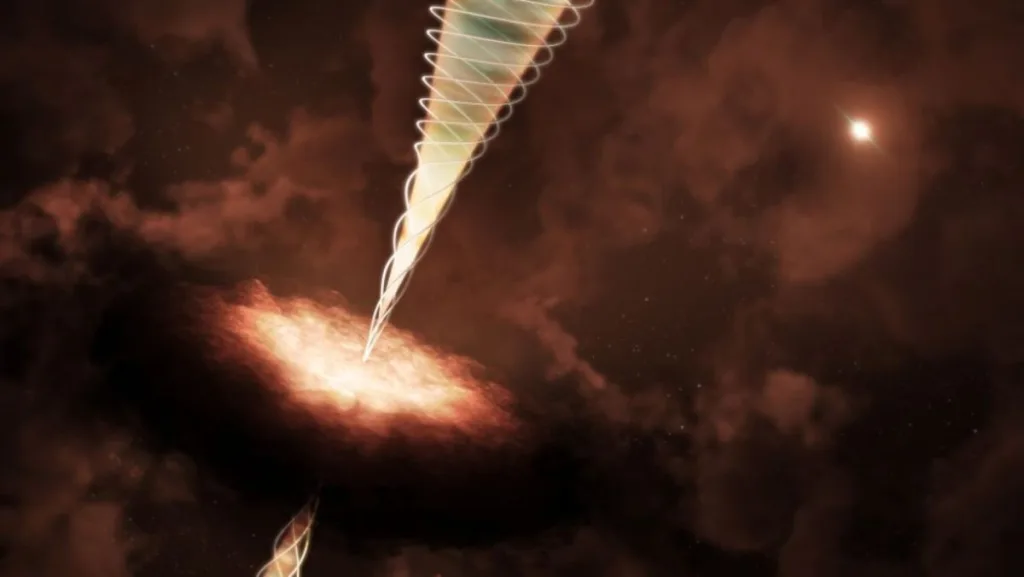
Magnetic fields around protostars were detected using ALMA.
Resolution Changed the Picture
Earlier arrays had observed polarization around IRAS 4A. Their resolution could not separate the binary clearly or identify the dominant field geometry. ALMA achieved a spatial resolution of about 147 by 99 astronomical units. That was roughly 31 times sharper than the earlier polarization data.
The resulting map revealed a decisive pattern. Magnetic orientations lay mainly perpendicular to the outflow axis. At the same time, they aligned with the rotating structure of the gas. This combination points to a toroidal field wrapped around the outflow rather than a mainly poloidal field extending along it.
Models strengthened that interpretation. A toroidal configuration produced a polarization level consistent with ALMA’s measurements. By contrast, the predicted signal from a poloidal configuration fell below the array’s sensitivity for extended polarized emission.
A Weak Field With a Large Effect
The protostar magnetic spiral measures only a few milligauss. Across hundreds of astronomical units, however, it can exert a major influence on moving gas.
Researchers estimated a strength above three milligauss about 300 astronomical units from IRAS 4A1. It declined to less than two milligauss near 500 astronomical units. More importantly, their calculations showed that magnetic acceleration could exceed the protostar’s gravitational pull near 400 astronomical units.
Magnetic pressure also surpassed the estimated thermal pressure in the outflow. These comparisons indicate that the field is not simply present beside the gas. It has enough strength to accelerate the material and keep the flow concentrated.
ALMA also detected a velocity gradient across the outflow, indicating rotation. Position-velocity maps revealed parabolic cavity shells shaped by a wide-angle protostellar wind. The geometry, rotation and polarization support the same magnetic explanation.
Evidence for a Magneto-Centrifugal Outflow
The result matters because it links two predicted magnetic regimes. Close to an accretion disk, poloidal fields can help lift material. Farther away, rotation winds the field until its toroidal component becomes dominant. ALMA appears to have captured that transition’s outcome several hundred astronomical units from IRAS 4A1.
The team also found a relationship between the magnetic field’s curl and the inferred electric-current density. This result agrees with Ampère’s law and offers new constraints for magnetohydrodynamic simulations. It may eventually help researchers determine the three-dimensional direction of similar fields.
Several questions remain open. Current observations cannot show whether the field wraps clockwise or counterclockwise. Future Zeeman measurements or improved rotation studies may resolve that direction.
A strongly toroidal field can also become vulnerable to a kink instability. In this system, the estimated expansion speed may prevent that instability from growing efficiently. Still, future observations must test how stable the structure remains at greater distances.
Why the Protostar Magnetic Spiral Matters
This discovery does not mean every forming star has identical magnetic geometry. The study examined one outflow from one member of a young binary system. Even so, it demonstrates that a decades-old mechanism operates in nature with enough force to shape stellar outflows.
Models of other cosmic jets also combine rotation, accretion and twisted magnetism. This research does not test those environments directly. Instead, IRAS 4A1 offers a detailed laboratory for the underlying physics.
Conclusion
The protostar magnetic spiral around IRAS 4A1 turns a long-standing theoretical picture into resolved observational evidence. Its orientation follows the gas rotation and wraps across the outflow axis. Its strength can also influence the flow hundreds of astronomical units from the young star. ALMA has therefore revealed more than an invisible structure. It shows how magnetic forces help a forming star manage incoming material while directing some of it outward. Broader surveys can now test how often this toroidal pattern appears across young stellar systems.