
BY:SpaceEyeNews.
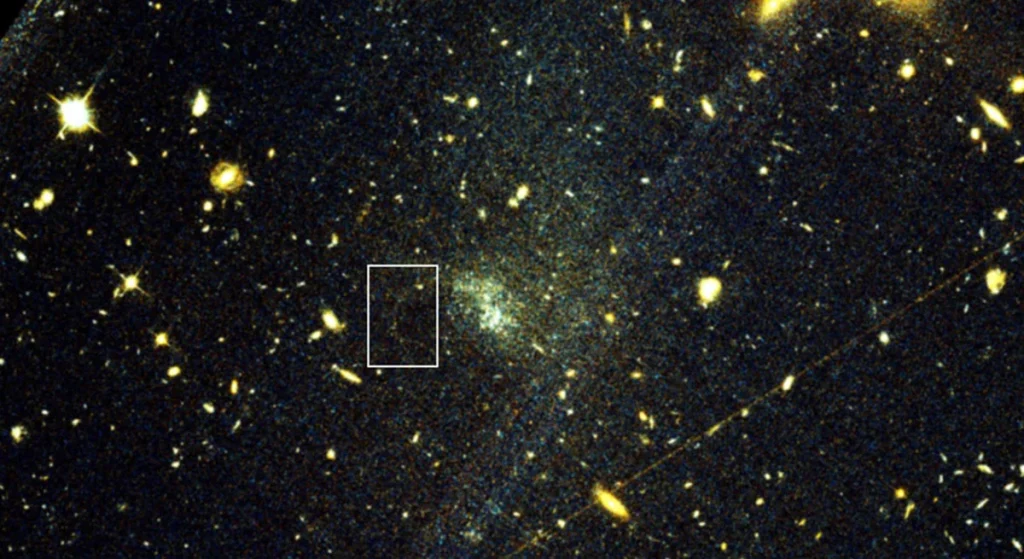
Hubble Space Telescope image showing the globular cluster stellar stream. Credit: Hubble Space Telescope and Holm et al. (2026),
A Faint Star Stream Opens a New Window on Dark Matter
A globular cluster stellar stream has appeared where astronomers had never confirmed one before: beyond the Milky Way. The faint ribbon crosses UGC9050-Dw1, an ultra-diffuse galaxy about 115 million light-years away. Its light is weak, but its shape carries valuable information. By modelling that shape, researchers gained a new view of the galaxy’s hidden mass. The discovery could turn distant stellar streams into practical tools for mapping dark matter across very different galaxies.
The Oyashio Stream Emerges in a Ghostly Galaxy
Researchers named the stream Oyashio after a cold current in the Pacific Ocean. It appears beside a compact object that may be its surviving parent globular cluster. Both lie about 2.5 kiloparsecs from the center of UGC9050-Dw1.
UGC9050-Dw1 sits roughly 35.2 megaparsecs from Earth, or around 115 million light-years. Its widely dispersed stars leave the galaxy unusually dim for its size.
Finding such a weak structure inside an already dim galaxy is especially difficult.
The visible arm stretches about two kiloparsecs, or 6,500 light-years. Its measured width is close to 72 parsecs. That narrow profile became one of the first clues to its origin.
Why the Globular Cluster Stellar Stream Looks Genuine
The team examined deep images from the Hubble Space Telescope and the Canada–France–Hawaii Telescope. Both observatories detected the feature independently, making a processing error or camera artifact highly unlikely.
Width provided another clue. Streams created by globular clusters tend to remain thinner than streams left by disrupted dwarf galaxies. Oyashio’s narrow form fits the globular-cluster explanation much better.
Color strengthened the case. The stream and compact cluster candidate overlap in color, suggesting similar stellar populations. Simulations also reproduced the stream’s surface brightness.
Together, the evidence supports a globular cluster that is gradually losing stars along its orbit.
Still, the Nature paper carefully describes the result as evidence. Astronomers cannot resolve the stream into individual stars at this distance. Follow-up observations could test the connection with its proposed parent cluster more directly.
Using a Stellar Stream to Trace Invisible Mass
Oyashio matters because gravity shapes every part of its path. The stars respond to all the mass in UGC9050-Dw1, including matter that telescopes cannot see. Therefore, the stream acts like a record of the galaxy’s gravitational field.
The researchers used generative stream modelling to read that record. Their system varied the cluster’s mass, orbit, disruption time, and surrounding halo structure.
The team compared simulated paths with Oyashio’s curve, width, and position. The closest matches revealed plausible combinations of cluster and halo properties.
This approach does not photograph dark matter. Instead, it measures the gravitational influence associated with the galaxy’s total mass. That distinction matters because the identity of dark matter remains unknown.
UGC9050-Dw1 Appears to Have a Massive Dark Matter Halo
The best-fitting models point toward a massive dark matter halo around UGC9050-Dw1. This conclusion agrees broadly with earlier estimates based on the galaxy’s unusually rich globular-cluster population.
The model’s central estimate for the halo’s M200 mass is about 430 billion solar masses. However, the uncertainty range remains very broad. The stream offers a meaningful constraint, not a precise final measurement.
Researchers also estimated the inner slope of the halo’s density profile. That describes how sharply density rises toward the galactic center. For the first time, astronomers derived both halo mass and density-profile constraints for an ultra-diffuse galaxy using a stellar stream.
Ultra-diffuse galaxies make this result especially useful. Their dark matter content has generated debate because different systems appear to contain very different amounts. Their faint stars also make traditional rotation and velocity measurements difficult. Oyashio offers an independent route to the answer.
What the Discovery Can and Cannot Tell Us
This single stream does not solve the dark matter mystery or identify a particle candidate. The analysis also assumes an orbit, age, original cluster, and three-dimensional position.
Only one visible arm has been identified. Researchers mainly measured integrated light rather than individual stream stars. These limits widen the range of halo structures that can fit the data.
Yet the result provides a strong proof of concept. A method developed inside the Milky Way can now probe a galaxy far beyond it. With a larger sample, astronomers could compare halo masses, central density profiles, and possible dark matter clumps across many environments.
Euclid and Roman Could Reveal More Streams
Future surveys could transform this first case into a population study. ESA’s Euclid telescope combines a wide view with the sensitivity needed to record faint galactic structures. NASA’s Nancy Grace Roman Space Telescope will survey broad areas with sharp infrared vision.
Roman should excel at finding thin streams in nearby external galaxies. Euclid can expose low-surface-brightness features across large regions. Follow-up observations could then examine the strongest candidates.
More streams would let researchers test whether UGC9050-Dw1 is typical or unusual. They could also show how dark matter halos differ between ultra-diffuse galaxies, larger spirals, and other systems.
Conclusion: A Globular Cluster Stellar Stream With Wider Importance
The globular cluster stellar stream in UGC9050-Dw1 is faint, narrow, and scientifically powerful. It does not reveal dark matter directly. Instead, its structure traces the gravity of otherwise invisible mass. Oyashio now shows that this technique can work beyond the Milky Way. Future discoveries may turn these delicate stellar trails into a new network of dark matter maps.
Main Sources:
Nature — Evidence for the First Globular Cluster Stellar Stream Beyond the Milky Way
https://www.nature.com/articles/s41586-026-10878-w
University of Copenhagen — Breakthrough in Unusual Galaxy May Help Unravel the Mystery of Dark Matter
https://news.ku.dk/all_news/2026/08/breakthrough-in-unusual-galaxy-may-help-unravel-the-mystery-of-dark-matter/
NASA — A New Theoretical Framework for Globular Cluster Science With Roman
https://science.nasa.gov/mission/roman-space-telescope/a-new-theoretical-framework-for-globular-cluster-science-with-the-roman-wide-field-imager/
European Space Agency — Euclid Celebrates First Science With Cosmic Views
https://www.esa.int/Science_Exploration/Space_Science/Euclid/ESA_s_Euclid_celebrates_first_science_with_sparkling_cosmic_views