
BY:SpaceEyeNews.
The HOEE starshade could give astronomers a new way to photograph nearby Earth-like planets. Instead of placing another enormous telescope in space, the concept would pair a giant orbital screen with powerful observatories on Earth. Recent simulations suggest that this unusual system could separate rocky planets from the glare of their stars. It might also examine their atmospheres for water, oxygen and auroral activity. However, HOEE remains a developing concept rather than an approved space mission.
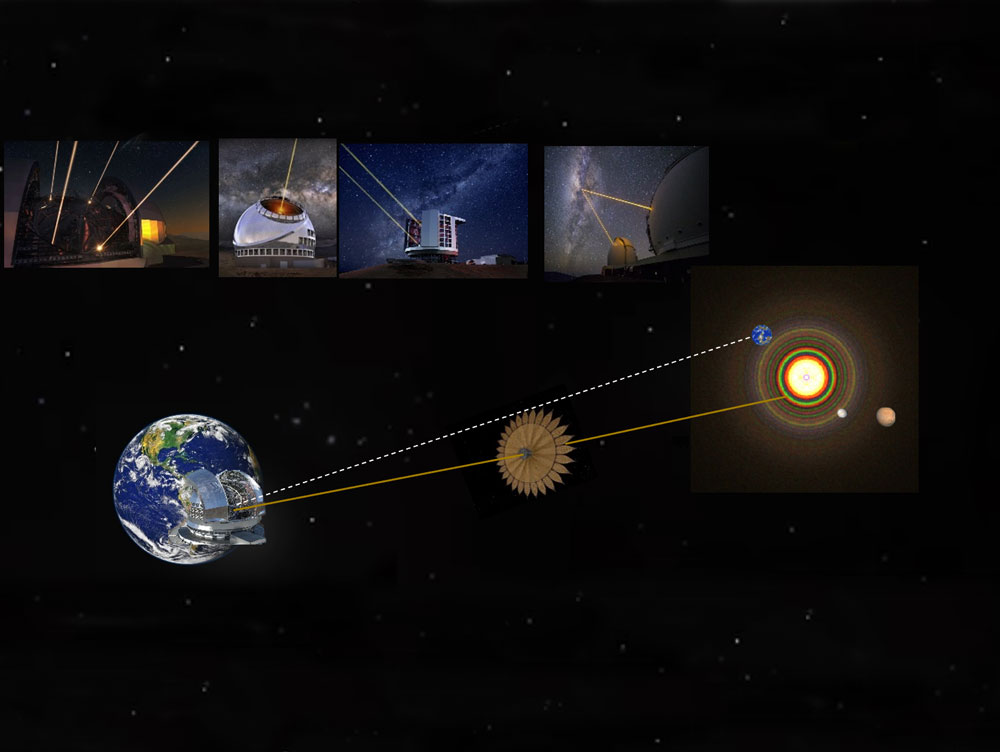
Hybrid Space-Ground Observatories: Revolutionizing the Search for Earth-like Exoplanets.
How the HOEE Starshade Would Create an Artificial Eclipse
The project’s full name is the Hybrid Observatory for Earth-like Exoplanets. Its design combines a space-based starshade with an extremely large ground telescope. The screen would travel between the telescope and a selected star. From the observatory’s viewpoint, it would cover the star while leaving nearby planets visible.
The proposed screen measures about 99 meters across. Its design has a 50-meter central disk and 48 petals, each about 24.5 meters long. The tapered edges control diffraction and direct unwanted starlight away from the telescope.
The screen would follow a long elliptical orbit roughly 170,000 to 175,000 kilometers from Earth. There, the HOEE starshade must remain aligned with the target and telescope. Propulsion systems would make fine corrections and move it between stars.
Combining Space and Ground Technology
HOEE separates two demanding jobs. The orbital screen suppresses starlight before it reaches the atmosphere. Meanwhile, a ground observatory collects the planet’s faint reflected light.
The main candidate is the European Southern Observatory’s Extremely Large Telescope in Chile. Its mirror spans 39 meters. The study also considered the Thirty Meter Telescope and Giant Magellan Telescope.
What the HOEE Starshade Study Actually Found
A peer-reviewed 2026 Nature Astronomy study tested this arrangement. The team modelled Solar System-like systems around nearby stars. Its calculations included atmospheric turbulence, background light and realistic ELT adaptive optics.
The results suggest that HOEE could distinguish several planets in one nearby system. Under favorable conditions, it might detect an Earth-sized world within minutes. Longer observations could examine atmospheric features linked to oxygen and water.
These findings come from simulations. The starshade does not yet exist. Claims about first-minute detection describe projected performance under selected conditions, not a completed observation.
Solving the Extreme Contrast Problem
In visible light, an Earth-like planet can appear around 10 billion times fainter than a Sun-like star. That contrast overwhelms instruments that try to isolate the planet after the star’s light enters the telescope.
JWST can study many exoplanet atmospheres. However, it cannot image true Earth analogues beside nearby Sun-like stars. Roman will demonstrate advanced coronagraph technology, but not routine Earth-twin characterization.
HOEE would remove the glare earlier by casting a deep shadow over the telescope. Adaptive optics could then correct atmospheric distortion. This combination may offer strong contrast and sharp images.
Searching for Oxygen, Water and Distant Auroras
Direct detection would only begin the scientific investigation. Astronomers also want to divide the planet’s reflected light into a spectrum. Specific patterns could reveal chemicals and physical processes within its atmosphere.
The team expects HOEE to search for water and oxygen features. Researchers also want to examine red and green auroral emissions on rocky planets around F-, G- and K-type stars. Such signals could show how an atmosphere responds to its star. They might also reveal atmospheric composition and magnetic conditions.
However, none of these signals would confirm life alone. Oxygen can develop through non-biological processes, while water does not guarantee habitability. Scientists would need complementary measurements before drawing stronger conclusions.
Earth’s atmosphere also contains oxygen and water. These gases affect the same wavelengths that scientists want to measure. The study accounted for this interference, but real observations would require precise calibration.
Why the Hybrid Observatory Could Matter
Placing a telescope comparable to the ELT in space would exceed current engineering and budget limits. HOEE offers another route. It puts the starlight-blocking component in orbit while leaving the largest equipment on Earth.
This strategy could image complete planetary systems, separate neighboring worlds and study surrounding dust. The telescope’s collecting area could also shorten observations without requiring a giant space mirror.
HOEE would complement future space observatories. Those telescopes avoid atmospheric interference. The hybrid system could add greater collecting power and resolution for selected targets.
A Promising Design With Major Challenges
Engineers must launch, deploy or assemble a screen almost 100 meters wide. Its petals require an extremely accurate shape. The platform must also maintain alignment while the telescope moves with Earth.
Retargeting would require time and propellant. Telescope schedules, weather and orbital mechanics would also affect each observation.
NASA studies have considered inflatable, deployable and robotically assembled structures. Early designs target a mass of roughly 1,000 to 1,500 kilograms. A project researcher has estimated a cost near $1 billion. Yet NASA has not approved that figure as a mission budget.
NASA selected HOEE for a NIAC Phase I study in 2022. A related inflatable-starshade proposal received Phase I support in 2025. These awards support research, not construction or launch.
HOEE Starshade Timeline Remains Uncertain
ESO currently expects the ELT to achieve telescope first light in March 2029. Scientific observations should begin in December 2030. That schedule does not mean HOEE will start operating at the same time.
The starshade has no launch date. Researchers must complete its roadmap, obtain funding and demonstrate key technologies. A participating institution suggests realization around 2045 at the earliest.
The HOEE starshade represents a long-term opportunity, not an observatory arriving this decade. Still, the study strengthens its scientific foundation. If engineers can build it, HOEE could directly examine nearby Earth-like worlds and their atmospheric conditions.
Main Sources:
NASA — NASA Research Proposes Technology to Seek Earth-Like Exoplanets:
https://www.nasa.gov/directorates/stmd/nasa-research-proposes-technology-to-seek-earth-like-exoplanets/
NASA — Hybrid Observatory for Earth-Like Exoplanets:
https://www.nasa.gov/general/hybrid-observatory-for-earth-like-exoplanets-hoee/
NASA — NIAC Funded Studies:
https://www.nasa.gov/niac-funded-studies/
Nature Astronomy — The Observation of Earth-Like Exoplanets With Ground-Based Telescopes and a Shared Orbiting Starshade:
https://www.nature.com/articles/s41550-026-02787-9
European Southern Observatory — Updated ELT Schedule:
https://www.eso.org/public/announcements/ann25001/
University of Innsbruck — Sunshade Helps in the Search for a Second Earth:
https://www.uibk.ac.at/en/newsroom/2026/sunshade-helps-in-the-search-for-a-second-earth/