BY:SpaceEyeNews.
What if the Big Bang was not the absolute beginning of time? A striking cosmological proposal suggests it may instead form a mirror between two cosmic branches. Our Universe occupies one side. A counterpart with reversed charge, spatial orientation, and time occupies the other.
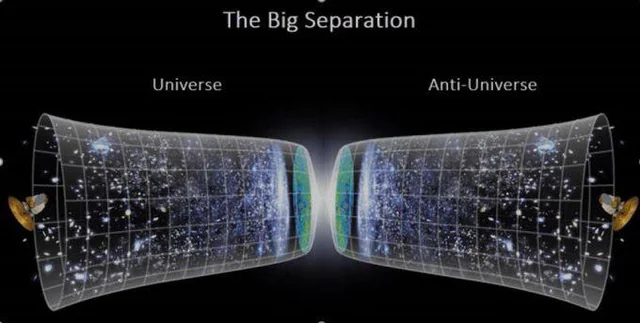
Our universe could be the mirror image of an antimatter universe extending backwards in time before the Big Bang.
This idea is known as the CPT-symmetric Universe. It connects several deep questions about dark matter, neutrinos, and the arrow of time. Yet one fact must remain clear from the start. Scientists have not detected an Anti-Universe. This remains a theoretical model with predictions that future experiments can test.
What the CPT-Symmetric Universe Actually Proposes
Physicists Latham Boyle, Kieran Finn, and Neil Turok introduced the model in a 2018 Physical Review Letters paper. They asked whether the entire Universe could preserve CPT symmetry.
CPT combines three transformations. Charge conjugation exchanges particles with antiparticles. Parity reverses space, while time reversal changes time’s direction. Together, they leave the laws of particle physics unchanged.
The researchers applied this symmetry to the cosmos as a whole. In their picture, the Universe after the Big Bang is the CPT image of a branch before it. Together, both branches form a Universe–Anti-Universe pair.
“Anti-Universe” does not describe a hidden region beyond space. Nor has a telescope photographed another cosmos. The term identifies the model’s second, symmetrical branch.
The Big Bang Becomes a Cosmic Mirror
Standard cosmology describes the early Universe as extremely hot and dense. However, it does not yet provide a complete account of the Big Bang singularity itself. The CPT-symmetric Universe changes the role of that boundary.
Rather than treating the Big Bang as the first instant of all reality, the model treats it like a cosmic mirror. The pre-Big-Bang and post-Big-Bang branches emerge into hot, radiation-dominated phases on opposite sides.
The proposal extends spacetime and quantum fields mathematically near the boundary. It does not show that ordinary objects could cross the Big Bang.
Would Time Run Backward?
From our coordinates, time on the opposite branch points in the reverse direction. Hypothetical observers there would not see broken clocks or memories disappearing. Their experience would feel normal because their own arrow of time would lead away from the Big Bang.
Observers on both sides could therefore regard the Big Bang as part of their past. Each branch would evolve away from the same central boundary. The description remains unusual, but it does not require events to look reversed to anyone living there.
The combined CPT transformation also exchanges matter with antimatter. As a result, antimatter would dominate the mirror branch when described from our side. Across the full pair, the theory restores a larger balance between matter and antimatter.
Could Cosmic Symmetry Replace Inflation?
Cosmic inflation remains the leading framework for explaining several features of the early Universe. It proposes a brief period of extremely rapid expansion. That phase can account for the cosmos’ large-scale flatness, uniformity, and primordial density fluctuations.
The mirror model seeks a more economical starting point. It moves directly into a hot, radiation-dominated era and uses symmetry to restrict the initial quantum state. In this picture, the Universe may not need a separate inflationary field.
Later studies explored whether symmetry and gravitational entropy could explain cosmic flatness and uniformity. Boyle and Turok also proposed a new origin for primordial density fluctuations. These remain theoretical extensions.
Cosmic microwave background measurements closely match several predictions associated with inflation. Any alternative must reproduce that success. Data have not yet established the CPT framework as its replacement.
A Superheavy Neutrino Could Explain Dark Matter
Dark matter gives the model one of its most specific predictions. The researchers added right-handed neutrinos to the Standard Model of particle physics. A symmetry then makes one of these particles stable enough to survive as dark matter.
Their calculations produced a mass of about 4.8 × 10⁸ GeV. That equals roughly 500 million times the proton’s mass. The early Universe could create the required abundance through the quantum state selected by CPT symmetry.
This proposal does not introduce a large collection of unknown particles or forces. Still, descriptions that claim it adds “nothing” to established particle physics go too far. Right-handed neutrinos remain hypothetical and extend the experimentally confirmed Standard Model.
This numerical prediction gives scientists a concrete target. It also connects dark matter with neutrino physics.
How Scientists Can Test the CPT-Symmetric Universe
A useful scientific model must risk being wrong. This one makes three major predictions.
First, all three light neutrinos should be Majorana particles. That means each neutrino would also act as its own antiparticle. Experiments such as LEGEND search for neutrinoless double-beta decay, which could reveal this property. Researchers have not observed that decay so far.
Second, the lightest neutrino should have exactly zero mass. The KATRIN experiment reported in 2025 that the effective electron-neutrino mass lies below 0.45 electronvolts. However, that result does not show whether the lightest individual neutrino has no mass.
Third, the model predicts no primordial long-wavelength gravitational-wave background when it excludes inflation. Scientists have not confirmed such primordial waves. However, their absence does not prove the mirror model because many inflationary scenarios also predict signals too faint for current instruments.
A clear detection of primordial long-wavelength gravitational waves would create a serious conflict with the non-inflationary CPT model. Neutrino measurements could provide equally important tests.
The CPT-Symmetric Universe Remains a Hypothesis
The CPT-symmetric Universe offers an elegant possibility. The Big Bang may have acted as a mirror, with two cosmic branches evolving away from the same boundary. This structure could connect the arrow of time, antimatter, dark matter, and neutrino properties.
Still, elegance cannot replace evidence. No observatory has detected an Anti-Universe, and current experiments have not confirmed the model’s unique predictions. Its value comes from the clear questions it places before science. Future neutrino studies and gravitational-wave searches may reveal whether the Big Bang marked the beginning of everything or a point of symmetry in a larger cosmic structure.
Main Sources:
- Physical Review Letters — “CPT-Symmetric Universe”: https://journals.aps.org/prl/abstract/10.1103/PhysRevLett.121.251301
- APS Physics — “Universe Preceded by an Antiuniverse?”: https://physics.aps.org/articles/v11/s147
- Perimeter Institute — Latham Boyle research profile: https://perimeterinstitute.ca/people/latham-boyle
- ESA — Planck and the Cosmic Microwave Background: https://www.esa.int/Science_Exploration/Space_Science/Planck/Planck_and_the_cosmic_microwave_background
- Karlsruhe Institute of Technology — Latest KATRIN neutrino-mass result: https://www.kit.edu/kit/english/pi_2025_029_astroparticle-physics-neutrinos-weigh-less-than-0-45-electronvolts.php
- Lawrence Berkeley National Laboratory — MAJORANA and LEGEND: https://nuclearscience.lbl.gov/research/research-programs/neutrinos/neutrinos-research/majorana-legend/