
BY:SpaceEyeNews.
Venus looks pale and almost featureless in visible light. Ultraviolet images tell a different story. They reveal dark patterns moving through the planet’s upper clouds. The material behind those patterns remains unidentified after almost a century of investigation.
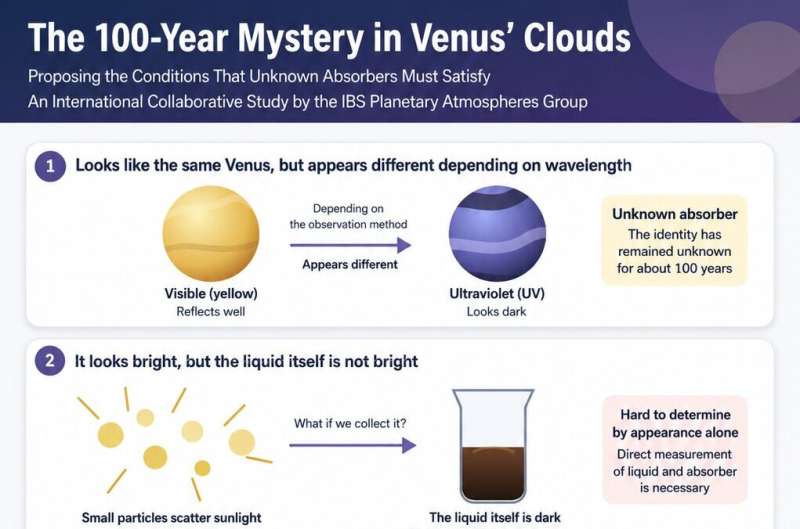
Now, a peer-reviewed study has placed strict numerical limits on the Venus unknown absorber. Researchers did not discover its chemical identity. Instead, they calculated how strongly the material inside Venusian cloud droplets must absorb light. Their result points to an exceptionally efficient absorber, a very high concentration, or both.
A New Test for the Venus Unknown Absorber
Scientists cannot place Venusian cloud liquid inside a laboratory instrument yet. However, the team designed a model that asks what such a sample might look like.
The radiative-transfer model starts with ultraviolet and blue observations of Venus. It then accounts for light scattering by atmospheric molecules and tiny cloud droplets. This step matters because a bright cloud does not necessarily contain bright material.
Cigarette smoke offers a useful comparison. Its particles scatter light efficiently, so the smoke can appear white. When collected, however, those particles form a much darker substance. Venus’s sulfuric acid droplets could produce a similar optical effect.
The researchers converted astronomical observations into a laboratory measurement called the decadic absorption coefficient. In simple terms, it describes how quickly a material reduces light passing through it.
What the Model Assumes
The study assumes that the absorber is distributed through two classes of small particles. They occupy a six-kilometer layer below the cloud top, near an altitude of 65 kilometers.
The real distribution could vary by altitude, location, or particle type. Still, the model gives scientists a consistent benchmark. Proposed chemicals can now be tested against the same optical and atmospheric requirements.
The Number Behind the Venus Cloud Mystery
Across wavelengths from 365 to 455 nanometers, the absorption coefficient reaches 1,278 cm⁻¹ at 375 nanometers. This is the study’s central result.
The correct figure is 1,278 cm⁻¹, not 1.278 cm⁻¹. Some reports display punctuation that readers could mistake for a decimal point. The peer-reviewed paper confirms the higher value.
Such intense absorption creates a demanding chemical test. A weak absorber would need to fill a large share of every droplet. A less abundant substance would need extraordinary efficiency.
Any successful candidate must match the required strength, concentration, spectral profile, particle distribution, and surrounding chemistry.
Why the Absorber Matters
The Venus unknown absorber matters beyond the planet’s appearance. NASA identifies it as important because maximum solar-energy absorption occurs in ultraviolet wavelengths within the upper clouds. The mysterious substance therefore influences atmospheric heating.
Its changing distribution may also help scientists interpret cloud circulation. ESA’s Venus Express observed dark ultraviolet regions at lower latitudes. It detected brighter areas farther north and south. Atmospheric movement and differences in absorber abundance appear to shape those patterns.
Identifying the chemical could improve models of how Venus absorbs energy and transports heat.
Could Organic Molecules Fit the Evidence?
The calculations show that highly absorbing conjugated organic molecules could meet the optical requirement. Such molecules contain connected electron systems that interact strongly with light.
Here, “organic” means carbon-based. It does not mean biological or show that life exists in Venus’s clouds.
Researchers used porphyrin-type pigments as examples of efficient absorption. A material with representative porphyrin-like strength would require a concentration near 12 grams per liter. Chlorophyll and heme provide familiar comparisons, but the authors do not propose either as the answer.
The Spectral Shape Creates a Problem
The absorption curve creates another challenge. Many simple organics react with concentrated sulfuric acid and produce tar-like mixtures. These mixtures often absorb broadly across visible wavelengths and appear brown or black.
Venus shows a steeper decline in inferred absorption between 365 and 455 nanometers. If carbon-based chemistry causes it, the material may be a chemically defined absorber. It would also need to resist becoming a broad-absorbing mixture.
Inorganic Candidates Face the Same Test
Scientists have proposed more than 20 candidates. They include sulfur-bearing molecules, chlorine, iron compounds, and iron-sulfur minerals.
No candidate explains every observation. Many inorganic materials also absorb less efficiently than the model requires. They may need extreme concentrations. Some could remain too weak even in relatively pure form.
Researchers must compare each proposal with Venus’s reflectance curve. They also need measured absorption values, realistic particle sizes, and credible atmospheric distributions.
No Evidence of Life in the Venus Clouds
The study measures optical constraints, not biological activity. It detects no cells, metabolism, genetic material, or biological pigment. It also does not prove that the absorber is organic.
Carbon-based molecules can form through non-biological chemistry. Fluorescence can indicate unusual material without revealing its identity or origin.
The advance is testability. Laboratories can place proposed substances in concentrated sulfuric acid. Researchers can then measure their spectra and compare them with the new curve.
Future Missions Could Sample the Clouds
Morning Star Missions and Rocket Lab plan a small Venus probe with an Autofluorescence Nephelometer. The instrument would illuminate cloud particles with a 440-nanometer laser. It would then measure scattered light and fluorescence between 470 and 520 nanometers.
The data could constrain particle size, number, shape, refractive properties, and possible fluorescent material. Fluorescence may suggest certain organic molecules. However, it would not confirm life or identify a compound alone.
No Confirmed Rocket Lab Launch Date
The project currently lists its launch date as “Coming soon.” A larger Morning Star balloon mission targets May 2031. It would investigate cloud chemistry, acidity, particles, and possible organic material over a longer period.
Conclusion: The Venus Unknown Absorber Is More Constrained
Scientists still cannot name the Venus unknown absorber. However, they now have a demanding standard for evaluating it. The material must absorb ultraviolet light exceptionally well, reach a high concentration, or do both.
Organic compounds remain possible, but they do not provide evidence of life. Inorganic candidates remain possible too, although many face serious concentration limits.
The mystery is narrower but unsolved. Laboratory experiments can now reject candidates that fail the benchmark. Direct cloud measurements could eventually connect Venus’s ultraviolet patterns to a specific chemical source.
Main Sources:
Peer-reviewed study in Astrobiology:
https://journals.sagepub.com/doi/10.1177/15311074261477502
NASA — Studies of Venus’s mysterious ultraviolet absorber:
https://www.nasa.gov/technology/nasa-studies-cubesat-mission-to-solve-venusian-mystery/
ESA — Ultraviolet observations of Venus’s cloud structures:
https://sci.esa.int/web/venus-express/-/39679-ultraviolet-mosaic-of-venus-s-cloud-structures
Morning Star Missions — Rocket Lab mission to Venus:
https://www.morningstarmissions.space/rocketlabmissiontovenus
Morning Star Venus Habitability Mission:
https://www.morningstarmissions.space/venushabitabilitymission