
BY:SpaceEyeNews.
Fading black hole flares have challenged astronomers because they appear after the same star repeatedly passes close to a supermassive black hole. The star survives, returns months or years later, and produces another flare. Yet some systems become dimmer after every passage.
A new study suggests that the missing explanation may not lie with the black hole alone. Instead, the answer could depend on how rapidly the surviving star was rotating before its first encounter.
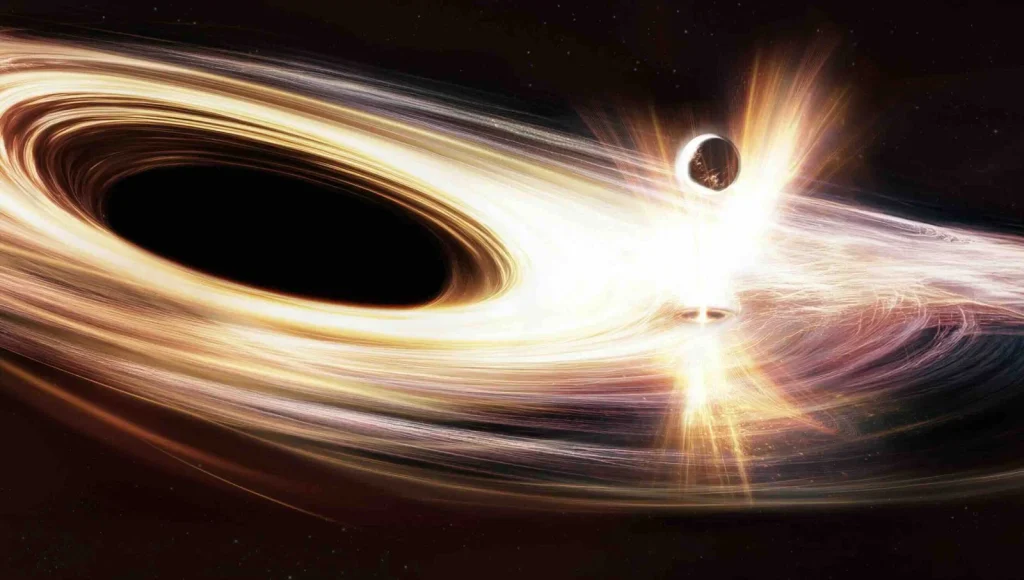
A Long-Dormant Supermassive Black Hole Has Awakened, and It’s Doing Something Extreme and Unusual.
The Mystery of Repeated but Weaker Flares
Astronomers call these systems repeating partial tidal disruption events, or rpTDEs. During each close passage, tidal forces remove part of the star’s outer material. The surviving core remains in orbit and later returns for another encounter.
Wide-field surveys now allow researchers to follow the same systems across several cycles. Syracuse University reports that astronomers had identified roughly ten repeating systems when it announced the study. Four showed flares that became progressively dimmer.
That trend created a clear question. If the star survives several close approaches, why does each event release less light than the one before it?
Why Fading Black Hole Flares Defied Earlier Models
A simple answer seemed likely: the star loses less material during each return. However, earlier hydrodynamical simulations exposed a problem with that explanation.
Relatively massive or evolved stars have dense central regions. After losing some outer material, they can become denser and more resistant to later tidal encounters. As a result, each passage may remove less material.
At the same time, the black hole’s tidal influence applies torque to the star. This torque makes the surviving core rotate faster. The added rotation allows the stripped material to return toward the black hole over a shorter period.
Therefore, less material can still produce a similar peak fallback rate. Earlier models consequently predicted flares with nearly constant peak strength. They did not reproduce the fading pattern seen in several candidates.
Stellar Spin Changes the Result
Ananya Bandopadhyay and her colleagues at Syracuse University proposed a new starting condition. Their study appeared in The Astrophysical Journal. Their models gave the star substantial rotation before its first close passage.
That initial stellar spin changes how strongly the black hole can increase the star’s rotation. If the star already rotates rapidly in the same direction as its orbit, each encounter adds relatively little spin. Astronomers describe this alignment as prograde rotation.
With less additional spin, the debris fallback time remains comparatively stable. Meanwhile, the increasingly dense star gives up less material on each return. Less material then falls back over a similar interval, so the peak fallback rate declines.
This combination finally reproduced successively weaker outbursts across more than two encounters.
The finding does not mean rotation explains every repeating event. The effect depends on the star’s mass, rotation rate, internal structure, and spin direction. Retrograde rotation could create a different trend.
How Researchers Tested the Stellar Spin Idea
The team used smoothed-particle hydrodynamical simulations to model repeated encounters. It built stellar structures with MESA and simulated their response using the Phantom code.
The models included main-sequence stars with one and three times the Sun’s mass. Researchers also tested stars at different stages of their main-sequence lives. Each star approached a simulated black hole with one million solar masses. The stellar models contained about one million particles.
Results showed that substantial prograde rotation could produce declining peak fallback rates over four modeled passages. In several cases, the stellar rotation remained almost unchanged while the amount of removed material decreased.
However, fallback rate is not identical to observed brightness. It describes how rapidly material returns toward the black hole. The final luminosity can also depend on how debris forms an accretion flow and converts energy into radiation.
Therefore, the study offers a physical explanation that observations must continue testing.
A Close Binary Could Explain the Rapid Rotation
The proposed solution creates another question. Why would a star arrive near a supermassive black hole already rotating so quickly?
The Hills mechanism may connect both parts of the mystery. In this scenario, two stars begin in an extremely close binary. When the pair passes near a supermassive black hole, the interaction separates them. One star escapes, while the other enters a compact orbit around the black hole.
Stars in a close binary can become tidally locked. Each star then rotates at the same rate that the pair orbits. A tighter binary completes an orbit more quickly, so its stars can also spin faster.
Such a configuration could give the captured star the rotation required by the new simulations. It could also explain how that star entered an orbit lasting months or less than a year.
One earlier binary system may therefore account for both the rapid spin and the repeating flares.
What the Finding Can—and Cannot—Tell Us
Brightness changes could help astronomers reconstruct the history of stars near galactic centers. A sequence of weakening flares may contain clues about stellar mass, density, rotation, and orbital origin.
The same mechanism might also help explain some stars around Sagittarius A*, the supermassive black hole at the Milky Way’s center.
Still, the evidence remains indirect. Researchers have not directly measured the rotation of the stars producing these distant events.
The model also has difficulty reproducing the roughly tenfold decline reported between two outbursts from AT2018fyk. The study suggests that relativistic effects or changes in the star’s closest approach may contribute there.
Fading Black Hole Flares Offer a New Test
Fading black hole flares may preserve evidence from a star’s life before its capture. Rapid initial rotation links weaker repeated outbursts with the breakup of a tightly bound binary.
Future monitoring can test whether flare sequences match the predicted effects of mass, spin, and alignment. If they do, astronomers may gain a new way to trace how stars arrive and survive near supermassive black holes.
Main Sources:
Syracuse University:
https://artsandsciences.syracuse.edu/physics/news/the-spin-behind-fading-black-hole-flares/
The Astrophysical Journal study:
https://doi.org/10.3847/1538-4357/ae8f31
Research manuscript:
https://arxiv.org/abs/2606.02692
Supporting simulation data:
https://zenodo.org/records/20594641