
BY:SpaceEyeNews.
Magnetic braking has moved closer to meaningful flight tests after Japanese researchers changed the hot, glowing flow around miniature spacecraft models. Their pulsed electromagnets generated fields reaching 1.58 tesla. With the field active, the luminous layer ahead of one model grew approximately 16% thicker.
That result strengthens efforts to control reentry heating through magnetic interaction with atmospheric plasma. It also gives engineers a more flexible way to investigate additional drag. However, the experiment’s immediate achievement concerns laboratory testing. The practical question is how those measured changes could translate into useful protection during flight.
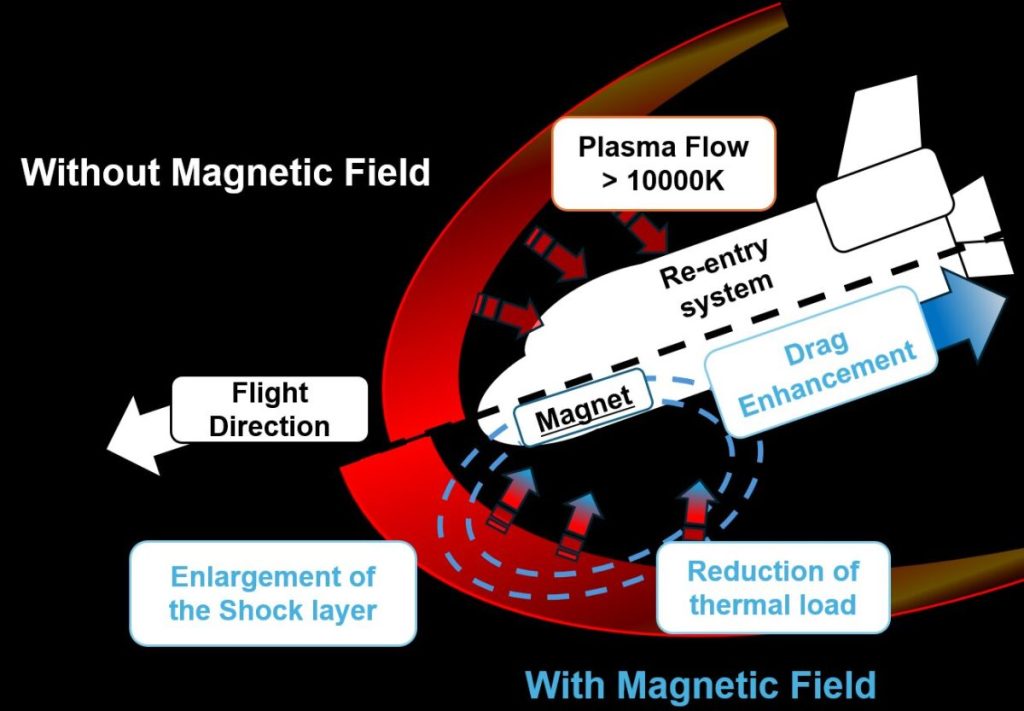
Magnetic braking in the spacecraft. Source: phys.org.
Why magnetic braking needs better tests
Magnetohydrodynamic aerobraking, or MHD aerobraking, uses magnetic fields to influence the electrically conducting gas around a returning spacecraft. This interaction can move the hot shock layer farther from the surface. Researchers aim to reduce heat transfer while increasing resistance to the vehicle’s motion.
Testing magnetic braking requires control over the magnetic field. Earlier experiments often placed permanent magnets inside small models. Their fixed properties restricted both field strength and the way the field spread around each shape.
Consequently, engineers had limited options for exploring different configurations. Stronger fields alone would not solve that problem. They also needed a way to position those fields where the interaction matters.
The new system addresses both needs through an electromagnet with customizable coils, explains the university’s English announcement.
A magnetic pulse at exactly the right moment
Researchers from Tokyo Metropolitan University and Tottori University developed the experimental platform. Their setup uses a pulse-forming network to deliver a brief, intense current through coils inside each model.
Instead of operating continuously, the electromagnet produces its strongest field during the short observation window. This approach suits an expansion tube, where useful test conditions last only tens of microseconds.
Synchronizing the experiment
Pressure sensors detect the approaching shock wave. The system then coordinates the electrical pulse with the incoming flow and a high-speed camera.
That timing allows researchers to observe the heated gas while the magnetic field remains strong and nearly constant. Without synchronization, the camera could capture conditions that do not represent the intended test.
Matching the field to the model
The team tested two shapes with different coil arrangements. Each configuration directed the magnetic field around the model’s forward surface.
Changing the coil diameter and number of turns changes how the field spreads. One arrangement can cover a broader region. Another concentrates the field closer to the surface, allowing engineers to investigate different patterns of interaction.
This flexibility lets engineers explore how vehicle geometry and magnetic-field distribution work together. It also creates opportunities to compare designs under similar laboratory conditions.
What the magnetic braking experiment measured
The tests exposed the models to flows at roughly seven kilometers per second. Both configurations produced stronger fields than the similarly sized permanent magnet used for comparison.
Stronger fields and a thicker glowing layer
The first model reached 1.24 tesla, while the second reached 1.58 tesla. Those values corresponded to approximately 1.7 and 2.1 times the reference magnet’s field strength.
High-speed imaging revealed another measurable change. With the field active, the glowing region became approximately 15.7% thicker around the first model and 16.2% around the second. The universities’ original announcement documents these results.
Together, the measurements show that the magnetic field altered the shock-layer conditions in both configurations.
What those percentages mean
The thickness increase does not establish an equivalent reduction in heating. Nor does it measure an improvement in spacecraft deceleration.
Those distinctions matter because visible changes provide only part of the performance picture. Researchers still need to connect the altered flow with useful thermal and aerodynamic effects.
The new platform gives them greater freedom to investigate that connection across different magnetic configurations.
What this could mean for reusable spacecraft
If magnetic braking reduces surface heating in practical systems, it could ease demands on thermal protection. That could eventually reduce inspection and repair work between missions.
Lower thermal loads might also allow designers to reconsider how much protective material a vehicle needs. Any resulting mass savings could create room for additional payload or equipment.
However, the complete spacecraft must benefit. Magnets, electrical equipment, and supporting hardware also occupy space and add mass. Engineers would need to assess those requirements alongside any gains in thermal protection.
For now, the research supports investigating magnetic control as a way to reduce the burden on existing heat shields. It does not establish that future spacecraft could dispense with them.
The strongest practical case will come from measured performance across realistic operating conditions, including the changing environment throughout atmospheric entry.
From laboratory measurements to flight tests
The next research steps involve connecting several measurements. Heat transfer, drag, shock position, and plasma properties together can reveal how magnetic interaction changes the flow.
Such measurements would help engineers evaluate whether magnetic braking provides useful protection and deceleration. They would also support comparisons between experimental observations and numerical predictions.
A planned capsule demonstration
A related Japanese research project aims to develop a capsule for a sounding-rocket flight demonstration. Its official KAKEN record identifies two central development tasks.
One concerns supplying an ionizing agent so electromagnetic interaction can operate across different entry conditions. The other involves arranging magnets to provide sufficient field strength while leaving space for onboard equipment.
The laboratory platform can help researchers examine candidate shapes and operating conditions before flight. However, the project description sets out a research plan. It does not confirm a completed demonstration or a specific launch date.
Magnetic braking still needs flight evidence
Magnetic braking now has a stronger experimental foundation. Researchers can generate more adaptable fields and observe their effects under brief reentry-like conditions. The next milestone is demonstrating useful reductions in heating and increased deceleration during flight. If those benefits justify the added hardware, the technology could help make atmospheric return more practical for reusable spacecraft.
Main sources:
Tokyo Metropolitan University and Tottori University: Official research announcement, July 28, 2026.
Tokyo Metropolitan University: English research announcement, published by Phys.org.
Japan’s KAKEN database: Research project for an electromagnetic aerobraking flight demonstration.