
BY:SpaceEyeNews.
The IC 1101 galaxy stretches across roughly 1.7 million light-years, yet its outer regions suggest that its growth continues. Astronomers have identified a boundary around its main stellar body while uncovering faint structures beyond it. Those findings connect an extraordinary size measurement with clues about how this giant assembled.
The discovery raises a question: how can a galaxy have a recognizable edge and still expand? The answer lies in the difference between its established stellar structure and the material accumulating around it.
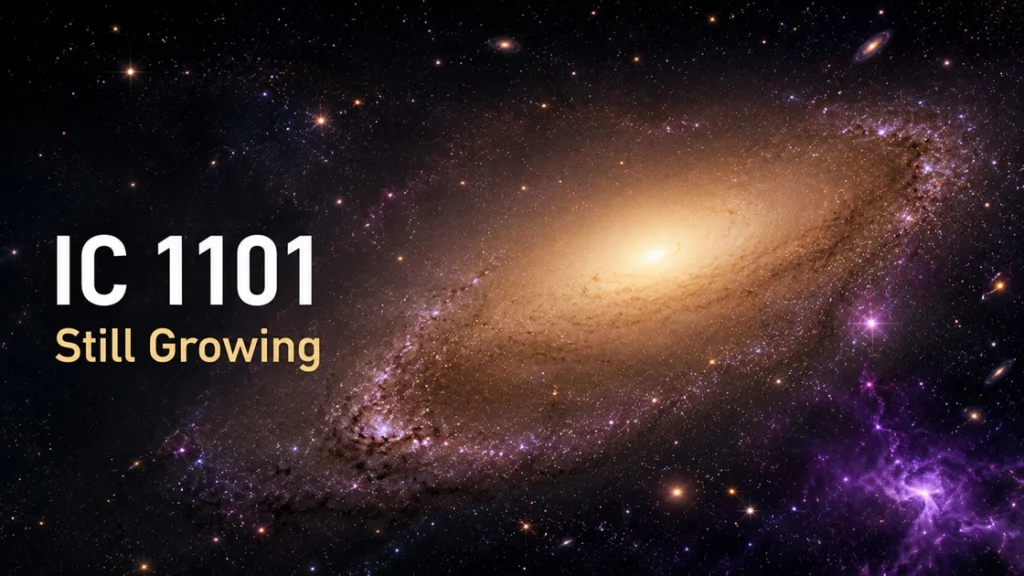
How large is the IC 1101 galaxy?
At the center of the Abell 2029 galaxy cluster, IC 1101 occupies an exceptional position on the galactic size scale. Researchers place its main stellar boundary approximately 260 kiloparsecs from its center along its longest axis. Doubling that radius gives a diameter near 520 kiloparsecs, equivalent to 1.7 million light-years.
For perspective, NASA describes the Milky Way as approximately 100,000 light-years across. Using that familiar disk measurement, IC 1101 spans roughly 17 times the distance. However, the comparison involves different stellar boundaries, so it serves as an illustration of scale. NASA’s size reference
The team also estimates that the main body contains around 3.4 trillion solar masses in stars. This measures the combined mass of the stellar population. It is separate from the surrounding cluster’s mass and does not represent a count of individual stars.
The research team identifies IC 1101 as the largest known galaxy using its measured stellar extent. That qualification matters. Galaxy sizes depend on which components astronomers include and how they define an outer boundary. Larger galaxies could still await equally detailed observations.
Finding an edge hidden in faint light
Astrophysicist Carlos Marrero-de la Rosa led the investigation with colleagues from several institutions. The team used the 2.5-meter Isaac Newton Telescope at Spain’s Roque de los Muchachos Observatory.
Their deep images captured extremely faint light around IC 1101. However, collecting more light only solved part of the problem.
Removing the scattered glow
Light from bright foreground stars spreads across telescope images. The galaxy’s luminous center also contributes scattered light that can obscure or imitate faint outer structures.
Researchers modeled and removed these effects before examining the outskirts. This correction helped them distinguish genuine features from light redistributed by the observing system. Meanwhile, diffuse starlight throughout the surrounding cluster complicated the task of separating the galaxy from its environment.
Several clues point to one boundary
At approximately 260 kiloparsecs, multiple properties changed together. These included brightness, stellar color, estimated stellar mass density, and the system’s shape and orientation.
Together, those transitions indicated the edge of the main stellar structure. The boundary describes a change in how the system behaves; faint material continues beyond it. Original research
Why the IC 1101 galaxy keeps growing
After correcting the images, the researchers identified faint, asymmetric features around the galaxy. Some resemble extended filaments, while others appear as plumes or diffuse clouds.
Their shapes suggest a history of interactions and continuing accumulation of material. Smaller galaxies can contribute stars to an expanding outer envelope as gravity rearranges their orbits.
Reading the evidence in the outskirts
These structures help explain how IC 1101 reached its extraordinary scale. Repeated interactions allow a central galaxy to gather material over long periods. Its outer regions can preserve signs of that assembly after the central body appears comparatively settled.
The findings therefore support ongoing growth through accretion. They do not provide a direct measurement of the diameter increasing between photographs.
This distinction also explains why the measured edge and continuing growth fit together. The edge marks the established main body. Surrounding structures reveal material involved in the broader assembly process.
Abell 2029 preserves an older chapter
A separate investigation with NASA’s Chandra X-ray Observatory adds context to the cluster’s history. Researchers found evidence that Abell 2029 encountered a smaller galaxy cluster approximately four billion years ago.
Hot gas preserves a large spiral pattern that the team interprets as sloshing from that encounter. Simulations suggest the smaller cluster had roughly one-tenth the mass of the larger system.
Chandra also revealed additional gas structures that help researchers reconstruct the sequence of events. Together, these features show how an apparently settled cluster can retain evidence of an eventful past. Official Chandra release
Some faint optical structures around IC 1101 align with disturbances in the surrounding gas. That correspondence supports a connection between the galaxy’s outskirts and its cluster’s history. However, a cluster encounter involves a much larger system than an individual galaxy merger.
Does this giant reveal a maximum galaxy size?
IC 1101 gives astronomers a valuable benchmark for studying extreme galaxy growth. Its size helps researchers examine how repeated accretion builds extended stellar systems.
Why older size claims differ
Readers may encounter larger numbers for IC 1101 elsewhere. An older NASA explainer, for example, quotes a size reaching four million light-years. Such figures require attention to the boundaries and diffuse components under discussion. NASA’s earlier explainer
The new work focuses on identifying the main stellar body’s edge. Describing it simply as larger than every previous estimate would misrepresent the advance.
Could other giants remain overlooked?
Comparable studies could reveal whether IC 1101 is unusually extended. Alternatively, it may represent a broader population of enormous galaxies. Consistent measurements would make those comparisons more meaningful.
For now, its dimensions describe an observed extreme. They do not establish a universal ceiling or a guaranteed future for the Milky Way.
IC 1101 galaxy: An unfinished giant
The IC 1101 galaxy offers astronomers both a measurable stellar boundary and evidence of continuing assembly beyond it. Careful image correction connects those findings, revealing structure that brighter light previously obscured.
Its significance extends beyond a size ranking. IC 1101 provides a way to investigate how galaxies accumulate material and how their surroundings influence that process. Further observations can test whether this exceptional system stands alone. Other giants may still await equally careful study.
Main sources:
Original IC 1101 study — stellar extent, imaging methods, mass estimate, and growth evidence.
NASA Chandra: Abell 2029 — gas observations and the cluster’s past encounter.
NASA: How Big Is Space? — Milky Way size comparison.
NASA: Our Milky Way Galaxy — older IC 1101 size reference.