
BY:SpaceEyeNews.
PDS 70 comets may help explain how water reaches places where rocky planets could form. Astronomers have found changing sodium signals near this young star, suggesting that evaporating icy bodies pass through its inner system. Their movements could connect a distant reservoir of frozen material with water vapor already detected closer to the star.
The finding offers a way to investigate water delivery during planetary development. However, connecting the suspected comets to that water remains an open scientific question.
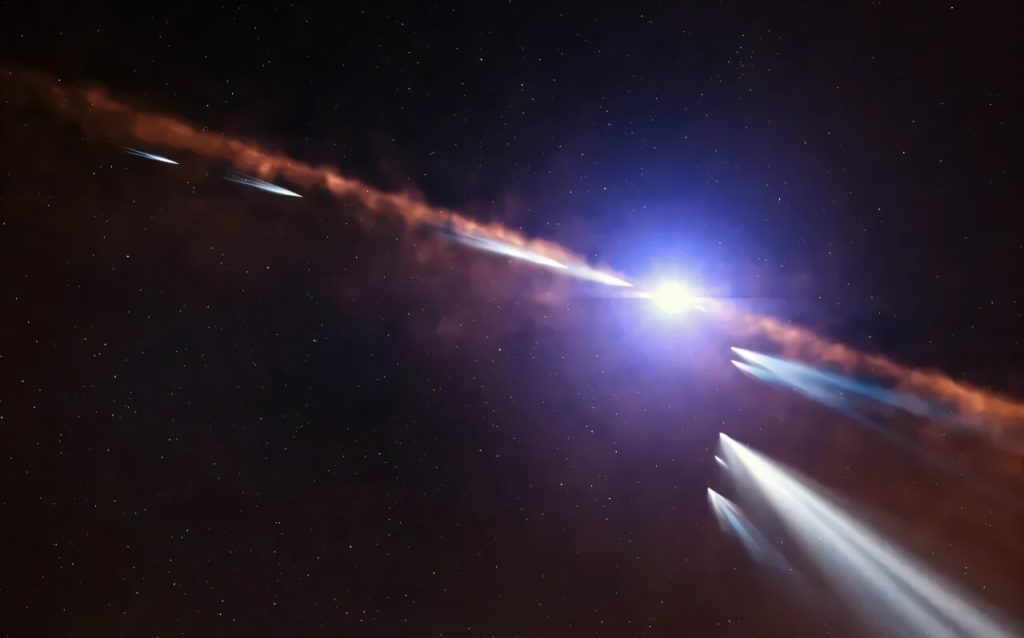
Artistic interpretation of the distant planetary system PDS 70. Credit: Aline Novais.
Sodium Signals Point to PDS 70 Comets
Aline Novais and colleagues at Lund University examined archival observations from HARPS, an instrument at ESO’s La Silla Observatory in Chile. Their analysis focused on sodium gas crossing our view of the star.
The sodium absorption changed between nights, with signals appearing, shifting, and disappearing. The measured gas moved toward the observer at roughly 25–115 kilometers per second relative to the star. Those figures describe motion along our sightline, rather than complete comet orbital speeds.
The researchers also found that the gas often covered only part of the star’s visible surface. That suggests separate clouds of material.
Why the Pattern Matters
Such behavior fits material escaping from bodies passing close to a star. The team identified 43 variable absorption components in the main dataset. These measurements do not establish the presence of 43 individual comets.
The study, published in Nature Communications, presents comet activity as a plausible explanation for the observations.
Webb Had Already Found Water Nearby
PDS 70 lies approximately 370 light-years from Earth and is about 5.4 million years old. Its central star is cooler than the Sun. Two known giant planets, PDS 70 b and c, occupy a gap between its inner and outer disks.
In 2023, astronomers announced that Webb’s Mid-Infrared Instrument had detected water vapor in the inner disk. The observations placed water within a region where rocky planets might assemble.
Although PDS 70 is young, its disk has already evolved for millions of years. Earlier searches around similarly aged systems often found no inner water. Its presence here therefore raises another question: how does the system preserve or replenish that reservoir?
That location makes the new comet evidence especially interesting. Scientists already know water exists there; they now need to establish its source.
The detection also revealed an environment containing small dust grains and silicate material. Together, these ingredients make the inner disk relevant to studies of rocky worlds. However, available water does not establish that an Earth-like planet has formed. NASA’s Webb announcement explains the earlier discovery.
How Giant Planets Could Redirect Icy Bodies
The proposed journey begins in the system’s cold outer regions. There, small bodies can retain water as ice. Gravitational encounters with giant planets could change their orbits and send some toward the inner disk.
The Lund team tested this possibility through computer simulations. Their calculations support inward movement across the region occupied by the giant planets.
Consequently, those planets may influence which materials become available closer to the star. Their importance extends beyond their own formation.
From Frozen Material to Water Vapor
As an icy body approaches warmer regions, its ice can pass directly into gas through sublimation. This could release water and other volatile substances into the surrounding environment.
The simulations establish a possible transport route. They do not directly measure the quantity of water that suspected PDS 70 comets supply. That distinction matters when connecting the orbital calculations with Webb’s separate observations.
What the Evidence Still Cannot Confirm
Sodium provides a clue to moving material, but it does not identify water inside an individual comet. The interpretation depends on several observations fitting a common explanation.
The researchers considered alternatives, including gas flowing away from the disk. The changing signals favor the comet scenario, although further observations remain necessary.
Other Sources Could Supply the Water
Comets are also only one possible explanation for the inner disk’s water. Chemical reactions could produce water locally. Alternatively, tiny particles carrying ice could travel inward from the outer disk and release vapor as they warm.
ESA’s account of the Webb findings describes these possibilities. Dust and other water molecules may also help protect the vapor from ultraviolet radiation.
Several processes could therefore contribute to the same reservoir. Establishing their relative importance remains a separate challenge.
What PDS 70 Could Reveal About Earth’s Water
The proposed transport mechanism connects this distant system with a question closer to home: how did Earth acquire its water?
Water-rich asteroids and comets remain possible contributors. However, PDS 70 cannot determine how much either population supplied to Earth.
Its value comes from showing a planetary system during an early stage of development. Researchers can examine how giant planets, smaller bodies, and surrounding material interact while those processes continue.
In Lund University’s announcement, Alexandra Stockwell Murphy connects this mechanism with a possible process in the early Solar System. The comparison gives scientists a setting for testing water-delivery ideas against observations.
The Next Tests for PDS 70 Comets
More frequent observations could track how the gas changes during individual passages. Searches for dust tails crossing the star could provide another test. Chemical measurements would help characterize the escaping material.
Researchers also want a clearer inventory of planets within the system. Additional planets could change how small bodies move through its inner regions.
Jens Hoeijmakers points to the Extremely Large Telescope’s anticipated contribution to that work. Better planetary measurements could strengthen the connection between observed gas and simulated orbits.
Following the Water to Young Worlds
PDS 70 comets offer a promising explanation for how icy material could reach a region where rocky planets may develop. The strongest next step is to connect the gas signatures, orbital pathways, and water observations more closely. Doing so would help reveal how young planetary systems distribute an ingredient that future worlds might inherit.
Main sources:
Lund University: Comets may have transported water to a young planetary system.
Nature Communications: Potential sublimating exocomets around the young star PDS 70.
NASA: Webb Detects Water Vapor in Rocky Planet-forming Zone.
ESA: Webb detects water vapour in rocky planet-forming zone.