
BY:SpaceEyeNews.
The Sun’s influence on Earth’s climate may extend far beyond changes in brightness or solar activity. New research suggests that our star’s journey through the Milky Way also mattered. Dense interstellar clouds may once have compressed the Sun’s protective bubble until Earth was left outside it. Much earlier, intense activity from the young Sun may have created greenhouse gases that kept oceans from freezing. Together, these findings present a striking possibility: part of Earth’s climate history may have begun in space.
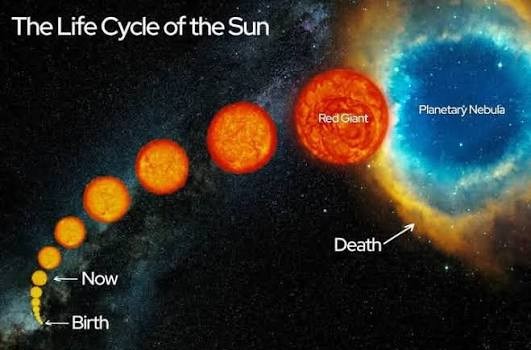
A star, akin to the Sun, commences its lifecycle as a main-sequence star, subsequently progressing through the subgiant and giant phases. Following this, it expels its outer layers, resulting in the formation of a planetary nebula. Credit: ESO, S. Steinhöfel.
Sun’s Influence on Earth’s Climate Beyond the Solar System
The solar wind forms the heliosphere, a vast bubble separating the Solar System from much of the surrounding interstellar environment.
Today, the heliosphere extends roughly 120 astronomical units in the direction of the Sun’s motion. However, its size and shape are not fixed. Conditions outside the Solar System can push against it and dramatically change its boundaries.
Over billions of years, the Sun has crossed galactic regions with different temperatures, densities, and chemical compositions. Some may have altered the protection reaching Earth.
Astrophysicist Merav Opher of Boston University and her colleagues reconstructed parts of that journey with computer models. Their work suggests that the Solar System encountered cold, dense clouds of gas and dust several times during the past 14 million years.
Three Encounters That May Have Exposed Earth
The models highlight three possible encounters. They occurred about 2–3 million, 6–7 million, and 13–14 million years ago. During each event, pressure from the surrounding cloud may have compressed the heliosphere to less than one astronomical unit.
Earth orbits the Sun at one astronomical unit. Therefore, such a collapse could have temporarily placed the planet outside the heliosphere. Earth would then have faced higher levels of interstellar material and cosmic radiation.
Earth’s atmosphere and magnetic field would have remained important barriers. However, its space environment could have changed considerably.
Interstellar Clouds and Ancient Climate Changes
Researchers have found traces of material associated with interstellar dust in deep-sea sediments, Antarctic deposits, and lunar samples. Some traces correspond broadly with the periods identified in the heliosphere models. That agreement makes the idea intriguing, although it does not prove that each cloud encounter occurred exactly as simulated.
The climate connection requires another step. When the heliosphere shrinks, more neutral hydrogen and interstellar particles can reach Earth. Simulations indicate that a dense hydrogen cloud could change chemistry and circulation in the upper atmosphere. It might also increase atmospheric water vapor.
Those changes could eventually influence conditions closer to the surface. Researchers have therefore proposed heliosphere collapse as a possible contributor to several ancient cooling shifts. The three modeled encounters overlap with periods when geological records show faster climate cooling.
A Compelling Link, but Not a Confirmed Cause
The timing alone cannot confirm that interstellar clouds caused past ice ages. Earth’s climate responds to many interacting forces. These include orbital variations, greenhouse gases, ocean circulation, volcanic activity, and changes in ice cover.
The scientific review led by Opher states that the causes of the cooling periods remain under debate. The galactic explanation should therefore be viewed as an additional mechanism, not a replacement for established climate factors.
Even so, the proposal expands the climate story. It suggests that researchers may need to examine both Earth’s internal systems and the changing environment surrounding the entire Solar System.
The Young Sun Created a Different Climate Mystery
About three billion years ago, the Sun produced only around 70% of its present brightness. Conventional calculations suggest that Earth should have remained deeply frozen.
Geological evidence tells a different story. Liquid water existed on the surface, creating what scientists call the Faint Young Sun paradox. A weaker Sun should have delivered insufficient warmth, yet early Earth maintained oceans and potentially habitable environments.
Scientists have long considered greenhouse gases as part of the answer. New experiments now suggest that the young Sun itself may have helped produce one of those gases.
Solar Particles May Have Produced Extra Warmth
Young Sun-like stars often generate energetic flares and release streams of high-energy particles. Researchers led by NASA astrophysicist Vladimir Airapetian recreated the possible effects of that activity inside a laboratory chamber.
They prepared a gas mixture containing molecular nitrogen, ammonia, carbon dioxide, and carbon monoxide. The mixture represented a proposed version of Earth’s early atmosphere. The researchers then exposed it to protons that simulated energetic particles from the young Sun.
The reactions produced nitrous oxide, a strong greenhouse gas. Intense ultraviolet radiation from the young Sun would have broken down much of it. Yet the team’s simulations showed that even a limited surviving amount could make a major difference.
If around 10% of the experimentally produced nitrous oxide remained, equatorial temperatures could have reached about 5°C. That would place them above water’s freezing point. Cool conditions just above freezing may also support the formation of long amino-acid chains more effectively than warmer environments.
This mechanism offers a fascinating reversal. The young Sun’s activity may seem hostile at first glance. However, the same energetic particles might have supported liquid water and useful prebiotic chemistry.
Sun’s Influence on Earth’s Climate Tells a Larger Story
These studies address separate eras, but they reveal the same deeper connection. The young Sun may have helped warm early Earth through atmospheric chemistry. Millions of years later, the Sun’s movement through interstellar clouds may have altered Earth’s exposure to the wider galaxy.
Neither idea solves every question about ancient climate. Both depend on models, experiments, and evidence that scientists must continue testing. Still, the Sun’s influence on Earth’s climate may be more complex than previously recognized. Earth’s rocks, oceans, and ice could preserve not only the history of one planet, but also traces of the Solar System’s long journey through the Milky Way.
Main Sources:
NASA — Starstruck: NASA Research Shows How Sun’s Ancient History Shaped Earth
https://science.nasa.gov/solar-system/starstruck-nasa-research-shows-how-suns-ancient-history-shaped-earth/
Annual Review of Astronomy and Astrophysics — Understanding the Heliospheric Shield
https://www.annualreviews.org/content/journals/10.1146/annurev-astro-120425-053711
Universe Magazine — The History of the Sun May Explain Past Climate Changes on Earth
https://universemagazine.com/en/the-history-of-the-sun-may-explain-past-climate-changes-on-earth/