
BY:SpaceEyeNews.
Oxygen in an early galaxy reveals how quickly the young universe began developing chemical complexity. Astronomers detected the element in JADES-GS-z14-0, a galaxy we see before the cosmos reached 300 million years old. By then, stars had already enriched its gas with elements they produced.
The discovery connects a distant point of light to a history of earlier stellar activity. Webb found the galaxy and supplied initial chemical clues. ALMA then identified oxygen directly, helping researchers investigate how much development could fit into such a brief cosmic window.
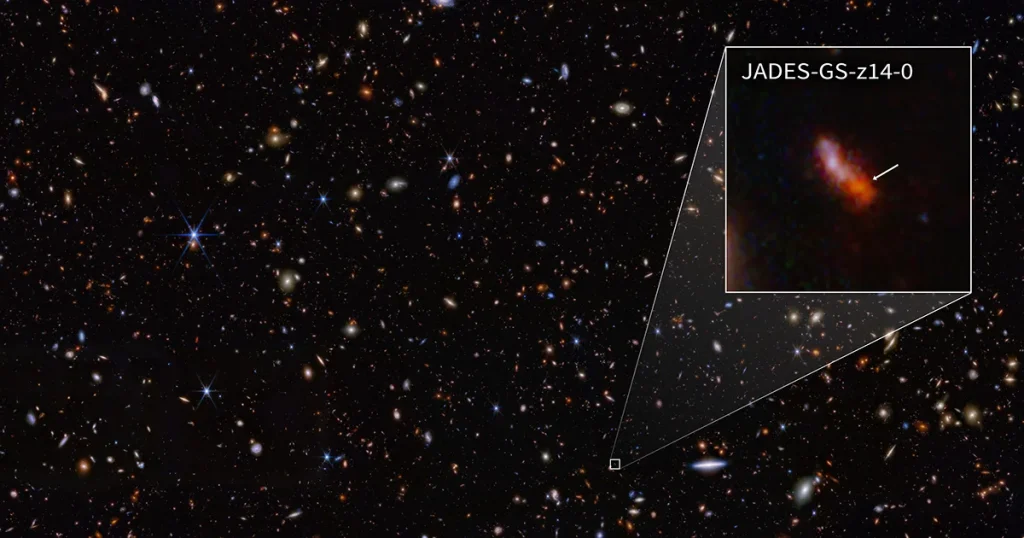
James Webb Space Telescope image of JADES-GS-z14-0, a galaxy that existed just 290 million years after the Big Bang. Credit: NASA, ESA, CSA, STScI, B. Robertson (UC Santa Cruz), B. Johnson (CfA), S. Tacchella (Cambridge), P. Cargile (CfA)
How Webb and ALMA Found Oxygen in an Early Galaxy
Webb supplied the first clues
NASA announced Webb’s discovery of JADES-GS-z14-0 in May 2024. Its Near-Infrared Spectrograph placed the galaxy within the universe’s first few hundred million years.
Another instrument added an intriguing clue. Webb’s Mid-Infrared Instrument measured more brightness at longer wavelengths than a simple extension of the shorter-wavelength light suggested. Researchers interpreted this excess as emission from ionised gas, including hydrogen and oxygen.
However, that measurement combined light across a wavelength band. A distinct oxygen line would offer a more specific chemical test.
ALMA confirmed oxygen
ALMA supplied that test through an emission line from oxygen atoms missing two electrons. The line originally had a wavelength of 88 micrometres. Cosmic expansion stretched it into the millimetre range that ALMA observes.
Sander Schouws and colleagues reported a strong detection and measured a redshift of 14.1793. Stefano Carniani’s team obtained a closely matching value through an independent analysis.
Together, these results strengthened the oxygen identification and sharpened the galaxy’s distance measurement. ESO announced the findings in March 2025, so the discovery predates the September 2026 coverage.
What the Oxygen Reveals About Earlier Stars
A chemical record
Oxygen in an early galaxy provides evidence that stars had already altered their surroundings. The observed gas contains products of earlier stellar activity, giving researchers another way to investigate the galaxy’s development.
NASA’s discovery account suggested that multiple generations of massive stars could explain the early oxygen. That interpretation offers a plausible history, but the signal cannot count those generations.
Nor does it reveal individual stars that supplied the material. Astronomers see the chemical outcome and work backwards to explore possible histories.
Rapid enrichment within a short window
The relevant timescale belongs to massive stars, which evolve much faster than stars like the Sun. Their short lives allow element production and release within the early universe’s limited time.
Consequently, the presence of oxygen does not require billions of years of development. The challenge involves explaining how efficiently stars formed and how their products reached the observed gas.
The detection concerns ionised oxygen in galactic gas. It provides no evidence of breathable air or living organisms. Its importance lies in tracing chemical processing at an early stage of galaxy formation.
Chemical maturity also differs from chronological age. An enriched galaxy can still belong to a very young universe. The observation constrains its earlier activity without providing a complete timeline.
How Chemically Developed Was This Galaxy?
The original abundance estimates
Schouws and colleagues combined ALMA observations, Webb measurements, and gas-emission models. They estimated a heavy-element abundance around 5–20% of the solar value.
These figures compare chemical composition with a solar reference. They do not mean that oxygen accounts for that percentage of the galaxy’s total mass.
The range also matters. It shows that researchers inferred the abundance through modelling, rather than reading an exact chemical inventory directly from the telescope data.
Interpreting the evidence
The oxygen line establishes the presence of the element more directly than it establishes its abundance. Converting emission strength into composition requires assumptions about the gas and its physical conditions.
Carniani and colleagues also explored whether earlier outflows could explain the galaxy’s inferred gas content. Their proposed history depends on estimates of stellar mass, gas mass, and previous star formation.
Those interpretations help test possible explanations. However, they carry more uncertainty than the measured emission itself. Keeping these layers separate preserves the discovery’s significance without overstating what scientists know.
What Deeper Webb Observations Are Revealing
Follow-up spectroscopy adds new evidence
Further research has already extended the original findings. A study first posted in December 2025 reported deep Webb/MIRI spectroscopy of JADES-GS-z14-0.
The researchers detected optical oxygen emission lines alongside hydrogen-alpha. These additional measurements provided new information about star formation and the conditions inside the galaxy.
They also investigated the carbon-to-oxygen ratio. Comparing these elements helps researchers examine the stellar populations responsible for enrichment, extending the chemical picture beyond oxygen alone.
The chemical history remains open
Even richer observations do not automatically produce one definitive abundance. The follow-up study obtained different oxygen estimates using standard emission-line diagnostics and detailed modelling.
This variation highlights a central challenge: converting faint, distant signals into a reliable account of physical conditions.
Future analyses must connect the chemical measurements with the galaxy’s stars and gas. Researchers still need to establish how rapidly enrichment progressed and how gas movements influenced the material they observe.
Each additional measurement narrows the possibilities. The aim is a consistent explanation that accounts for several signals together, while recognising the uncertainties in each.
Distance records also need historical context. JADES-GS-z14-0 held the record when the original announcements appeared. NASA later announced the more distant MoM-z14. That change leaves the oxygen finding intact: this galaxy remains a valuable example of chemical development near cosmic dawn, regardless of its place in distance rankings.
Why Oxygen in an Early Galaxy Matters
Oxygen in an early galaxy shows that stellar enrichment was underway within the universe’s first 300 million years. Webb and ALMA have turned that broad conclusion into increasingly detailed evidence.
The remaining mystery concerns the pace and efficiency of the process. How did early stars shape their galaxy’s chemistry so quickly? Answering that question will help explain how the first galaxies developed the complex conditions that astronomers now observe across cosmic history.
Main sources:
- NASA: Webb’s discovery of JADES-GS-z14-0
- ESO: Oxygen detection announcement
- Schouws and colleagues: ALMA oxygen measurements
- Carniani and colleagues: Chemical enrichment and gas modelling
- Helton and colleagues: Follow-up Webb spectroscopy
- NASA: MoM-z14 distance-record update