
BY:SpaceEyeNews.
Black holes inside stars could begin with surprisingly little mass. A new theoretical study suggests that one weighing about 40 metric tons could grow inside a white dwarf. That is roughly the mass of a loaded truck, hidden within a dense stellar remnant.
The key ingredient is a continuing supply of dark matter. Under suitable conditions, that supply could help a tiny black hole gain mass faster than it loses it.
No astronomer has detected such an object. However, the calculations offer a fresh way to investigate dark matter through stars that have survived for billions of years.
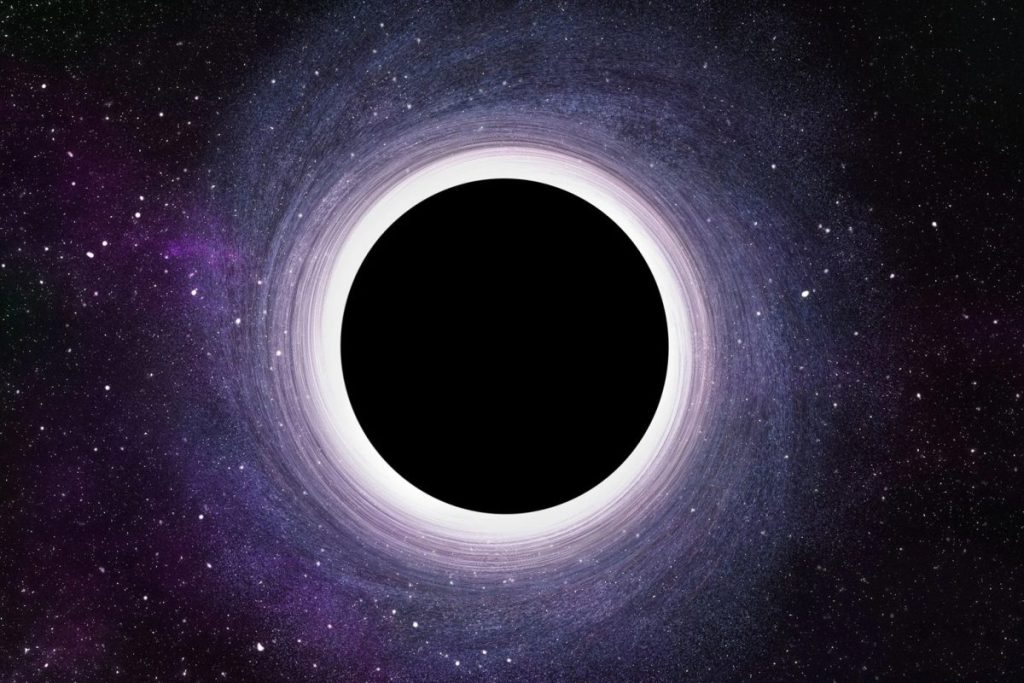
How Black Holes Inside Stars Could Form
Dark Matter Collects in the Core
The proposed process begins inside white dwarfs and neutron stars. These compact remnants provide the dense environments that the researchers examined.
Their model involves hypothetical ultraheavy asymmetric dark matter particles. The word “asymmetric” matters because these particles do not efficiently annihilate one another. Instead, captured particles can accumulate.
Over time, the collection could settle toward the core and become dense enough for its own gravity to matter. Eventually, it could collapse into a tiny black hole.
This scenario depends on specific particle properties and capture conditions. It does not mean every white dwarf or neutron star contains a hidden black hole.
A Different Route From Primordial Black Holes
These objects would form within existing stellar remnants, potentially long after the early universe. Primordial black holes, by contrast, would have originated shortly after the Big Bang.
That difference changes the survival question. A newly formed black hole inside a star need not have endured billions of years alone.
The researchers call it an “endoparasitic” black hole because it forms within a host and can draw matter from its surroundings.
Feeding Must Outpace Evaporation
Three Processes Determine the Outcome
A tiny black hole faces competing changes in mass. It can absorb ordinary stellar matter and receive additional dark matter. Meanwhile, Hawking radiation would carry energy away, reducing its mass.
If evaporation dominates, the object shrinks. If incoming matter compensates for those losses, it can persist. When feeding exceeds evaporation, growth becomes possible.
The host therefore provides more than a gravitational setting. Its surrounding matter, together with continued dark matter capture, can supply the mass needed for growth.
Gravity alone does not switch off Hawking radiation. This distinction explains why the “parasite” comparison works only as a metaphor for dependence on the surrounding supply.
What the New Calculation Adds
The study combines stellar feeding, continued dark matter input, and evaporation in an analytical description of growth.
It also accounts for quantum effects when the black hole is extremely small. At that scale, treating incoming matter as a smooth fluid can become inadequate.
Individual particle absorption then matters. As the object grows, a fluid description becomes more appropriate.
By connecting these regimes, the researchers update the estimated growth thresholds and the time required to transform a host.
Why Location Changes the Mass Threshold
The model produces different results for different stellar environments. A white dwarf in the Milky Way’s disk has a representative critical initial mass of about 10,000 metric tons.
For a white dwarf in the Galactic bulge, that threshold can fall to about 40 metric tons. A neutron star in the same broad region gives a value near 600 metric tons.
These figures reflect the host properties and assumed dark matter conditions. In the modeled bulge environment, a greater dark matter supply can help sustain smaller objects.
Crucially, these numbers describe thresholds for continued growth. They do not establish a universal minimum mass for forming a black hole.
Nor does the 40-ton result apply to an isolated object. Remove the surrounding supply, and the balance between feeding and evaporation changes.
Could the Host Eventually Become a Black Hole?
Sustained growth could eventually transform the stellar remnant into a black hole. However, the appearance of a tiny seed does not guarantee that outcome.
Its future depends on whether feeding remains sufficient and how long the process takes. The study therefore considers both formation and subsequent growth when calculating transformation timescales.
There is no single countdown that applies to every star. Particle properties, the host’s characteristics, and the surrounding dark matter density all influence the result.
Direct observation also remains challenging. The calculation establishes a possible pathway; it does not identify a confirmed hidden object or promise an easy detection method.
That limitation leads to another approach: studying the stars that remain.
Ancient Stars Can Test Dark Matter Models
Old white dwarfs and millisecond pulsars provide a useful check on the theory. Their continued existence tells researchers that any proposed transformation process cannot have happened too quickly.
Suppose a particular dark matter model predicts that a star should already have become a black hole. Finding that star still present challenges those assumed particle properties.
Researchers can therefore use stellar survival to constrain dark matter masses and interaction strengths. They do not need to observe the tiny black hole directly for this argument to help.
The method remains conditional on the model. Nevertheless, it connects an unusual theoretical possibility with astronomical evidence.
What Black Holes Inside Stars Could Reveal
Black holes inside stars remain a theoretical possibility, with the 40-ton result applying under specific conditions. The central finding concerns sustained feeding: an environment can change whether a tiny object evaporates or grows.
For now, ancient stellar remnants offer the clearest scientific value. Their survival helps researchers investigate which dark matter scenarios remain plausible, even while the proposed hidden black holes stay unconfirmed.
Main Sources:
- Physical Review D — Original peer-reviewed study: Transmutation timescales for the dark matter induced collapse of compact stars into black holes
- arXiv — Research preprint: Full research paper
- Phys.org — Explanation by the researchers: A black hole as light as 40 tons can exist inside a star if dark matter helps
- Universe Magazine — Original coverage: Black holes may exist inside stars as parasites