
BY:SpaceEyeNews.
Could a speck of lunar dust hold evidence of a civilization that vanished billions of years ago? Researchers studying alien technology on the Moon want to turn that possibility into a scientific test. Their proposal focuses on microscopic fragments that might survive journeys between stars and settle into lunar soil.
Nobody has discovered such material. However, a new study asks whether modern instruments could identify it. The challenge connects an enormous question about life beyond Earth with some of the smallest objects scientists can examine.
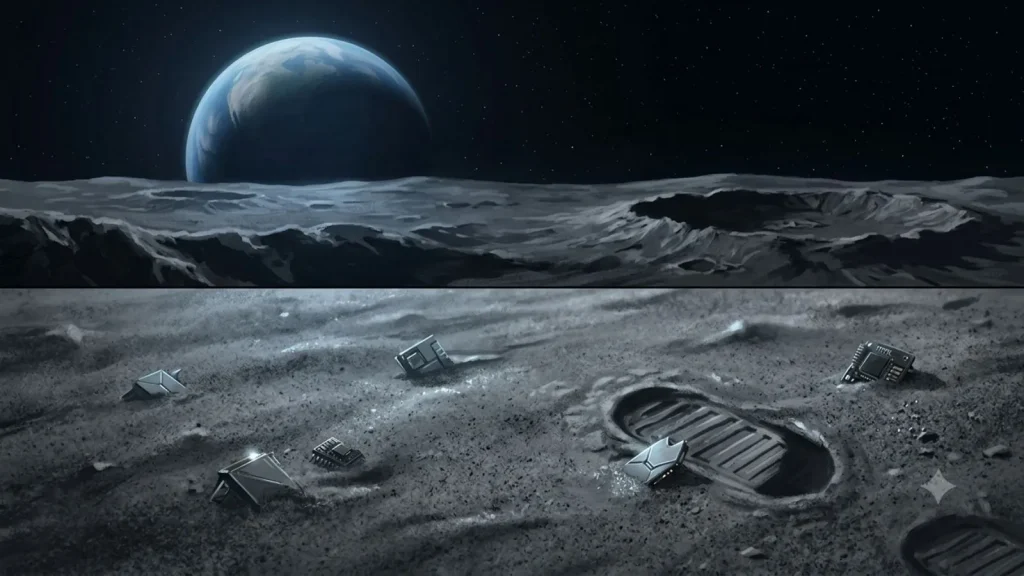
An Oxford astrophysicist has assumed that traces of ancient alien technology may be preserved within the Moon’s dusty surface.
Cosmic Microplastics from Distant Civilizations
An advanced civilization might build orbital stations, energy collectors, or mining facilities in space. Over time, those structures could shed tiny fragments. Radiation, collisions, and ordinary deterioration would gradually release material into their surroundings.
Think of the idea as cosmic microplastics. The comparison describes how technology might leave widespread debris, rather than suggesting that researchers expect actual plastic.
Given enough time, some fragments could escape their original systems. They might then travel through interstellar space, carrying traces of the processes that created them.
Arkhipov Particles and Tiny Probes
The proposal builds on ideas that Ukrainian researcher Oleksii Arkhipov explored decades ago. The authors call the hypothetical technological grains Arkhipov particles.
They also discuss Bracewell particles, drawing on Ronald Bracewell’s ideas about extraterrestrial probes. These represent deliberately dispersed technology, rather than simply accidental debris. Both possibilities remain hypothetical, and neither establishes that extraterrestrial visitors reached the Moon.
Why Search for Alien Technology on the Moon?
Earth constantly reshapes its surface. Water, weather, and geological activity can alter or remove ancient material. The lunar surface offers a different environment for preserving particles over immense timescales.
That makes the Moon a potentially useful collection site. Dust arriving from space could accumulate within its surface material, known as regolith.
The attraction extends beyond location. A surviving technological fragment might outlast the civilization that produced it. Researchers could therefore investigate an ancient technological history through physical remains.
An Archive with Missing Pieces
Nevertheless, lunar soil does not preserve everything perfectly. Repeated impacts mix the ground, bury particles, and change their structures.
Some fragments would disappear. Others might retain only part of their original identity. Any credible search must account for those losses.
Could Tiny Fragments Survive Interstellar Travel?
The study’s central task involves testing the journey itself. Lewis Pinault and his colleagues modeled how microscopic grains might move through interstellar environments and eventually reach the Moon.
Space presents several obstacles. Gas can slow particles, while energetic encounters can erode them. Near our Solar System, sunlight and the solar environment further influence which grains continue inward.
Arrival creates another problem: a fast collision could destroy the features scientists hope to recognize.
The models identify conditions under which some durable grains could travel between stars and survive arrival, at least partially. That finding supports physical possibility within the model’s assumptions. It does not establish that artificial grains exist.
Size, composition, speed, and exposure time all matter. Consequently, the study cannot promise that technological debris commonly reaches lunar soil.
What One Cubic Metre of Lunar Soil Could Reveal
The researchers propose examining approximately one cubic metre of regolith as a useful starting scale. That volume offers a concrete target for planning a search.
The work would require more than spotting something shiny. Scientists would need to screen many grains, identify unusual candidates, and investigate their properties.
Imaging tools could help locate promising particles. Detailed measurements would then explore whether their shapes or compositions deserve closer attention.
From Screening to Laboratory Evidence
AI-assisted image analysis could help researchers prioritize candidates. Microscopy, tomography, and spectroscopy would provide complementary information about their structures and materials.
An automated alert would begin an investigation, not settle it. Researchers would still need laboratory evidence and careful interpretation.
Future samples from programs such as Artemis and Chang’e could offer opportunities to explore this approach. The proposal does not establish a dedicated, approved search mission.
The Hardest Question: Who Made the Particle?
Finding an unusual grain would create a second challenge. Scientists would need to determine whether natural processes could explain it.
A striking shape alone would not prove engineering. Likewise, an unfamiliar chemical composition would require comparison with known natural materials.
Human exploration adds another complication. Spacecraft and equipment have already introduced terrestrial materials to the lunar environment. Sampling and laboratory handling could also introduce contamination.
Why Several Tests Must Agree
Researchers would therefore need several independent clues. Chemical and isotopic measurements could help assess a particle’s origin, while structural analysis could investigate possible manufacturing features.
The sample’s collection history would matter too. Investigators must understand where it came from and how people handled it.
Even convincing evidence of engineering would leave the question of origin open. Independent teams would need to confirm the results before researchers could responsibly claim extraterrestrial technology.
Why Finding Nothing Would Still Matter
An unsuccessful search could still produce useful information. Under stated assumptions, an absence of detections could limit how much durable technological debris certain hypothetical civilizations released.
Those limits would depend on transport, survival, mixing, and detection efficiency. They would test particular scenarios rather than answer every question about intelligent life.
The SETI Institute announced the research on September 8, 2026. At that point, the paper remained a preprint under review by the International Journal of Astrobiology.
Alien Technology on the Moon: A Testable Possibility
The value of this proposal lies in its practical question: what evidence should scientists seek, and how could they verify it?
Searching for alien technology on the Moon would demand patience, careful sampling, and strong evidence. A strange grain would only mark the beginning.
For now, lunar dust holds a possibility rather than a confirmed answer. Learning how to examine that possibility could expand our search for civilizations across cosmic history.
Main sources:
- SETI Institute, official announcement, September 8, 2026: Researchers Propose Searching the Moon for Microscopic Technosignatures
- Original research, revised August 18, 2026: Micron-Scale Technosignatures
- Original coverage supplied: Universe Magazine