BY:SpaceEyeNews.
The New Horizons mission is heading toward a boundary that refuses to stay still. Far beyond Pluto, the spacecraft is measuring changes in the solar wind as interstellar material influences its flow. Ahead lies the termination shock, where that outward stream slows sharply. Yet reaching this frontier is only part of the challenge. Scientists also need sustained support to collect and interpret its measurements. Recent research reveals why those observations matter, while reports of funding difficulties raise questions about their future.
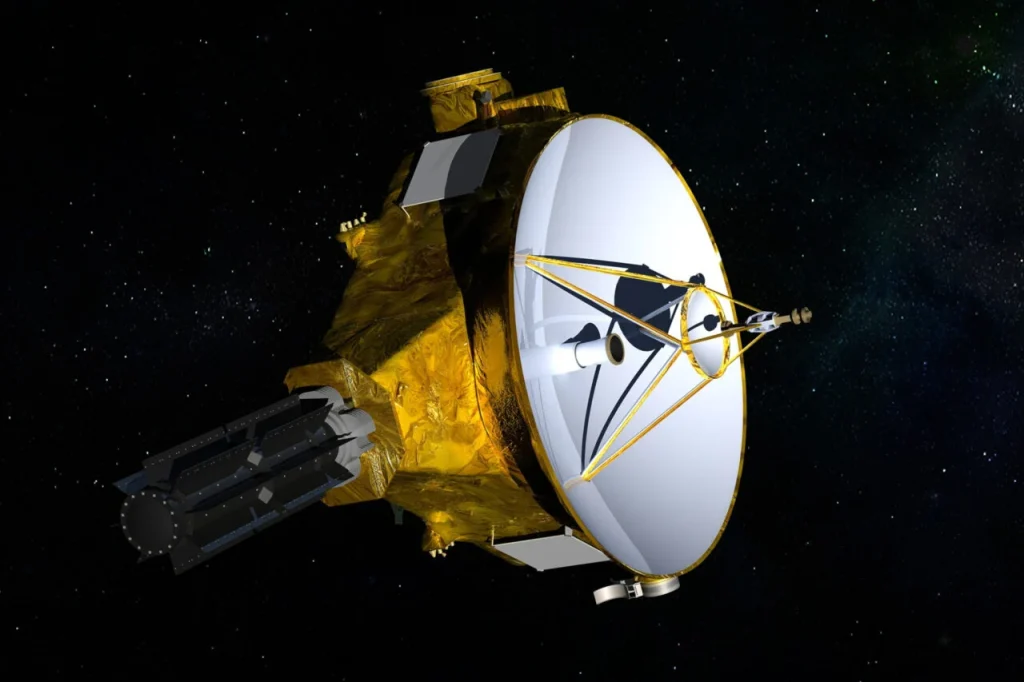
Depiction of NASA’s New Horizons spacecraft. Image: NASA
New Horizons Is Already Measuring the Change
A Measurable Slowdown Beyond Pluto
New Horizons does not need to reach the termination shock to discover something important. Its SWAP instrument has already tracked the solar wind across vast distances.
Researchers analyzed measurements between 21 and 58 astronomical units from the Sun. At the outer end, the wind moved approximately 13–15% slower than near Earth. An astronomical unit equals the average distance between Earth and the Sun.
The result extends earlier evidence that the solar wind gradually loses speed during its outward journey. More importantly, it connects that change to interactions with material arriving from interstellar space.
How Interstellar Particles Change the Flow
Neutral atoms can enter the heliosphere and become electrically charged through interactions with the solar wind. The flowing plasma then picks them up.
These “pickup ions” change the wind’s energy balance and contribute to its slowdown. Consequently, the surrounding interstellar environment influences conditions well inside the heliosphere.
The frontier is therefore more than a distant crossing point. Its effects already appear in the spacecraft’s measurements.
A Moving Boundary Complicates the Arrival Date
The termination shock marks the transition where the solar wind drops below the local sound speed in the plasma. However, its position responds to changing pressure.
As solar activity changes, the outward flow varies. The boundary can shift, meaning New Horizons is approaching a moving destination.
A 2026 study in Advances in Space Research compared three modeling approaches. Its predictions placed a possible encounter between 2029 and 2040, depending on the model and future solar conditions.
That broad range matters. Describing the spacecraft as about to cross suggests more certainty than the research supports.
For scientists, that uncertainty strengthens the case for monitoring the approach. Regular measurements can reveal evolving conditions before the encounter, rather than leaving researchers with only a brief snapshot of the transition.
One Encounter Could Become Several
The same study found that multiple crossings could occur over one or several years. A shifting boundary could sweep past the spacecraft more than once.
Crossing it would bring New Horizons into the heliosheath. Interstellar space begins farther out, beyond the heliopause.
Neither boundary marks the end of the Sun’s gravitational reach. Calling this the absolute edge of the solar system would therefore blur an important distinction.
What the New Horizons Mission Adds to Voyager
Voyager has already demonstrated that spacecraft can explore these distant boundaries. Voyager 1 crossed the termination shock in 2004, followed by Voyager 2 in 2007.
New Horizons therefore offers another opportunity to investigate the frontier, with its own instruments, trajectory, and observing period.
SWAP measures solar-wind particles. Meanwhile, PEPSSI examines higher-energy charged particles, including their composition and density. Together, these instruments help researchers investigate how particle populations change across the outer heliosphere.
Another View of a Changing Environment
Voyager’s measurements captured conditions along two paths at particular times. A later encounter would let scientists compare those findings with another set of local conditions.
Such comparisons can test whether models explain different observations consistently. They can also help reveal how changing solar activity affects the distant boundary.
The value extends beyond recording a crossing date. Measurements along the approach provide context for interpreting whatever happens during the encounter itself.
The Funding Question: What Is Confirmed?
The Daily Galaxy account published on September 8 describes a funding dispute affecting support for SWAP and PEPSSI. It presents a possible interruption of observations, rather than an announced final shutdown.
NASA’s July 7 update establishes an earlier, confirmed picture. New Horizons emerged from a 321-day hibernation in good health. During that period, its particle instruments and dust detector continued gathering and storing measurements.
The agency also described plans to transmit those observations and continue scientific work.
That update does not settle the later funding claim. Nor does it establish that either instrument has stopped operating.
The distinction matters because spacecraft health and scientific support are separate issues. Collecting useful results requires teams to manage observations, process measurements, and interpret the data. The reported concern involves that continuing work on Earth.
Why Continued Observations Matter
Testing Our Picture of the Heliosphere
The New Horizons mission can help researchers compare predicted conditions with measurements from the outer heliosphere. Each observation adds evidence about how solar material interacts with its interstellar surroundings.
Continuous coverage offers particular value around a moving boundary. Data from the approach, crossing, and aftermath can show how conditions evolve.
Gaps could make that sequence harder to reconstruct. They could also limit comparisons between gradual changes and sudden transitions.
Understanding the Cosmic-Ray Environment
The heliosphere influences how galactic cosmic rays enter the solar system. Its structure and changing conditions therefore matter beyond the spacecraft’s immediate location.
Better measurements can improve the physical models scientists use to describe this environment. They also provide useful context for studying conditions that future deep-space missions may encounter.
These benefits build through careful observation and analysis. They do not depend on an immediate breakthrough in interstellar travel.
New Horizons Mission: The Value of Keeping Watch
The New Horizons mission has already shown that the solar wind changes substantially before reaching its outer shock. Its next contribution could reveal how those changes connect to a shifting boundary.
The arrival date remains uncertain, and the reported funding dispute needs a confirmed resolution. What is clear is the scientific opportunity ahead. Sustained observations would allow researchers to follow that transition, compare it with Voyager’s experience, and sharpen our understanding of the Sun’s surrounding environment.
Main sources:
NASA — Spacecraft health and science operations, July 7, 2026:
https://science.nasa.gov/missions/new-horizons/nasas-new-horizons-spacecraft-wakes-from-hibernation-in-good-health/
INAF — Solar-wind slowdown findings, June 30, 2026:
https://www.media.inaf.it/2026/06/30/new-horizons-vento-solare-mezzo-interstellare/
Gasser and colleagues — Predictions of New Horizons’ termination shock crossing:
https://www.sciencedirect.com/science/article/pii/S0273117726005612
NASA — Voyager’s interstellar mission:
https://science.nasa.gov/mission/voyager/interstellar-mission/
NASA — New Horizons particle instruments:
https://science.nasa.gov/science-research/planetary-science/new-horizons-discoveries-keep-coming-news/
Original coverage — attributed funding claim:
https://dailygalaxy.com/2026/09/a-nasa-probe-to-enter-a-mysterious-region/