BY:SpaceEyeNews.
Moon formation may have taken a surprising shortcut. New simulations suggest our natural satellite could have emerged largely intact about five hours after early Earth encountered Theia. The unexpected ingredient is the physical strength of the worlds involved.
By including how rocky material resists deformation, researchers produced very different outcomes from familiar models. Some scenarios created a surrounding debris disk. Others formed a substantial satellite almost immediately. The finding offers another possible route to the Moon’s birth, although it does not prove which route nature followed.
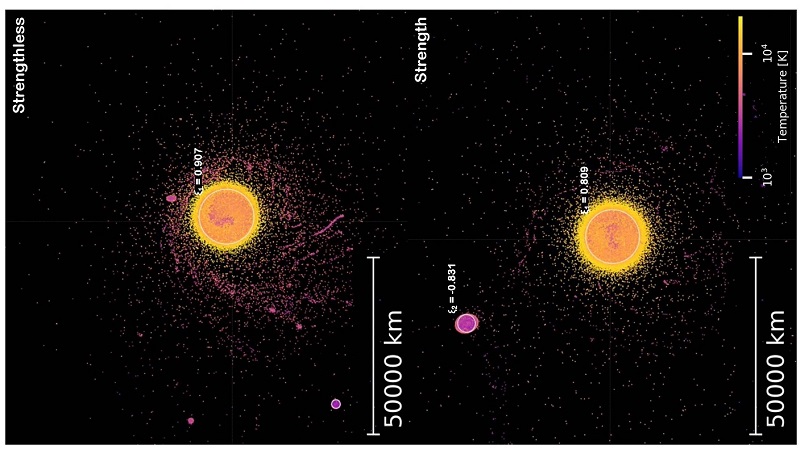
Credit: Southwest Research Institute.
The Overlooked Ingredient in Moon Formation
Researchers at Southwest Research Institute and the University of Arizona revisited an assumption behind many giant-impact simulations. Their study appears in The Astrophysical Journal Letters.
Earlier models often treated Earth and Theia as fluids, leaving out material strength. Scientists expected the enormous energy involved to make that strength relatively unimportant. After all, such an encounter could melt and vaporize large amounts of planetary material.
However, an energetic event does not automatically make every mechanical property irrelevant. The team tested whether allowing material to resist deformation would change the result.
Giving Simulated Rock Physical Strength
Lead researcher Adeene Denton used updated smoothed particle hydrodynamics simulations. This computational approach represents material through interacting particles, allowing researchers to follow its movement.
The version developed at the University of Arizona and the University of Bern incorporates geologic strength. It therefore adds behavior that fluid approximations leave out.
For readers, the central point is straightforward: the condition of the starting worlds influences what emerges afterward.
The study builds on the giant-impact framework rather than replacing it. Earth and Theia still meet in the proposed scenario. What changes is the behavior of their material and the route toward a separate lunar body.
How Temperature Changes Lunar Origins
Temperature became a crucial part of the investigation. Hotter planetary bodies generally have less mechanical strength than colder ones. Consequently, changing their internal temperatures can alter how their material responds during an encounter.
The simulations connect this difference to two broad outcomes. In some cases, Theia disperses into a disk around Earth. That material can later gather into the Moon.
In other cases, a largely intact satellite emerges within hours. The same broad formation scenario can therefore produce very different beginnings.
Why the Starting Conditions Matter
This does not establish a universal rule that colder worlds always produce intact moons. Instead, it shows that temperature and strength deserve attention when researchers compare possible histories.
Both properties help determine how planetary material deforms and redistributes. Ignoring them can change the simulated outcome, even when researchers retain other familiar starting conditions.
The result also changes the questions scientists can ask. Alongside the encounter’s geometry, they must consider the physical state of Earth and Theia before their meeting.
What “Formed in Five Hours” Really Means
The most striking result came from a simulation using parameters matching earlier impact modeling, including the bodies’ internal temperature structures. With material strength included, an intact Moon emerged in approximately five hours.
That timescale refers to the satellite’s initial assembly. It does not mean today’s familiar lunar landscape appeared within an afternoon. A newly assembled body would still undergo cooling and geological change.
Likewise, “intact” describes a coherent satellite, rather than material awaiting assembly within a broad disk. It should not suggest an untouched world.
A New Explanation for Rapid Assembly
Earlier simulations had already produced intact moons. Therefore, this study does not introduce rapid lunar formation for the first time.
Its contribution concerns what controls that outcome. Temperature and material strength can help determine whether a satellite forms directly or develops from a disk.
The five-hour result is compelling because it demonstrates that possibility within a particular model. It remains a proposed pathway, rather than a reconstruction scientists have conclusively verified.
Could Moon Formation Reveal Its Timing?
The findings may eventually help researchers narrow down when the Moon-forming event occurred. The connection begins with how young planetary bodies change over time.
Protoplanets generally begin hot and cool as they age. Their thermal histories can therefore influence their strength when they encounter another world.
If different starting temperatures produce different lunar beginnings, the Moon’s properties might help researchers distinguish among those possibilities.
Looking for Clues in Lunar Material
Robin Canup, who did not participate in the study, highlighted a possible connection involving the Moon’s volatile content. Volatiles are substances that readily enter a gaseous state.
Their abundance could help connect lunar characteristics with the thermal conditions of Earth and Theia.
However, this remains a potential research direction. The simulations do not provide a new precise date for the Moon’s birth. Instead, they suggest another relationship scientists can investigate alongside existing evidence.
The Composition Mystery Still Remains
One major puzzle survives the new modeling: Earth and the Moon have remarkably similar compositions. A successful origin scenario must explain that resemblance alongside the satellite’s formation.
The new simulations do not settle this issue. Producing a coherent moon quickly does not automatically explain why its material resembles Earth so closely.
One possibility places Theia and early Earth in a common region of the developing solar system. They may therefore have started with similar ingredients. However, researchers still need to evaluate that explanation.
This distinction matters when interpreting the discovery. A model can clarify one stage of lunar history while leaving other questions open. Researchers must ultimately connect the assembly process with the chemical evidence, rather than judge success by appearance alone.
Moon Formation: A Clearer Question
Moon formation may depend on details that earlier simulations often set aside. The strength and temperature of Earth and Theia could influence whether a satellite emerged quickly or assembled from debris. Five hours remains a possible timescale under specific conditions. The broader advance is a clearer understanding of which conditions deserve testing. To uncover the Moon’s beginnings, scientists must also investigate the worlds that existed before it.
Main sources:
- Southwest Research Institute: SwRI-led modeling identifies new scenarios for Moon formation
- University of Arizona: Soft and stretchy or rock solid? New modeling study sheds light on how the Earth got its moon
- The Astrophysical Journal Letters: Research paper — DOI: 10.3847/2041-8213/ae91e9