BY:SpaceEyeNews.
The Sun swallowed a planet billions of years ago: that possibility could explain some puzzling features inside our star. New research explores whether an ancient super-Earth left chemical traces that still influence the Sun today.
The idea connects a potentially missing world with problems that standard solar models struggle to explain. These include the Sun’s internal structure and its unusually low surface lithium abundance.
However, the findings come from computer simulations. They offer a possible explanation, not confirmation that a lost planet once existed.
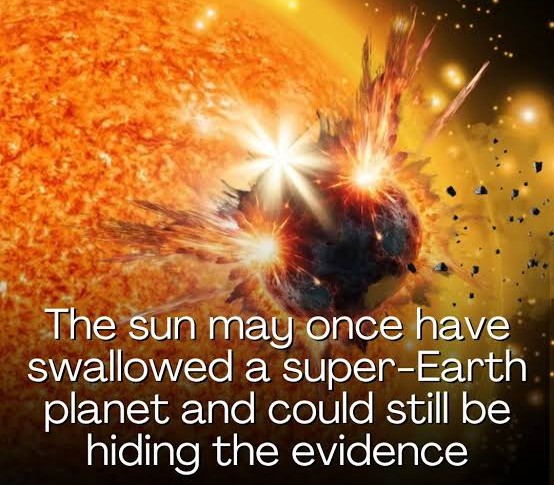
Why Scientists Think the Sun Swallowed a Planet
Astronomer Mutlu Yıldız of Ege University in Turkey investigated whether planetary material could improve models of the Sun’s evolution. The study appeared in Monthly Notices of the Royal Astronomical Society on September 10, 2026.
Its starting point is a familiar scientific challenge. Measurements of the Sun do not perfectly match predictions about its interior.
Scientists can therefore test different histories and ask which ones better reproduce the star we observe. In this case, Yıldız explored a history that includes an early episode of planetary engulfment.
Three Clues Worth Explaining
The first clue concerns sound waves traveling through the Sun. Their behavior reveals small differences between the actual solar interior and model predictions.
Another involves the convection zone, the outer region where rising and sinking material carries energy. Models struggle to reproduce its measured depth precisely.
Meanwhile, surface lithium adds a separate puzzle. Together, these observations provide several checks that a proposed explanation must address.
A Super-Earth Emerges From the Models
Yıldız used MESA, a stellar evolution software package, to examine different scenarios. The preferred model points to a planet with approximately 5.6 times Earth’s mass. Related solutions favor roughly five to ten Earth masses.
These numbers describe mass, rather than diameter. They also represent model estimates, rather than measurements of an observed world.
The calculations combine incoming planetary material, later gas accretion, and internal mixing. Consequently, the result depends on a broader evolutionary history, not simply adding a planet to an otherwise unchanged Sun.
What the Best Match Means
A closer match makes the scenario interesting because it links several solar puzzles through one possible event.
Nevertheless, matching observations does not establish a unique history. Different physical assumptions can sometimes produce similar outcomes.
That distinction matters when interpreting the headline. Scientists have proposed a plausible candidate explanation. They have not identified the remains of a specific planet through a direct observation.
Where a Lost Planet Could Leave Its Signature
The proposed evidence lies in the Sun’s chemistry and structure.
In the model, planetary material enriches a region beneath the convection zone with heavy elements. That concentration changes how readily energy passes through the surrounding material.
Those changes can influence the internal structure that scientists infer from solar vibrations. A planet’s contribution might therefore remain relevant long after the original world has disappeared.
Chemical Traces, Not an Intact World
The study also examines whether a compact rocky planet could pass through the Sun’s outer layers while losing little mass.
However, surviving that passage would not mean surviving indefinitely. The lasting signature concerns material that eventually becomes part of the star.
Think of the proposed evidence as a change in composition. There would be no recognizable planetary surface for a telescope to photograph.
Why the Lithium Explanation Needs Care
Lithium makes this story particularly intriguing because its abundance provides another way to assess the proposed solar history.
The Sun’s low surface lithium levels form part of the mystery described in the research. A useful model must account for that chemical detail alongside the structural measurements.
Yet planetary engulfment does not automatically explain the shortage.
The study reproduces lithium depletion under particular conditions, including lithium-poor incoming material and suitable limits on internal mixing.
This qualification deserves space beside the result. Without it, readers could assume that swallowing any super-Earth would produce today’s Sun.
Other explanations remain possible, so lithium serves as a constraint on the hypothesis rather than proof by itself.
Could This Explain Our Missing Super-Earths?
The possibility also connects with a larger question about our planetary neighborhood. Our solar system has no super-Earth, despite the presence of such worlds around other stars.
Earlier research suggested that one or more planets could have formed inside Mercury’s orbit. They might then have moved inward and entered the Sun.
The new study explores whether our star could retain evidence of such a history.
Still, an absent planet leaves an incomplete story. The simulations do not establish its original orbit or demonstrate exactly how it traveled inward.
The connection is compelling, but it remains a possible explanation for our solar system’s architecture.
How Scientists Could Test the Idea
Further investigation would need to identify the predicted chemical and structural signature independently.
Helioseismology offers one route. By studying solar vibrations, scientists can examine internal conditions that ordinary images cannot reveal.
A distinctive match would strengthen the case for ancient engulfment. Researchers would also need to evaluate whether competing models could explain the same pattern.
Independent analysis would also help establish how sensitive the result is to the assumptions behind the calculations. Agreement across separate approaches would carry more weight than one successful simulation.
For readers, this keeps the discovery in perspective: the research offers a way to investigate the past, while leaving room for the explanation to change.
The key question is therefore more demanding than whether the scenario works. It is whether the observations favor that scenario over other credible histories.
The Sun’s Past Remains Open
Whether the Sun swallowed a planet remains an unanswered question. The study gives scientists a specific possibility to investigate, linking a lost super-Earth with persistent solar puzzles.
For now, the most interesting prospect is that our star could preserve clues to worlds that no longer exist. Reading those clues accurately will require further observations and careful comparisons.
Main sources:
Royal Astronomical Society — Official research announcement
Monthly Notices of the Royal Astronomical Society — Original scientific study
WTHR — Original news story