BY:SpaceEyeNews.
A Deimos asteroid impact may explain why Mars’s smaller moon looks so smooth beneath its dusty covering. Researchers propose that one ancient collision created its southern depression and scattered debris across the surface. Their simulations suggest that the moon’s porous interior helped it remain intact. Together with observations from ESA’s Hera spacecraft, the findings connect two longstanding geological puzzles through one possible event.
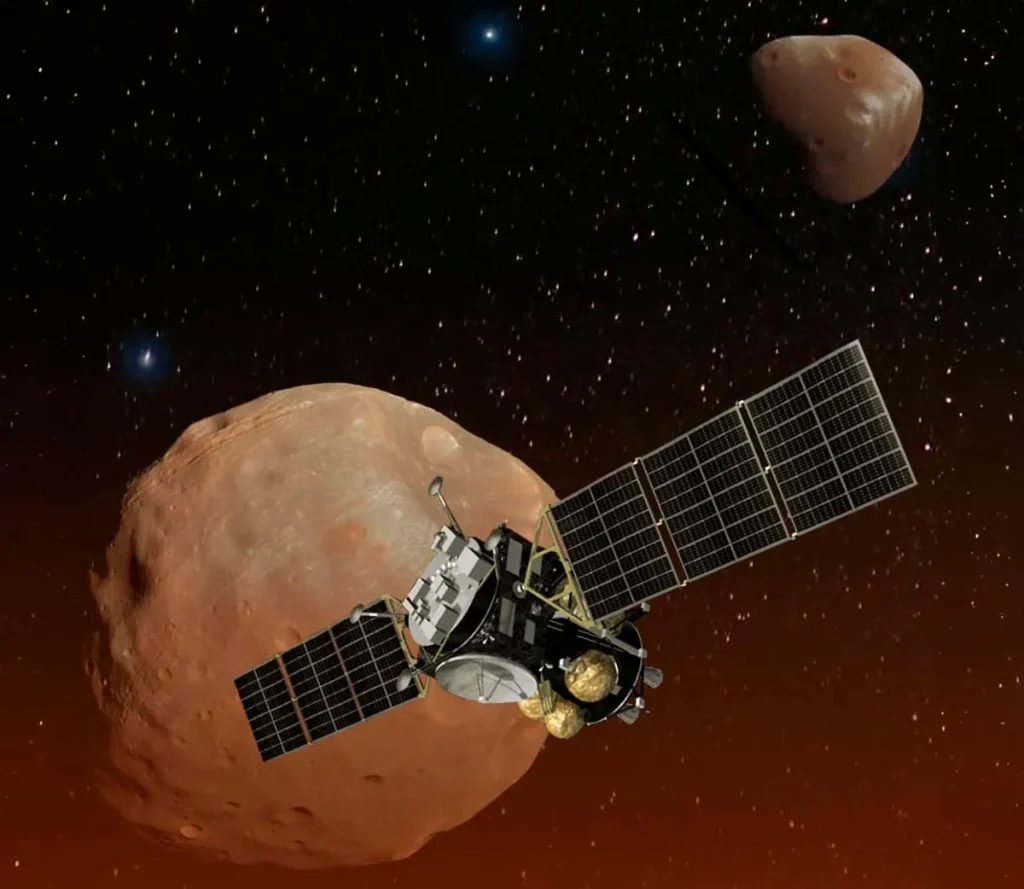
Artist’s concept of Japan’s Mars Moons eXploration (MMX) spacecraft, carrying a NASA instrument to study the Martian moons Phobos and Deimos. Credit: JAXA/NASA
Two surface features with a possible shared origin
Deimos presents an unusual combination: a broad southern depression and a surface that conceals many older features. Compared with the more visibly cratered Phobos, its landscape looks softer and smoother.
A blanket of regolith, meaning loose dust and rocky fragments, covers much of the moon. However, identifying that covering does not explain where all the material came from.
The southern depression offers a potential answer. An impact could have excavated the basin while supplying debris for the surrounding terrain. Instead of treating those features separately, the research investigates whether one event could account for both.
A smooth appearance therefore does not necessarily mean that a surface lacks an older geological record. Some features may still exist beneath the covering. Understanding how material moved and accumulated is essential for interpreting the terrain that spacecraft can see today, including its partly concealed craters.
That connection matters because a successful explanation must reproduce more than a crater. It must also fit the landscape around it.
Reconstructing the Deimos asteroid impact
An international team led by Sabina Raducan investigated the scenario using the University researchers published their findings in Nature Astronomy on August 18, 2026.
Rebuilding the earlier landscape
The Bern Smoothed Particle Hydrodynamics code represents objects through millions of interacting particles. It allows scientists to explore how gravity, material strength, and internal structure influence a collision.
Researchers reconstructed a possible earlier shape for Deimos by filling its southern depression digitally. They then simulated impacts to see which conditions could recreate the observed landscape.
The team completed about 100 simulations. Each required roughly a week of computing, reflecting the complexity of tracking moving material throughout the event.
The scenario that best matched observations
Their preferred model involved an asteroid approximately 320 meters across, approaching at an angle of about 45 degrees. It reproduced the broad southern depression while leaving Deimos largely intact.
The study assumed an impact speed of 8.2 kilometers per second. That figure describes the model’s input, rather than a historical measurement.
Likesent a fitting scenario. Scientists did not observe the ancient event itself.
How returning debris could smooth a moon
The proposed impact would have lifted material from the southern region and dispersed it across Deimos. Much of that debris would then have returned to the surface.
This fallback provides a possible source for the moon’s extensive regolith blanket. As fragments accumulated, they could fill older hollows and reduce the prominence of existing terrain.
An uneven covering of dust and rock
The simulations suggest that debris did not settle into a layer of uniform thickness. Some locations received much deeper deposits than others.
Locally, the covering could reach around 200 meters or more. That estimate concerns particular areas, rather than the depth across the entire moon.
Such uneven accumulation helps explain how the same event could leave both a major depression and smoother surrounding plains. The basin records excavation, while the covering records where displaced material eventually settled.
Importantly, these depths remain model estimates, not direct measurements beneath the surface.
Why Deimos survived—and what Hera revealed
An event capable of changing so much terrain raises another question: how could Deimos retain evidence of older craters?
The answer may lie within its interior. The simulations favor a weak, highly porous structure that can absorb energy through compression.
A fragile interior that absorbs energy
A porous body contains empty spaces between or within its constituent materials. During an impact, compression can close some of those spaces and dissipate energy.
That process could limit how strongly disturbances travel through Deimos. Consequently, older features might remain recognizable even after debris partly covers them.
The result suggests physical similarities with rubble-pile asteroids, which consist of loosely assembled fragments. It does not establish that Deimos originally formed as an asteroid.
Hera provided another piece of evidence
During its March 2025 Mars flyby, Hera obtained additional views of Deimos. Those observations helped researchers identify previously unrecognized buried craters.
Their survival offered adels had to account for the older terrain as well as the southern depression.
However, spacecraft images reveal surface features. Scientists infer the interior’s properties by testing which structures best explain those observations.
What remains uncertain—and how MMX could help
The Deimos asteroid impact scenario offers a coherent explanation, but alternatives remain possible. Other processes may also have contributed to the moon’s present appearance.
Nor does the research settle its origin. Deimos could possess asteroid-like mechanical properties even if it developed from material ejected from Mars.
Future observations can test the proposed history more closely. Sharper images could reveal whether the southern depression has the expected impact features. Better crater measurements could also refine estimates of the debris covering.
JAXA’s Martian Moons eXploration mission, or MMX, plans to investigate both Martian moons. Its published schedule targets launch in Japanese fiscal year 2026.
MMX will collect samples from Phobos and study Deistinct objectives matter: the mission does not plan to return Deimos samples.
Deimos asteroid impact: a history still taking shape
The proposed Deimos asteroid impact connects a large depression, widespread debris, and clues about a porous interior. Its strength comes from explaining several observations within one physical scenario.
Yet a convincing simulation remains a hypothesis that needs further testing. Future views of Deimos could reveal whether its smooth exterior preserves the record of one transformative event.
Main sources:
- Nature Astronomy — Original study: https://www.nature.com/articles/s41550-026-02956-w
- European Space Agency — Hera observations and impact study: https://www.esa.int/Space_Safety/Hera/Hera_s_Mars_flyby_guided_impact_study_of_Deimos_moon
- JAXA — MMX mission overview: https://www.mmx.jaxa.jp/en/mission/