BY:SpaceEyeNews.
Planet Nine could explain some of the strangest orbital patterns beyond Neptune. Yet astronomers still lack the observation that would transform this intriguing hypothesis into a discovery: a direct detection of the planet itself.
The search now involves more than finding an unfamiliar dot in the sky. Researchers are testing whether one unseen world can explain several distinct features of the distant solar system. Their results offer promising clues, but important uncertainties remain. Better observations could strengthen the case, reshape it, or point toward another explanation.
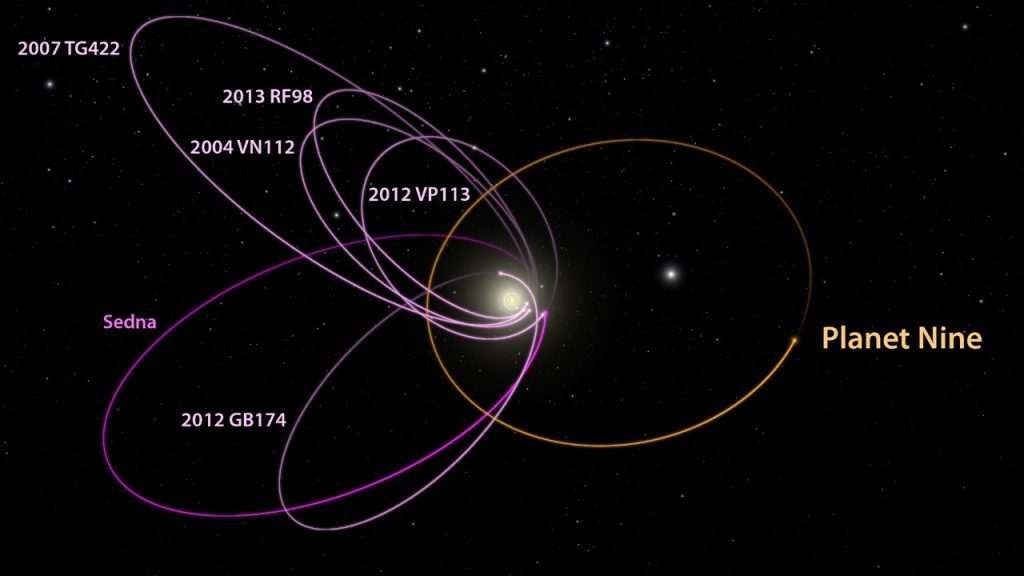
The six most distant known objects in the solar system with orbits exclusively beyond Neptune (magenta) all mysteriously line up in a single direction. Moreover, when viewed in 3-D, the orbits of all these icy little objects are tilted in the same direction, away from the plane of the solar system.
Planet Nine’s Gravitational Clues
Caltech astronomers Konstantin Batygin and Michael Brown proposed the modern Planet Nine hypothesis in 2016. They argued that an undiscovered planet could explain unusual orbital patterns among several distant objects.
These clues concern the orientation and shape of orbits. They do not mean the objects sit together in a tight group. Instead, some elongated paths appear to share preferred directions in space.
More Than Orbital Alignment
The proposed planet could also help explain objects that remain far from the Sun throughout their journeys. Other bodies follow steeply tilted paths. Some even travel around the Sun in the opposite direction from the planets.
For supporters, the appeal lies in connecting these different patterns through a common gravitational influence. A convincing explanation should account for several observations together.
However, today’s hypothesis differs from Percival Lowell’s historical Planet X proposal. That earlier search concerned apparent irregularities in the giant planets’ motions. Modern researchers focus on smaller bodies much farther out. Pluto’s classification does not determine whether this separate, hypothetical world exists.
What the 2024 Planet Nine Study Added
In 2024, Batygin and colleagues investigated another population: distant objects with long orbital periods and relatively small orbital tilts. Their paths cross Neptune’s orbit.
Such objects offer a useful test because their orbits are dynamically unstable. Over time, gravitational interactions alter this population. Something must continually supply new members if it persists.
Comparing Two Simulated Solar Systems
The team ran computer simulations with and without Planet Nine. These calculations included the giant planets, passing stars, and the Milky Way’s gravitational influence. They also incorporated assumptions about the solar system’s early development.
After accounting for observational biases, the researchers found that the model containing the proposed planet closely matched the observed population. Their comparison model without it performed substantially worse.
This result added a line of evidence beyond the original orbital clustering argument. It also produced predictions that further observations can test.
Nevertheless, a successful simulation does not establish that an unseen planet exists. The result depends on the observations, assumptions, and scenarios under comparison. It supports the hypothesis within that analysis; it does not eliminate every conceivable alternative. Keeping that distinction clear preserves the significance of the finding without overstating its reach.
Why the Evidence Still Leaves Room for Doubt
Distant objects provide an incomplete view of the outer solar system. Telescopes survey particular regions, and their sensitivity limits which bodies they can detect.
Consequently, the objects astronomers find may not fairly represent the entire population. Researchers must understand these selection effects before deciding whether apparent patterns reflect something physical.
A Larger Sample Can Complicate the Picture
Batygin cautions that the theory does not predict identical clustering for every distant object. Finding an object with a different orbit therefore does not automatically settle the question.
Equally, another unusual discovery does not necessarily strengthen the hypothesis. Its significance depends on whether its behavior matches a specific prediction.
The crucial issue concerns the overall pattern after researchers account for how observations select objects. That requires careful comparisons, rather than simply counting examples that appear supportive.
NASA describes Planet Nine as hypothetical and acknowledges scientific debate over its existence. Claims that discovery is certain or imminent go beyond the available evidence.
How Rubin Observatory Could Test Planet Nine
The Vera C. Rubin Observatory in Chile offers a way to examine the mystery through a much larger observational sample. Its surveys can help researchers discover additional distant solar system objects and measure their movements.
Finding the Planet—or Testing Its Influence
One possibility is a direct detection of the proposed world. However, that outcome depends on whether it exists and falls within the survey’s practical reach.
Another valuable outcome involves smaller bodies. Their orbits could reveal whether the suggested patterns persist as the sample expands.
Survey consistency matters here. Astronomers need to understand which objects their observations could detect and which they would miss. Otherwise, more discoveries could still leave misleading patterns.
Rubin therefore offers a test of the hypothesis, rather than a guaranteed discovery. Its observations could support particular predictions or narrow the range of explanations that remain plausible.
What Would Make the Hidden-Planet Case Stronger?
The strongest indirect case would connect multiple observations to the same proposed planet. Orbital directions, tilts, closest approaches to the Sun, and Neptune-crossing populations would need to tell a consistent story.
Batygin identifies that convergence as especially valuable. A much larger, well-characterized sample could show whether the different patterns point toward compatible planetary properties.
Researchers would then have stronger grounds for treating those clues as signs of a shared cause. Conversely, persistent mismatches would challenge the model or require changes.
Direct detection would provide a different level of evidence. Astronomers would need observations sufficient to establish the candidate’s motion and orbit. Until then, the planet’s proposed properties remain inferences from models, rather than measurements of a confirmed world.
Planet Nine Remains an Open Question
Planet Nine remains compelling because it connects unusual observations with predictions that astronomers can test. Yet those predictions still need stronger observational support, and nobody has confirmed the planet itself.
The next advances may come from discovering a world or understanding the smaller bodies around it. Either outcome would improve our picture of the outer solar system. The answer depends on what the evidence reveals next.
Main sources:
Space.com — Is there a hidden “Planet 9” in our solar system?
https://www.space.com/astronomy/solar-system/is-there-a-hidden-planet-9-in-our-solar-system
NASA Science — Hypothetical Planet X
https://science.nasa.gov/solar-system/planet-x/
Caltech — Caltech Researchers Find Evidence of a Real Ninth Planet
https://www.caltech.edu/about/news/caltech-researchers-find-evidence-real-ninth-planet-49523
CaltechAUTHORS — Generation of Low-inclination, Neptune-crossing Trans-Neptunian Objects by Planet Nine (2024 research paper)
https://authors.library.caltech.edu/records/fa1bh-b6493