BY:SpaceEyeNews.
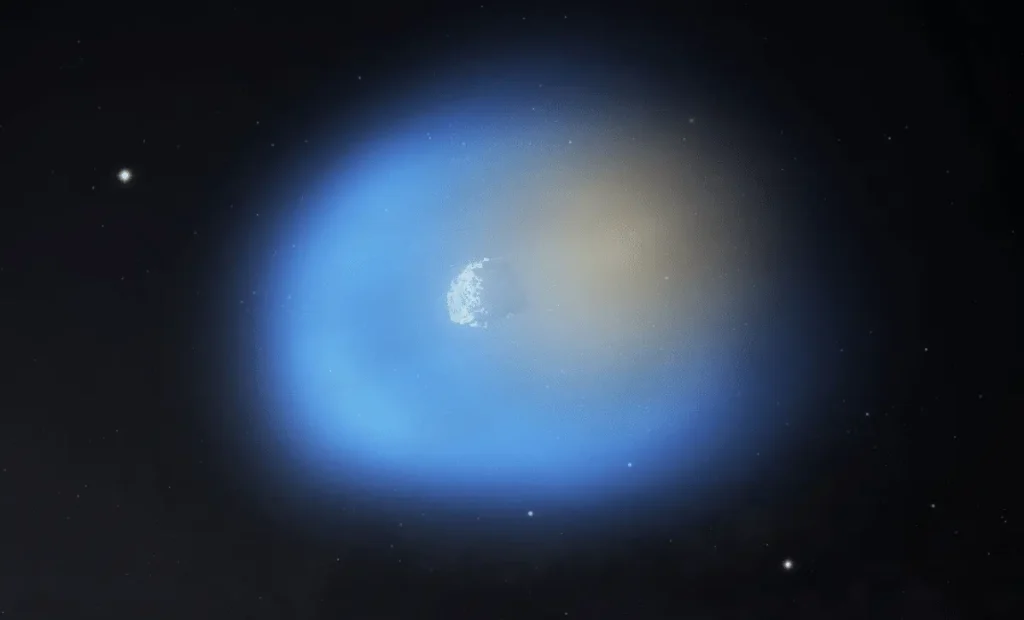
3I/ATLAS origins are becoming clearer through an unexpected clue: nitrogen in the interstellar comet’s tail. Researchers found a chemical signature that points toward an exceptionally cold birthplace, likely below −240°C. That suggests the comet formed far from its original star, where little warmth reached its icy surroundings.
The discovery goes beyond identifying another ingredient in a visiting comet. It connects material escaping today with conditions that existed when the object formed. However, the evidence describes a likely environment. It does not reveal the star system that once held this unusual visitor.
A new discovery in the comet’s tail
Dr Lea Ferellec of Northumbria University led the team studying the comet’s ionized gases. Using the William Herschel Telescope, researchers identified five different ions simultaneously. Their observations took place on November 30 and December 2, 2025, after the comet passed closest to the Sun.
Those ions included charged forms of molecular nitrogen, carbon monoxide, carbon dioxide, and water, alongside CH+. Together, they provided a detailed chemical view of material streaming away from the comet.
Looking beyond the coma
Earlier investigations largely examined the coma, the gas surrounding the icy nucleus. This research instead isolated signals from the ion tail. That distinction matters because different observing approaches reveal different parts of the comet’s chemistry.
The published study therefore adds a complementary view. It follows charged material beyond the comet’s immediate surroundings, opening another route into its composition.
How WEAVE revealed the chemical signatures
The team used WEAVE, an instrument on the 4.2-metre William Herschel Telescope in Spain’s Canary Islands. Its imaging spectroscopy combines spatial information with measurements of light across different wavelengths.
In practical terms, researchers could examine where particular chemical signals appeared. This helped them separate the tail’s faint emissions from surrounding gas and dust.
Why the instrument mattered
Detecting ions in an interstellar comet presents a particular challenge. During 2I/Borisov’s visit, astronomers found hints of ionic emissions but could not securely identify the species responsible.
WEAVE offered the sensitivity needed for a more detailed investigation. Its observations allowed the team to compare multiple chemical signatures within the same tail.
The advance concerns both the comet and the observing method. A clearer view of charged gases gives astronomers information that observations of neutral gas alone cannot supply.
3I/ATLAS origins: Why nitrogen matters
The crucial clue comes from nitrogen relative to carbon monoxide. The researchers found that 3I/ATLAS contains unusually abundant molecular nitrogen compared with most observed solar system comets.
Here, “nitrogen-rich” describes a chemical comparison. It does not mean nitrogen makes up most of the comet, or that researchers have measured every ingredient inside its nucleus.
A chemical guide to formation conditions
Different formation environments leave different chemical mixtures in cometary ice. Comparing nitrogen with carbon monoxide helps researchers investigate how cold those environments might have been.
For 3I/ATLAS, the ratio points toward an exceptionally cold setting. The Royal Astronomical Society’s announcement describes a likely formation temperature below −240°C.
That figure concerns the comet’s birthplace. It does not describe the temperature of its tail during the observations.
Evidence, rather than a direct thermometer
Astronomers did not observe the comet forming. Instead, they interpreted its present chemistry using comparisons and scientific models.
The distinction keeps the finding in perspective. The measured signals support a cold formation scenario, while the temperature estimate depends on how scientists connect those signals with ancient ice.
Did its star’s light really fail to reach it?
The suggestion that 3I/ATLAS formed beyond its star’s light creates a striking image. Scientifically, however, a distant region receiving little stellar warmth offers a more careful description.
The proposed birthplace lies in the cold outer reaches of its original planetary system. Such an environment fits the interpretation of the comet’s nitrogen-rich chemistry.
Weak starlight does not mean complete darkness
Distance reduces the energy an object receives from a star. It does not create a simple boundary where all starlight suddenly disappears.
Consequently, the finding does not establish that 3I/ATLAS formed in total darkness. Nor does it identify a precise distance from its home star.
The chemistry provides an environmental clue, rather than an address. Researchers still cannot name the original star from this result.
Another limitation concerns the tail itself. Researchers observe gas after it leaves the ice and undergoes chemical changes. They must therefore account for those changes when interpreting the signals. The study cautions that several other ion ratios cannot directly reveal the original mixture of neutral gases. This makes careful interpretation essential, even when an instrument clearly identifies the molecules that produce the light.
What this reveals about other planetary systems
An interstellar comet brings material from another stellar environment within reach of our telescopes. That makes its composition especially valuable for comparisons with objects that formed around the Sun.
3I/ATLAS origins research therefore connects a single visiting object with a much broader question. How similar are the conditions that produce comets around different stars?
Comparing environments without assuming sameness
A difference in nitrogen abundance gives researchers something specific to investigate. It helps move the discussion beyond whether an interstellar visitor simply resembles familiar comets.
However, one object cannot represent every comet in its original system. Its composition, however revealing in this case, also cannot describe the full diversity of planetary systems across the galaxy.
Each additional observation contributes another comparison point. The value grows as researchers examine more objects with instruments capable of separating faint chemical signals.
3I/ATLAS origins leave a clearer, incomplete picture
The strongest result is the chemical evidence: an unusually nitrogen-rich interstellar comet whose composition supports very cold formation conditions. Its distant birthplace remains an interpretation, and its original star remains unidentified.
Together, these findings show why the tail deserves close attention. Material leaving the comet now can help scientists investigate the environment where its ice first accumulated. For 3I/ATLAS, that evidence points toward the freezing outskirts of another planetary system.
Main sources:
- Royal Astronomical Society: Secrets of interstellar comet 3I/Atlas revealed.
- Monthly Notices of the Royal Astronomical Society: Ion abundances in the plasma tail of 3I/ATLAS show that it is N₂-rich.
- Space.com: Interstellar comet 3I/ATLAS likely formed where its star’s light couldn’t touch it.