BY:SpaceEyeNews.
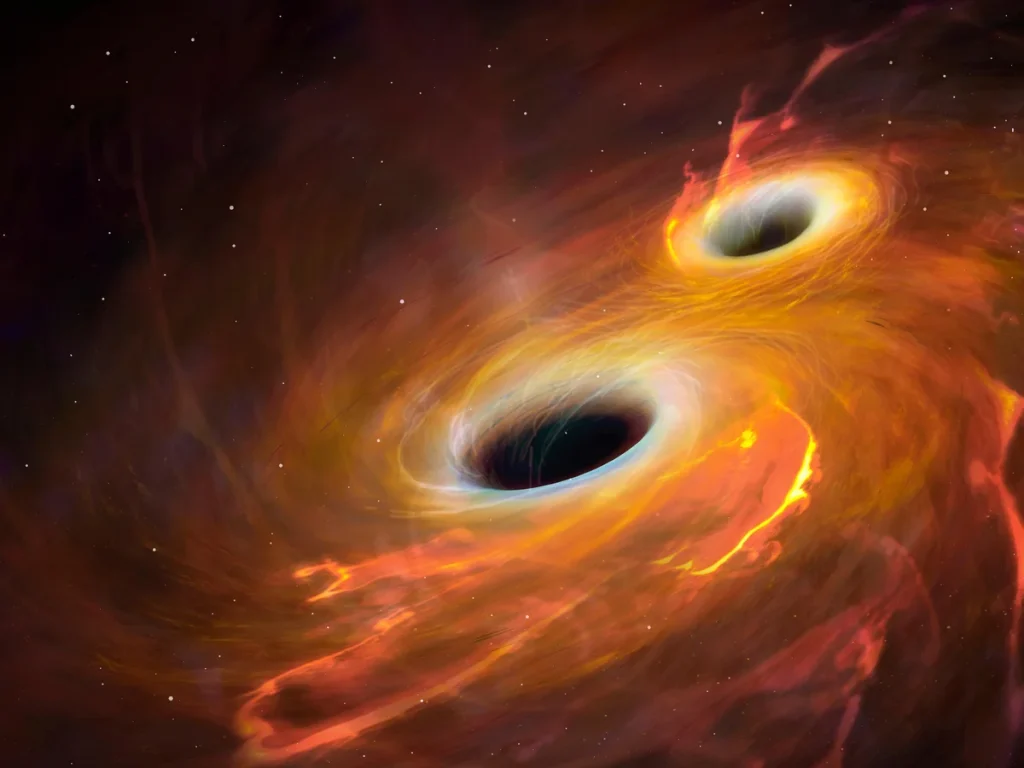
Black hole lookalikes have fewer places to hide in the signal from one remarkable cosmic merger. Researchers examined GW241011 to test the identity of its larger object. Its rotation left a measurable imprint in gravitational waves, allowing scientists to compare competing explanations.
The findings exclude certain hypothetical objects that could otherwise resemble black holes. However, some highly compact alternatives remain possible. Published in Physical Review Letters, the study offers a sharper test of an object’s nature without claiming a final answer.
Why GW241011 Stands Out
An Unequal Pair with Rapid Rotation
LIGO Hanford and Virgo detected GW241011 on October 11, 2024. Estimates place the two objects at approximately 19.6 and 5.9 times the Sun’s mass. That makes the larger component more than three times as massive as its companion.
The larger object also rotated rapidly. Researchers measured its dimensionless spin at roughly 0.78, where one represents the theoretical limit for a Kerr black hole.
This number does not mean its surface moved at 78 percent of light speed. Instead, it expresses angular momentum relative to mass using the standard black hole spin scale.
A Particularly Informative Signal
The detector network recorded a signal-to-noise ratio of about 36. Combined with unequal masses and rapid rotation, this strong signal supported an unusually precise measurement.
Each property mattered. Rotation strengthened the imprint researchers wanted to investigate, while the unequal masses helped reveal the larger object’s contribution. Together, these features made GW241011 an especially useful test case. The original collaboration research documents these event properties.
Black Hole Lookalikes and Rotation
What the Quadrupole Moment Reveals
The key measurement has a technical name: the spin-induced quadrupole moment. It describes how rotation affects an object’s mass distribution and gravitational field.
For a rotating, uncharged black hole, general relativity makes a specific prediction. Its mass and spin determine this feature of its gravitational field.
An exotic compact object can behave differently because its internal structure influences its response to rotation. Consequently, two objects with similar masses and spins might leave distinguishable gravitational signatures.
As the pair spirals inward, this difference changes the timing of the gravitational-wave oscillations. Researchers can search for that imprint within the recorded signal.
Testing Instead of Assuming
The team allowed the quadrupole measurement to depart from the value expected for a Kerr black hole. This approach let them investigate alternatives rather than fixing the answer beforehand.
They then compared the observational constraints with theoretical predictions for exotic objects. The analysis connected a measurable signal feature with models of what the larger object could actually be.
This distinction also explains why signal quality matters so much. Researchers must separate a subtle structural imprint from other effects within the waveform. A clearer signal helps them constrain the permitted departure from the black hole prediction.
Which Exotic Alternatives Failed the Test?
One important result concerns boson stars. These hypothetical objects consist of bosonic fields and could, under certain conditions, resemble black holes gravitationally.
However, boson stars do not form a single uniform category. Different particle interactions produce different structures and predictions.
The study excluded rotating boson stars with quartic self-interactions as explanations for GW241011’s larger component. Here, “quartic” identifies a particular mathematical form of interaction in those models.
Their predicted quadrupole moments did not match the observational constraints. This mismatch gave researchers grounds to reject that explanation for this object.
The result does not eliminate every boson-star model. Nor does it demonstrate that boson stars cannot exist elsewhere. The exclusion applies to the tested models and this particular member of the binary. The published study specifies that scope.
Why Some Black Hole Lookalikes Remain Possible
Compactness Keeps Certain Models Viable
Some exotic models still fit the measurements when their compactness reaches approximately 0.24 or higher. This threshold comes from the models the researchers examined, rather than a universal rule for every hypothetical object.
Compactness measures how much mass fits within a given radius, with gravitational constants setting the scale. It differs from ordinary density, which measures mass per unit volume.
That distinction matters when comparing objects of different masses. Calling the remaining possibilities simply “denser than anything observed” would oversimplify the finding.
The Remaining Uncertainty
A Kerr black hole remains consistent with the data. Nevertheless, matching its expected rotational imprint does not independently prove that an event horizon exists.
Some sufficiently compact alternatives can produce similar measurements. The study therefore reduces the range of possibilities while acknowledging what the signal cannot resolve.
What Comes Next
Building Evidence Across Many Events
One binary provides a detailed case study, but it cannot reveal how common exotic objects might be. Scientists need observations across many systems to investigate that broader question.
Additional events would offer different masses, spins, and signal strengths. Comparing them could show which theoretical alternatives repeatedly agree with the data and which struggle.
The present result also gives theorists a concrete observational requirement. Proposing an object that resembles a black hole is only the starting point. Its predicted rotational properties must also agree with the measured signal, within the uncertainties of the analysis.
Adding Complementary Measurements
Future analyses can also examine tidal deformability: how an object’s companion changes its shape through gravity. This probes a different response from rotational deformation.
Combining such measurements could strengthen tests of internal structure. More sensitive detectors should also improve access to informative signals, although individual events will vary in usefulness.
A Sharper Test of Black Hole Lookalikes
GW241011 shows how one well-measured signal can narrow the identity of an apparently familiar cosmic object. Researchers excluded specific exotic explanations while preserving uncertainty about others.
Black hole lookalikes remain a scientific possibility, but their proposed properties must fit increasingly demanding observations. As the sample grows, these tests can help distinguish convincing theoretical alternatives from models that fail to match the universe.
Main sources:
- Physical Review Letters: Implications of GW241011 for Rotating Exotic Compact Objects.
- LIGO–Virgo–KAGRA collaboration: GW241011 and GW241110: Exploring Binary Formation and Fundamental Physics.
- Perimeter Institute: Perimeter researchers test the nature of merging black holes.