BY:SpaceEyeNews.
Black hole jets can appear long after a star supplies fresh material to a black hole. Some radio signals emerge quickly. Others arrive months or years later. New research links that puzzling delay to a shared turning point in the feeding process.
The finding connects stellar-mass black holes with supermassive giants at galaxy centers. Despite their enormous differences, both appear to launch jets near a similar relative feeding threshold. That connection could help astronomers understand delayed activity and choose better times to observe it.
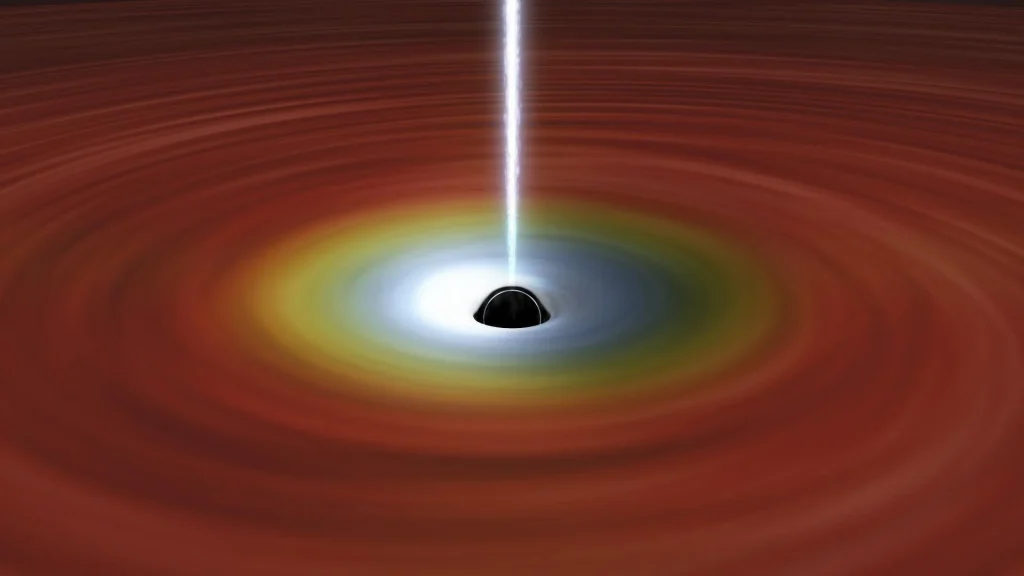
Illustration showing how a jet forms near a black hole. Credit: T. Kawaguchi (University of Toyama) & K. Yamaoka (Nagoya University)
A two-percent threshold for black hole jets
Researchers Adelle Goodwin and Andrew Mummery investigated how feeding activity relates to the launch of radio-emitting outflows. Their results point to a critical transition around 2% of the Eddington benchmark.
This benchmark describes the luminosity at which outward radiation pressure balances inward gravity under simplified conditions. It provides a common reference for comparing systems with very different masses.
Here, the percentage describes feeding activity relative to that reference. It does not mean a black hole consumes 2% of a star or ejects 2% of its mass.
The same proportion across different scales
Astronomers already associate a similar transition with jet activity in smaller black holes in our galaxy. Finding that pattern in supermassive systems strengthens the case for shared accretion physics.
However, the threshold remains approximate. Observations and modeling carry uncertainties, so the result does not establish an exact switch for every system. The authors’ research manuscript supports a common transition near this level.
Disrupted stars reveal a faster feeding cycle
Testing this connection presents a practical challenge. Accretion disks around ordinary active supermassive black holes can evolve over thousands of years. Astronomers cannot follow a complete cycle through direct observations of one such system.
Tidal disruption events offer a much shorter window. When a star passes sufficiently close, the black hole’s tidal forces separate its material. Some debris then supplies a temporary accretion disk.
That disk can change substantially within years. Researchers can therefore track how its emission evolves as feeding declines. These events provide a natural experiment for comparing small black holes with much larger ones.
Combining four kinds of observations
Goodwin works at Curtin University’s International Centre for Radio Astronomy Research. Mummery represents the Institute for Advanced Study in Princeton.
The team examined 20 events using optical, ultraviolet, X-ray, and radio observations. Ten offered enough information for detailed modeling of feeding activity and outflow timing.
Those complementary measurements connect the evolving disk with material moving outward. The Forrest Research Foundation announcement confirms the sample and describes the study’s publication in Nature Astronomy.
Two phases explain the delayed radio signals
The research identifies two distinct phases of outflow activity. Their timing reflects different conditions around the black hole, rather than one continuous episode.
Early outflows during intense feeding
Soon after a tidal disruption event, an abundant supply of debris can produce feeding above the Eddington benchmark. The researchers associate this phase with an early outflow.
Precision matters here. An outflow describes material moving away from the accretion system. A jet refers to a more concentrated stream. The terms overlap in popular coverage, but they do not always describe identical structures.
Later jets as feeding declines
The second phase can occur hundreds to thousands of days later. By then, the feeding rate has dropped considerably.
The proposed explanation links this delayed activity to a change in the accretion flow near the low threshold. A compact radio-emitting jet can then emerge.
This sequence helps explain why an event may attract renewed attention years after its initial flare. A fading feeding episode can still enter a new phase of outward activity. The authors’ analysis distinguishes an early wind from a later jet associated with an accretion-state transition.
The comparison also changes how readers should interpret the delay. A longer wait does not necessarily imply a different underlying mechanism. Different systems can reach a comparable feeding state at different times. For black hole jets, the useful comparison therefore concerns conditions around the disk, alongside the calendar. This distinction turns apparently inconsistent timelines into a physical relationship that future observations can examine.
What the shared pattern actually establishes
The important result concerns the relationship between feeding conditions and jet activity. It supports the idea that similar processes operate across enormous differences in black hole mass.
Still, the evidence does not mean every black hole continuously produces jets. Nor does it show that all jets share the same power, shape, or duration.
Researchers also infer launch times and feeding rates through models. They do not directly watch every stage unfold beside the event horizon.
A larger sample will help test how consistently the relationship holds. Future observations can also reveal exceptions and clarify which conditions affect the radio signal. That makes the proposed threshold both an explanation and a prediction worth testing.
Better timing for radio telescope observations
The discovery could change how astronomers plan follow-up observations. Instead of relying only on elapsed time, teams could consider an event’s evolving feeding state.
That approach may improve their chances of catching delayed radio activity. It could also reduce observations that occur before a system reaches the relevant transition.
Preparing for more discoveries
Future sky surveys will identify more tidal disruption events. Researchers will need to prioritize which ones deserve further attention and when to revisit them.
The institutional announcement highlights the potential relevance to facilities such as the Square Kilometre Array. Better timing could help scientists use limited observing hours more effectively. These benefits remain prospective, rather than demonstrated savings.
Black hole jets offer a testable connection
Black hole jets may follow a shared feeding threshold across vastly different masses. Disrupted stars give researchers a practical way to investigate that connection within a human observing timescale.
The next step is to test the pattern against more events. If it holds, astronomers will gain a clearer explanation for delayed jets and a stronger guide to when they should look.
Main sources:
Forrest Research Foundation, via Phys.org: Black holes from stellar to supermassive size may follow one jet-launching rule.
Goodwin and Mummery, author manuscript on arXiv: A universal critical accretion rate for black hole jet formation.
Nature Astronomy, publication record: A universal critical accretion rate for black hole jet formation.