
BY:SpaceEyeNews.
The S301 star reaches around 25,000 kilometers per second as it passes the Milky Way’s central black hole. That is more than 8% of light speed. Yet its extraordinary pace tells only part of the story.
Astronomers think this faint star could help reveal the rotation of Sagittarius A*. Its unusually close approach offers a way to track subtle changes in spacetime through stellar motion.
The discovery opens an exciting observational opportunity. However, measuring the black hole’s spin will require years of careful tracking, rather than one spectacular image.
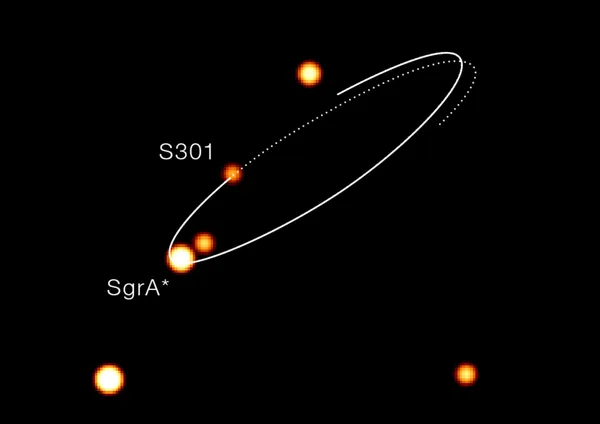
Fastest Star: S301 reaching approximately 25,000 kilometers per second, more than 8% of light speed.
The S301 star follows an extreme orbit
S301 completes a circuit around Sagittarius A* every 8.7 years. At its closest point, it passes approximately 12 Earth–Sun distances from the black hole.
That brings a familiar scale into an extraordinary setting. Sagittarius A* contains roughly four million times the Sun’s mass, concentrated at our galaxy’s center.
A close approach, not a constant distance
The star follows a highly elongated path. It approaches the black hole, accelerates through its nearest passage, then travels outward again.
Consequently, the headline speed describes its motion near closest approach. S301 does not maintain that speed throughout its journey.
Its proximity also distinguishes it from S2, a star astronomers have studied extensively. S301 approaches roughly ten times closer, allowing researchers to investigate a region with stronger relativistic effects. The original Nature study details this exceptional orbit.
How astronomers found a nearly invisible star
Finding S301 required separating a faint point of light from the crowded galactic center. To observers on Earth, it appears around two billion times fainter than Betelgeuse.
Researchers used GRAVITY at the European Southern Observatory’s Very Large Telescope Interferometer in Chile. The facility combines light from four eight-meter telescopes, providing the precision needed to distinguish closely spaced objects.
Following the trail through earlier observations
The team first identified S301 in spring 2023. Later observations helped establish its motion and guided a search through older data.
Researchers traced its positions back to 2017. Together, those measurements indicated that the star reached its most recent closest approach in early 2023.
Upgrades collectively known as GRAVITY+ have improved the system’s capabilities. For this discovery, the crucial achievement involved following a very faint source consistently across different observing periods.
The observation timeline also explains why discovery dates and orbital dates differ. Scientists can recognize a source today, then locate it in older observations. Those earlier detections extend the available record without requiring researchers to wait through every year again.
Each position added another constraint on the star’s path, turning scattered detections into a coherent orbital picture.
How the S301 star could reveal black hole spin
A rotating black hole influences nearby spacetime through an effect called frame dragging. That influence can gradually alter the motion of an orbiting star.
S301 passes close enough for astronomers to seek this subtle signature. Its orbit therefore offers a potential route to measuring Sagittarius A*’s rotation through gravity’s effect on stellar motion.
Separating two different effects
The challenge involves distinguishing spin from another consequence of relativity. A black hole’s mass alone causes the closest point of a stellar orbit to shift between successive circuits.
Scientists call this Schwarzschild precession. Frame dragging adds a smaller influence linked to rotation, making it harder to isolate.
Researchers must therefore compare precise observations with models that account for these different contributions. A changing orbit does not automatically establish a spin measurement.
The Max Planck Institute’s explanation highlights this distinction between the larger mass-related effect and the weaker rotation-related effect.
Astronomers already estimate black hole spins using other methods. Here, the distinctive opportunity comes from tracing an individual star and reading the gravitational influence recorded in its orbit.
Success would provide a direct dynamical measurement of Sagittarius A*’s spin. It would also offer a valuable test of predictions about spacetime around a rotating supermassive black hole.
How did S301 reach this unusual path?
The orbit raises another question: how did the star arrive so close to Sagittarius A*?
Researchers propose that S301 once belonged to a binary system, sharing its journey with another star. An encounter with the black hole could have separated the pair through gravitational forces.
In that scenario, S301 remained bound to Sagittarius A*. Its companion traveled outward at high speed, potentially fast enough to leave the Milky Way.
The shape of S301’s orbit supports this explanation. However, astronomers did not witness the original encounter, and the discovery does not identify the proposed companion.
This distinction matters. The observations establish the star’s current motion; reconstructing its earlier history requires interpreting the clues that motion preserves.
What the next decade could reveal
S301’s next closest approach should occur in 2031. Continued observations will help astronomers refine its trajectory before and after that passage.
GRAVITY+ will continue tracking its position. Meanwhile, MICADO on ESO’s upcoming Extremely Large Telescope should provide complementary measurements, including information about motion along our line of sight.
Better measurements, clearer answers
That missing information currently leaves two possible orbital orientations in the study. Future measurements could resolve the ambiguity and strengthen the overall orbital model.
The ESO announcement describes observations covering at least two complete orbits as central to the spin investigation.
Researchers hope to obtain a measurement within roughly a decade. That remains a forecast based on expected observational capabilities, rather than a guaranteed deadline.
The discovery and study appeared on August 19, 2026. The September date of subsequent coverage should not obscure that original announcement.
Why the S301 star matters
The S301 star gives astronomers an unusually promising target for studying our galaxy’s central black hole. Its scientific value will grow as researchers follow its path with greater precision.
For now, the next step is clear: keep watching, refine the measurements, and search for the smaller signature of rotation. A faint star’s changing position could eventually reveal a fundamental property of Sagittarius A*.
Main sources:
European Southern Observatory — Milky Way’s fastest star orbits our supermassive black hole so closely it feels its spin
Max Planck Institute for Extraterrestrial Physics — A Star with an Extreme Orbit
Nature — Discovery of a star sensitive to the spin of Sagittarius A*