BY:SpaceEyeNews.
McGetchin crater has given scientists an unusual lunar puzzle: a fresh hollow surrounded by ground that becomes colder at night. The discovery began with a bright patch in a Moon map. It developed into an opportunity to study how one event changed the surrounding landscape.
The crater itself measures approximately 222 metres across. However, its thermal signature reaches kilometres beyond the rim. That difference makes this discovery especially useful. Researchers can examine both the visible surface changes and the less obvious changes in the soil beneath their instruments.
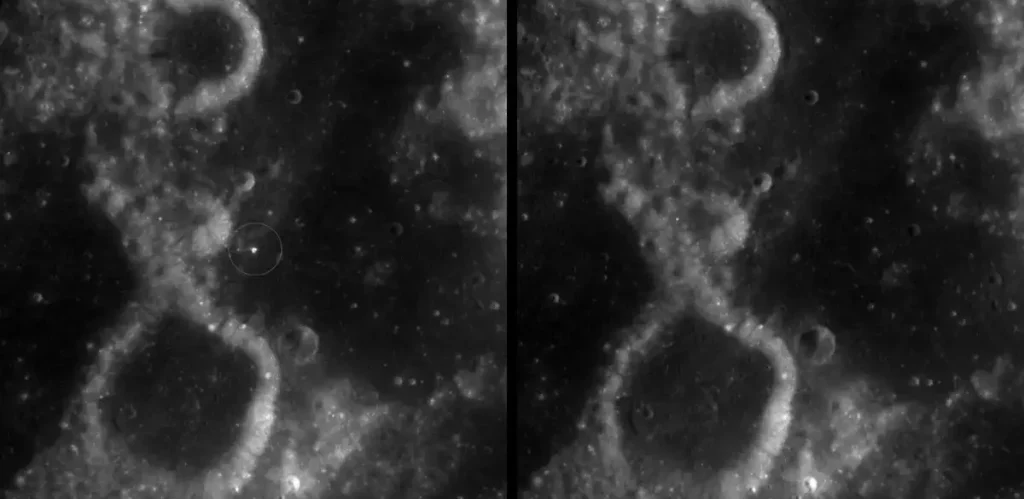
NASA scientist recalls spotting a mysterious bright spot on Moon that turned out to be a once-in-century crater.
Finding McGetchin crater
A bright patch catches attention
On October 24, 2025, Robert Wagner was checking the quality of a global lunar map. An image-processing specialist working with Lunar Reconnaissance Orbiter Camera data, he regularly examines comparisons between older and newer observations.
Usually, these comparisons produce plenty of distractions. Different lighting conditions and shifting shadows can resemble genuine surface changes. Investigators must separate those false signals from features that actually appeared between observations.
This time, a bright spot surrounded by a dark halo stood out. The pattern indicated that something had disturbed the surface.
The comparison software helps by making unchanged areas appear gray. Bright and dark patches highlight differences between the image sets. Stacking many observations also helps researchers distinguish persistent changes from misleading variations in individual frames.
Crucially, the bright patch was not simply a photograph of the hole. It largely showed material spread across the surrounding ground.
Sharper images reveal the feature
The initial discovery came from the Wide-Angle Camera, which captures broad views. Scientists then used the Narrow-Angle Camera for closer inspection. Those sharper images revealed the crater’s dimensions, shape, and immediate surroundings.
What the images establish
McGetchin crater measures about 222 metres wide and 43 metres deep. Its width roughly equals the combined length of two American football fields.
Comparisons narrow its formation to April 11 through May 22, 2024. That window matters because the images establish when the landscape changed. They do not identify the exact moment the event occurred.
The timeline therefore has three separate stages. The crater formed in spring 2024. Wagner discovered it in October 2025. NASA announced the findings in September 2026.
Its official name honors Thomas R. McGetchin, an American geologist and planetary scientist. The International Astronomical Union approved the name in May 2026.
Together, the measurements and timeline provide something particularly valuable: a large, fresh feature with a tightly constrained formation period. Researchers can study its condition against images of the same ground before the change.
A rare lunar discovery
Understanding the record
NASA describes McGetchin as the largest newly formed crater ever found in the solar system. The qualification “newly formed” is essential.
Much larger ancient craters already cover the Moon. This discovery concerns a recent formation that researchers identified through comparisons across time.
That distinction keeps the record meaningful. Scientists have a documented view of the landscape before and after this particular event.
A rare event, without a timetable
NASA places the estimated frequency of an event this size at roughly once per century or longer. Such estimates describe average occurrence rates.
They cannot tell us when another comparable crater will form. Nor does one discovery establish that these events follow a regular schedule.
The scientific opportunity comes from catching the aftermath while its features remain fresh enough for detailed investigation.
McGetchin crater’s cold spot
What Diviner measured
After the discovery, researchers examined the site with Diviner, the orbiter’s thermal instrument. Its observations added a different perspective to the photographs.
A surrounding region roughly six to seven kilometres across becomes about nine degrees Celsius colder at night than nearby ground. NASA rounds that region’s width to four miles.
This is a temperature difference, rather than the surface’s absolute temperature. It also describes nighttime conditions, when the ground releases heat accumulated during daylight.
The cold region extends far beyond the crater’s visible rim. Consequently, the hole alone cannot show the full extent of the changed landscape.
Why looser soil cools differently
Researchers link the colder nights to changes in the lunar soil, or regolith. The event loosened material around the crater, reducing its density and changing how it retains heat.
As a result, that disturbed ground cools more strongly overnight than its surroundings.
The broad explanation connects a measurable temperature pattern with a physical change in the surface. However, researchers still need to establish exactly how the soil became looser across such a wide area.
The cold spot does not, by itself, demonstrate the presence of ice. Its significance here concerns soil structure and thermal behavior.
Why altered ground matters
Looking beyond photographs
Visible images reveal brightness, shape, and scattered material. Thermal observations reveal differences that photographs alone cannot fully explain.
Combining those measurements helps researchers investigate how far surface changes extend. It also gives them a way to compare the obvious crater with its much broader surroundings.
Questions for future exploration
NASA notes that altered soil could affect how rover wheels interact with the ground. That makes the surrounding terrain relevant to exploration, even away from the rim.
Future monitoring could help researchers follow how the fresh site evolves. Surface measurements could also test explanations for the cold region more directly.
A known formation window makes that follow-up especially useful. Scientists would have a starting point for interpreting later changes, rather than estimating age from appearance alone.
These remain opportunities for investigation. The discovery does not establish a specific outcome for a future rover or confirm a planned visit.
McGetchin crater offers a fresh starting point
McGetchin crater gives scientists more than a new feature to map. Its surrounding cold spot provides a way to investigate changes that reach well beyond the visible hollow.
The next challenge is understanding those changes in greater detail. By comparing images, temperatures, and future observations, researchers can explore how freshly disturbed lunar ground behaves over time. The most revealing part of this discovery may lie outside the crater itself.
Main sources:
NASA — NASA’s Moon Orbiter Spots New, ‘Once-in-Century’ Moon Crater
USGS / International Astronomical Union — McGetchin official naming record