
BY:SpaceEyeNews.
Water near Sagittarius A* has given astronomers a revealing glimpse into the Milky Way’s crowded center. The James Webb Space Telescope detected water around IRS 3, an aging star close to our galaxy’s central supermassive black hole. Its surrounding envelope also contains oxygen-rich dust.
The surprise lies in where this material survives. IRS 3 occupies an environment filled with intense radiation, yet it continues shedding gas and producing dust. Webb’s observations show that a star can keep enriching its surroundings even in this extreme neighborhood. They also clarify the chemistry of a familiar but previously uncertain object.
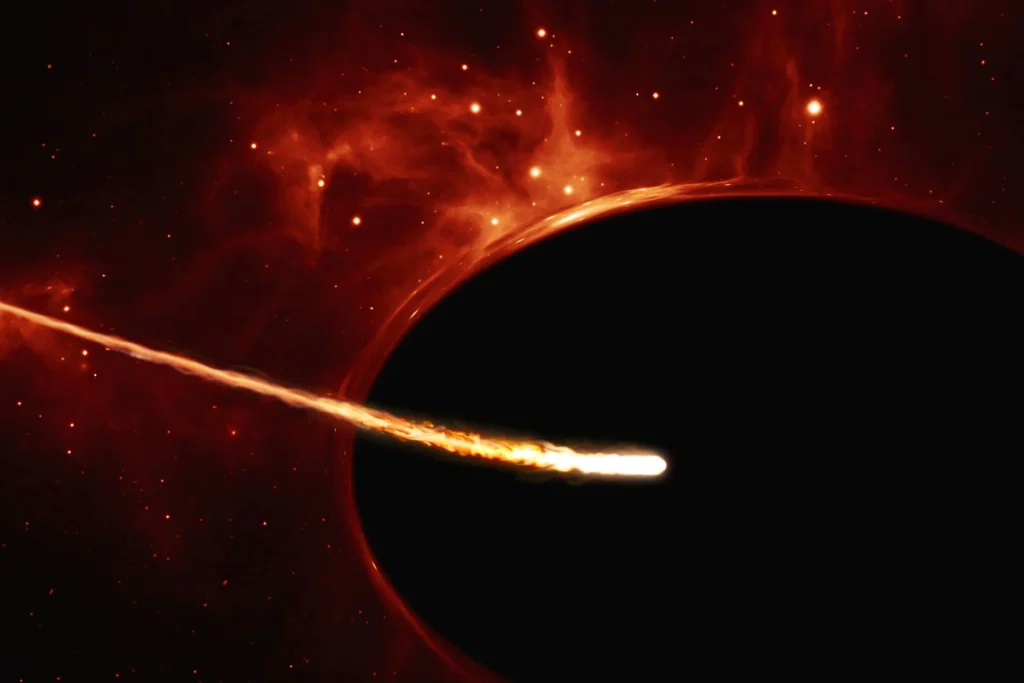
IRS 3: An Aging Star Near the Galactic Center
IRS 3 sits just 0.55 light-years from Sagittarius A*. For comparison, Earth lies roughly 26,000 light-years from the black hole. That places the star in a very different setting from our own cosmic neighborhood.
As IRS 3 approaches the end of its life, it expands and cools. Meanwhile, stellar winds carry gas away from its outer layers. This escaping material builds the envelope of gas and dust that Webb examined.
The star therefore offers researchers a close look at stellar material entering the galactic center. Its surroundings provide an opportunity to investigate whether this process continues under especially harsh conditions.
Dust production is central to that question. Astronomers wanted to understand whether an aging star so close to a supermassive black hole could still create it. IRS 3 gives them direct evidence that the process remains active.
How Webb Detected Water Near Sagittarius A*
Chemical Clues in Infrared Light
Webb studied IRS 3 with its Mid-Infrared Instrument, known as MIRI. Researchers analyzed the star’s infrared light and identified signatures of oxygen-rich dust and water within its envelope.
The chemical evidence matters as much as the image. A detailed view reveals the region’s appearance, while the infrared data help identify the material around the star. Together, they connect the scene with its underlying chemistry.
NASA’s image coverage confirms both findings: oxygen-rich silicate dust and the first water detection in this star’s surrounding envelope. That qualification keeps the discovery precise. The team identified water around IRS 3 specifically.
A Detection Around the Star
The water occupies material surrounding IRS 3, close to Sagittarius A*. Researchers did not detect it inside the black hole. Keeping that location clear helps explain the result without overstating the headline.
The observation also does not establish liquid oceans or habitable conditions. Its importance concerns the survival of molecular material within a demanding environment. Water provides a particularly interesting clue to what can persist there.
Webb Clarifies IRS 3’s Chemical Identity
Earlier studies suggested IRS 3 might be carbon-rich. Webb’s observations instead revealed two strong infrared signatures associated with silicate dust. Silicates contain silicon and oxygen, supporting the identification of IRS 3 as an oxygen-rich evolved star.
ESA/Webb describes these data as the first continuous mid-infrared spectrum collected for this object. That coverage allowed researchers to distinguish chemical features that clarify its identity.
This changes how astronomers interpret the dusty envelope. They can connect its composition more confidently with the star producing it. Understanding what IRS 3 releases is essential to assessing its contribution to the surrounding region.
Alongside the water detection, the dust signatures therefore provide a fuller picture of the star’s activity. The findings address both what surrounds IRS 3 and what kind of aging star lies within that material.
Researchers also combined the spectrum with models of the envelope. Their results suggest layered dust extending roughly 10,000 astronomical units from IRS 3. Estimated temperatures range from about 1,200 kelvin near the star to 100 kelvin farther out. These figures describe a model of the surrounding dust, rather than a direct measurement of liquid water. They add physical context to the detection of water near Sagittarius A*.
Why Water and Dust Can Persist Here
Stellar Activity in a Harsh Environment
The galactic center exposes nearby material to intense radiation. Finding water within IRS 3’s envelope shows that molecular material can survive under these conditions. Likewise, the dust reveals that the star continues supplying solid particles to its surroundings.
The observations establish that these processes persist around this particular star. They do not, by themselves, explain every detail of how the material survives. That distinction leaves room for further investigation while preserving the strength of the result.
Researchers now have a concrete example to examine. IRS 3 continues losing material despite its unusual location, allowing astronomers to study stellar output close to Sagittarius A*.
Material for Future Generations
ESA/Webb connects the finding with a broader question: how evolved stars supply material for future stars and planets. Dust from aging stars contributes to that continuing cycle.
However, this observation does not show planets forming around IRS 3. It demonstrates that an important source of material can remain active near the galactic center. That makes the discovery relevant beyond the presence of water alone.
What the Discovery Leaves Open
One star cannot establish how every aging star behaves near a supermassive black hole. A natural next question is how widely IRS 3’s behavior occurs elsewhere in the central region.
Another concerns the material after it leaves the star. Detecting water and dust within an envelope does not establish their entire future journey. Readers should separate the observed chemistry from broader possibilities about what happens next.
The timing also deserves clarity. ESA/Webb announced the research on August 11, 2026, using observations obtained in 2025. The September 23 Space.com feature revisits that discovery.
Water Near Sagittarius A*: A Clearer View of Stellar Recycling
Water near Sagittarius A* reveals a star still contributing to its surroundings late in life. IRS 3’s envelope contains both water and oxygen-rich dust, offering evidence of continued activity in an extreme setting. Webb has given astronomers a clearer view of that process and a stronger basis for exploring how stars replenish the Milky Way’s center.
Main sources:
ESA/Webb — Webb reveals dust and water surviving in the extreme environment around the Milky Way’s central black hole
https://esawebb.org/news/weic2617/
NASA — Dust and Water in Sagittarius A*
https://www.nasa.gov/image-article/dust-and-water-in-sagittarius-a/
Space.com — Original feature supplied for this article