
BY:SpaceEyeNews.
ALMA has revealed gas swirling around a growing giant planet, bringing WISPIT 2b planet formation into sharper focus. The observations connect a planet astronomers already knew existed with the gas movements it creates nearby. That connection provides a valuable test of how young worlds interact with their surroundings.
Located about 430 light-years away, WISPIT 2 contains two confirmed planets within a disk of gas and dust. The new findings show how those planets reshape their environment. They also help explain what astronomers should look for when searching other disks for developing worlds.
Why WISPIT 2 Offers an Exceptional View
WISPIT 2 attracted attention in August 2025, when astronomers announced the discovery of a planet inside its disk. Researchers identified that world using the SPHERE instrument on the Very Large Telescope and the Magellan Clay Telescope.
The discovery of a second planet followed in March 2026. Together, the two worlds made this system an especially useful place to examine planet formation.
WISPIT 2b has roughly five times Jupiter’s mass. Despite its size, it continues gathering material. Earlier observations detected hydrogen emission that indicates ongoing growth.
There is another detail behind this planetary nursery. Research highlighted by the Max Planck Society indicates that two closely orbiting stars occupy the disk’s center. The system therefore offers a more complex setting than the original description of one young star suggests.
What ALMA Revealed Around the Growing Planets
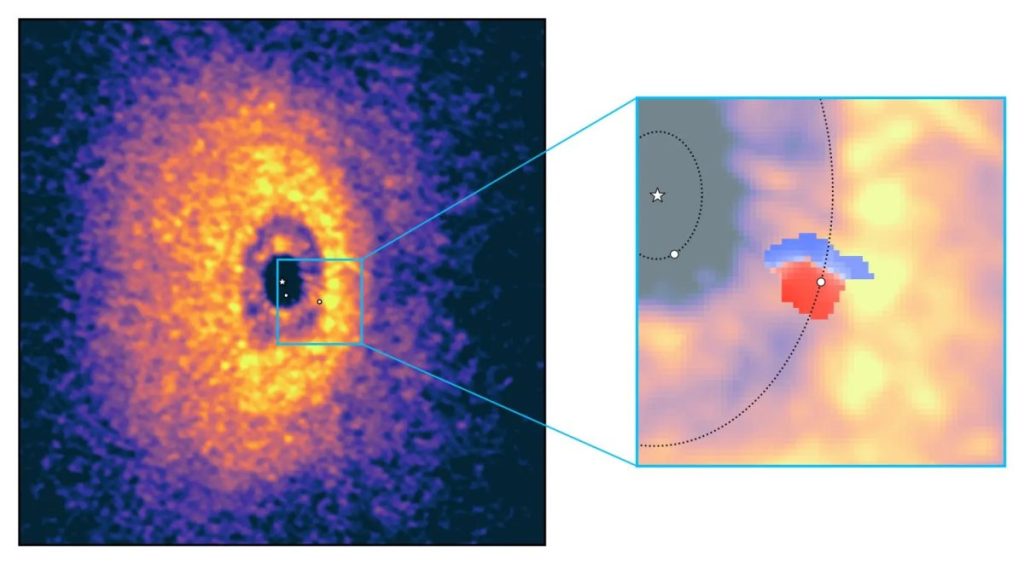
ALMA’s observations show distinct changes in the gas surrounding the two planets. WISPIT 2b occupies a gap, while an inner cavity lies within WISPIT 2c’s orbit.
Between their orbits, researchers also identified a ring containing gas and a thin concentration of dust. These structures reveal an environment that the planets are actively reshaping.
However, the most significant finding concerns movement. At WISPIT 2b’s location, the team detected a distinctive feature in the gas velocity maps. Its appearance matches predictions from simulations of interactions between planets and disks.
Reading the Gas-Motion Image
The image uses color to communicate information that an ordinary photograph cannot show. Blue represents gas moving toward Earth, while red indicates gas moving away.
Around WISPIT 2b, these opposing motions reveal a swirling pattern. Astronomers can therefore examine both the disk’s structure and the behavior of its gas.
These colors encode measured motion, rather than the visible appearance of the gas. Reading them correctly helps explain the scientific result without mistaking the image for a conventional view through an optical telescope.
The planet markers need careful interpretation. They identify positions established through earlier telescope observations. ALMA supplied the detailed gas measurements; it did not newly discover both planets in this image.
Why WISPIT 2b Planet Formation Stands Out
Astronomers have photographed developing planets before. The PDS 70 system provided an earlier example of planets embedded within a surrounding disk.
Consequently, describing this result as the first image of a forming exoplanet would overstate the discovery. Its significance comes from connecting several kinds of evidence.
Scientists already had direct observations of WISPIT 2b. They also had evidence that the planet was still growing. ALMA now adds a detailed view of gas interacting with that same world.
Previously, researchers had identified unusual gas motions in other disks without directly detecting the suspected planets. Those observations left room for alternative explanations, including turbulence.
WISPIT 2b provides a much firmer reference point. A known planet occupies the location of the gas disturbance. That association helps researchers test whether their interpretation of similar features elsewhere makes sense.
It also gives simulations a concrete observational target. Models must explain the behavior around an identified world, rather than merely reproduce a suggestive disk pattern.
How ALMA Captured Such Fine Details
The observations required ALMA’s ability to combine signals from multiple antennas in Chile. Its 66 antennas can work together with a maximum separation of about 16 kilometers.
That arrangement provides the resolving power needed to study fine details across enormous distances. It does not mean ALMA has a single dish that large.
Researchers also needed sophisticated methods to analyze the observations. The resulting maps trace carbon monoxide emission, revealing the distribution and motion of gas.
This combination of telescope capability and careful analysis made the planet’s influence visible. A broad image of the disk alone would not provide the same information.
What the Discovery Establishes—and What Remains Unclear
The observations strengthen the connection between growing planets and disturbances in their surrounding disks. However, they do not settle every question about how material behaves near WISPIT 2b.
The team detected extra emission across a region larger than the expected extent of a small disk surrounding the planet itself. Several processes could contribute to that signal.
Possible sources include spiral disturbances driven by the planet, local heating, and material in a circumplanetary disk. The present observations cannot fully separate those contributions.
Why Further Measurements Matter
Finer measurements of gas velocities could help distinguish these processes. For now, the strongest conclusion concerns the clear association between the planet and its surrounding gas signature.
The journal has accepted the study for publication in The Astrophysical Journal Letters. Its findings support predictions about planet–disk interactions while leaving specific details open for further investigation.
Future observations of comparable systems could also establish which gas patterns reliably indicate planets. One convincing example provides a starting point, but broader comparisons will strengthen that approach.
A Clearer View of WISPIT 2b Planet Formation
WISPIT 2b planet formation now offers a valuable connection between a growing world and the changing gas around it. Astronomers can compare the planet’s location, evidence of growth, and nearby gas motions within one system.
That combination makes the discovery useful beyond WISPIT 2. As researchers examine other disks, they can use this example to assess possible planetary signatures. Each comparison could bring a clearer understanding of how giant planets develop and shape the systems around them.
Main sources:
- Max Planck Society — Astronomers produce the first complete picture of (gas) planet formation in action
- Original research — Mapping the WISPIT2 Planet-Hosting Cavity at Sub-Hill-Radius scales
- Universe Magazine — ALMA radio telescope captured the first detailed image of an exoplanet forming in a gas-and-dust disk