
BY:SpaceEyeNews.
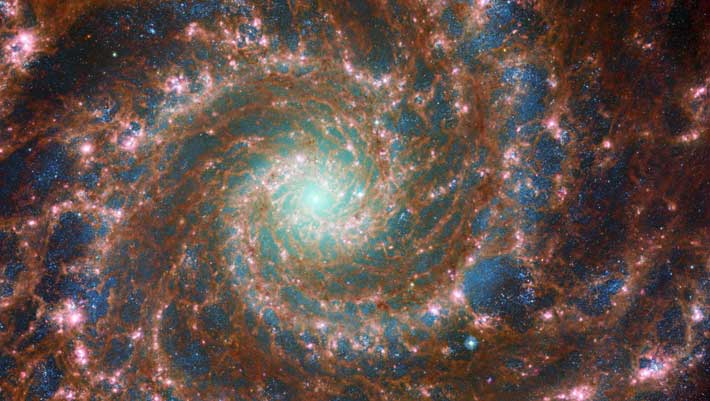
The Messier 74 hidden disk reveals how much even a familiar galaxy can conceal. Astronomers have detected faint outer starlight extending far beyond its previously measured stellar boundary. The discovery roughly doubles the known reach of its stellar disk. It also raises an intriguing possibility: a relatively recent episode of star formation helped build this enormous extension.
Researchers at the Institute of Astrophysics of the Canary Islands studied the galaxy using exceptionally deep images. Their findings connect its overlooked outskirts with a larger question. How quickly can galaxies add new stellar territory?
How large is the Messier 74 hidden disk?
The newly detected stellar component reaches about 30 kiloparsecs from M74’s center. That equals approximately 97,800 light-years. Earlier measurements placed the stellar disk’s edge at around 14 kiloparsecs, or 45,600 light-years.
These figures describe the radius. Doubling them gives an approximate diameter of 196,000 light-years for the newly traced disk, compared with about 91,000 light-years previously.
The distinction matters because confusing radius with diameter cuts the stated size in half. It also helps explain precisely what the discovery changes. arxiv.org
A larger measured stellar boundary
Astronomers have extended the galaxy’s known optical stellar boundary. They have not shown that its total mass doubled. Nor did M74 suddenly expand while the telescope watched.
Instead, deeper observations revealed stars that earlier optical surveys could not trace adequately. The stars’ properties then offered clues about when this outer component formed.
How astronomers revealed the faint outskirts
The team used the Transient Survey Telescope at Teide Observatory in Tenerife. Long exposures gathered enough light to reveal a structure that blends into the background in shallower images.
However, collecting light was only part of the challenge. Researchers also needed careful image processing that preserved faint, extended features.
A diffuse stellar disk spreads its light across a large area. Consequently, detecting its outskirts requires sensitivity to low surface brightness. A striking photograph of the bright central galaxy does not necessarily reveal its faintest extensions. iac.es
Optical light completes an earlier picture
M74 already had a known extended ultraviolet disk. Earlier observations had also mapped atomic hydrogen beyond its familiar bright stellar regions.
The new work adds faint optical starlight across those outskirts. Its extent agrees with the previously observed ultraviolet emission and outer hydrogen distribution.
This connection strengthens the interpretation that the structure belongs to M74’s extended disk. It also corrects a potential misunderstanding: the discovery is not the first detection of its ultraviolet outskirts.
Young stars point to recent disk growth
The outer stellar population appears comparatively young. Researchers estimate a representative age of about 640 million years, although that number carries substantial uncertainty.
They reached this estimate by comparing optical and ultraviolet colors with stellar-population models. Different assumptions about chemical composition produce different age estimates. Depending on metallicity, the preferred values range from roughly 260 million years to just over one billion years.
Therefore, 640 million years should not serve as an exact birthday for the entire structure. It represents an interpretation of the population’s combined light. www.researchgate.net
What the age reveals
Even with those uncertainties, the findings support a relatively recent episode of outer-disk star formation. The team proposes that substantial stellar growth occurred within less than a billion years.
That timescale distinguishes the physical interpretation from the observational discovery. Astronomers detected the disk now, but its stars preserve evidence of changes much earlier in the galaxy’s history.
Could a neighboring galaxy have encouraged star formation?
The researchers identify nearby UGC 1176 as a possible influence. A close passage roughly a billion years ago could have disturbed gas around M74.
Under this scenario, gravitational interaction encouraged existing outer gas to form stars. The galaxy gained a more extensive stellar disk as those new populations developed.
This explanation does not require the neighboring galaxy to supply all the material. Gas already surrounding M74 could provide the reservoir for growth.
A plausible explanation, not a confirmed encounter
The estimated stellar ages and the outer gas structure fit the proposed scenario. Nevertheless, consistency does not establish exactly what happened.
Researchers still describe the close passage as a possible trigger. The observations do not conclusively prove one encounter caused the whole extension. They also cannot establish that every extended ultraviolet disk forms through the same process. iac.es
Why the Messier 74 hidden disk matters
The discovery gives astronomers a useful case for investigating how stellar disks develop. It suggests that outward growth can include relatively rapid episodes, potentially influenced by neighboring galaxies.
It also shows why measurement methods matter. A galaxy’s apparent edge depends partly on how faint a structure an observation can detect. Different wavelengths reveal complementary components, while deeper optical images can connect them.
The result also separates the presence of gas from the reach of a stellar population. An outer gas reservoir can exist before substantial star formation makes its optical counterpart easier to detect. Comparing these components helps researchers investigate how material already around a galaxy contributes to its later development.
The next question reaches beyond M74
Further observations must establish whether similar young outer disks appear around other galaxies. Finding more examples would help researchers assess how frequently this growth pattern occurs.
Equally, an absence of comparable structures would make M74 particularly valuable for understanding unusual evolutionary paths. Either outcome would sharpen the distinction between a compelling individual case and a widespread mechanism.
A familiar galaxy with more to reveal
The Messier 74 hidden disk changes the measured extent of a well-studied galaxy while opening questions about its past. Faint outer stars trace a larger stellar structure, and their estimated ages suggest comparatively recent growth.
A neighboring galaxy may have helped initiate that change. For now, the strongest result is the newly revealed optical extension. Its origin remains an active question. The next step is to discover how many other galaxies conceal similar evidence in their faint outskirts.
Main sources:
- Institute of Astrophysics of the Canary Islands — Official research announcement.
- Ignacio Ruiz Cejudo and colleagues — Original study on arXiv.
- Astronomy & Astrophysics — Published paper.
- Universe Magazine — article :Messier 74 galaxy turned out to be twice as large as previously thought.