
BY:SpaceEyeNews.
An air-breathing satellite engine could turn a persistent orbital problem into a useful resource. Instead of carrying all its propellant, a spacecraft would collect gases from Earth’s upper atmosphere. Electricity would then accelerate those particles to produce thrust, helping the satellite maintain its altitude.
The attraction is clear: longer missions close to Earth without exhausting a conventional propellant tank. Research by Francesco Romano explores how an atmospheric intake and a radio-frequency plasma thruster could support that goal. However, laboratory operation and orbital calculations do not yet establish a working system in space.
Why flying closer to Earth matters
Very low orbits offer practical benefits for Earth observation. With comparable cameras, satellites closer to the surface can capture finer details. Shorter distances can also reduce power requirements for certain communications and radar applications.
Yet these advantages come with persistent atmospheric drag. Even sparse gas gradually slows a spacecraft, creating a need for propulsion to maintain altitude.
ESA’s GOCE mission illustrates that trade-off. Its electric engine compensated for drag using stored xenon. Once the propellant ran out, GOCE could no longer sustain its mission.
Collecting atmospheric gas could change this equation. A satellite would draw its working material from its surroundings, reducing dependence on a finite onboard supply.
How an air-breathing satellite engine collects gas
Romano examined several intake designs to guide incoming particles toward the thruster. Some scatter particles within the collector. Another uses more orderly, mirror-like reflections to redirect them toward the engine.
This specular design produced collection efficiencies approaching 94% in numerical research. That figure describes performance under modeled conditions, rather than a measured collection rate during orbital flight.
Why the intake surface matters
The mirror comparison describes particle reflection, not the collection of sunlight. Its effectiveness depends on how atmospheric particles interact with the surface.
Actual materials may behave differently from idealized models. Exposure, erosion, and changes in spacecraft alignment could also alter performance. Engineers therefore need to establish how well a practical intake preserves its collection ability.
Throughout this process, atmospheric gas acts as propellant. Solar-generated electricity supplies the energy; the spacecraft does not obtain free power from the air.
A plasma thruster built for atmospheric gases
Collecting gas solves only part of the challenge. The engine must also tolerate a demanding chemical environment.
Atomic oxygen presents a particular concern. Ultraviolet radiation splits oxygen molecules in the upper atmosphere, creating highly reactive individual atoms. These atoms can erode vulnerable spacecraft materials and propulsion components.
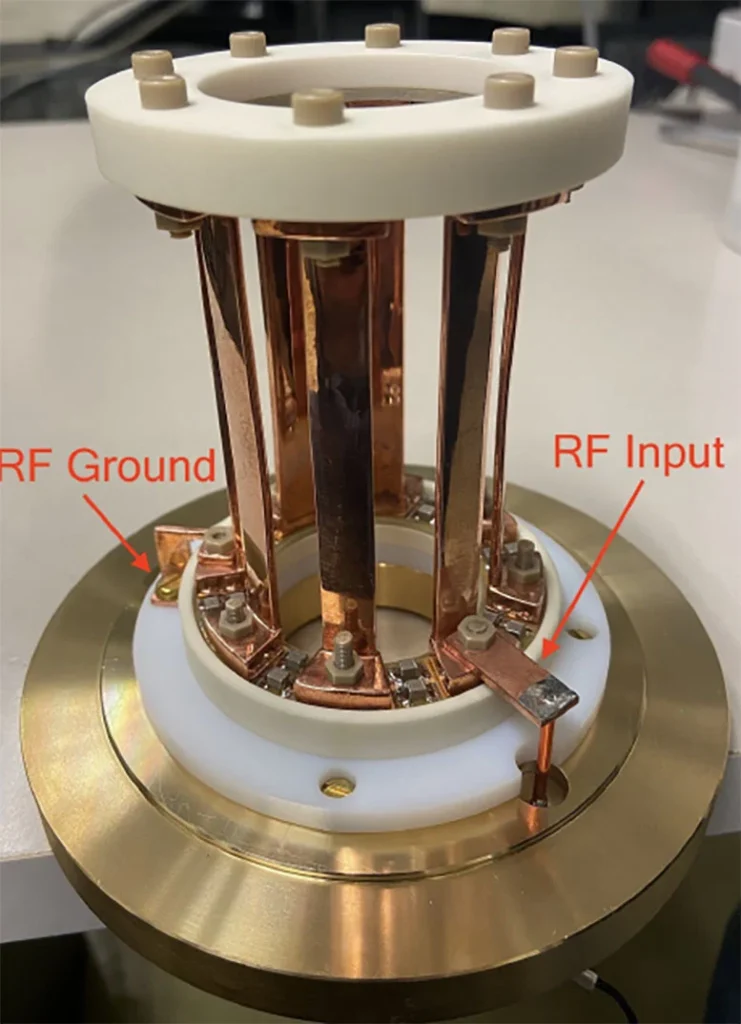
Romano’s approach uses an electrodeless radio-frequency plasma thruster. This design avoids exposed electrodes within the discharge, reducing a potential source of wear.
An antenna inspired by medical imaging
A birdcage antenna, familiar from magnetic resonance imaging, helps transfer radio-frequency energy into the gas. An external magnetic field supports plasma operation and the intended exhaust process.
The design aims to release ions and electrons together in a nearly neutral plume. That removes the need for a separate neutralizer.
However, protecting particular engine components does not eliminate every durability concern. The intake, surrounding materials, and other spacecraft systems still face prolonged atmospheric exposure.
What the laboratory results actually show
Experiments demonstrated plasma ignition and operation using argon, nitrogen, and molecular oxygen. The thruster operated at relevant gas flow rates with radio-frequency input below 60 watts.
These results support the feasibility of generating plasma with the proposed design. They do not demonstrate that a complete spacecraft could maintain orbit using only that power.
Likewise, the reported electrical efficiency above 99% needs careful interpretation. It does not mean that 99% of spacecraft electricity becomes useful thrust.
Plasma operation is only one milestone
A successful discharge establishes an essential capability. Engineers must also measure thrust and determine whether the full system can overcome drag.
The dissertation identifies direct thrust measurements among the next development steps. That distinction separates promising component experiments from demonstrated orbital performance.
What the calculations suggest for Earth and Mars
Romano also examined how atmosphere-breathing propulsion might support a GOCE-like spacecraft. The modeled Earth scenario covers roughly 190–250 kilometers in altitude, with calculated propulsion power below about 1.6 kilowatts.
These figures depend on assumptions about intake performance, thrust efficiency, spacecraft geometry, and drag. They are scenario results, not guaranteed operating limits for every satellite.
A separate Mars calculation explores approximately 120–160 kilometers above the planet. Its carbon-dioxide-rich atmosphere offers another potential source of propellant.
Such applications remain proposals. Neither calculation establishes that this particular engine has sustained a satellite around Earth or Mars.
Why “indefinitely” needs qualification
An air-breathing satellite engine could remove propellant depletion as a major lifetime constraint. Nevertheless, solar panels degrade, electronics age, and mechanical or thermal problems can end missions.
Atmospheric conditions also vary with location, sunlight, and solar activity. A practical system must accommodate those changes while producing sufficient thrust.
The research itself predates its recent coverage. Romano defended the dissertation in July 2021 and uploaded it to arXiv in July 2026. ESA had already demonstrated a different air-breathing electric thruster on the ground in 2018.
More available gas does not automatically make operation easier. Denser air supplies additional particles but also increases drag. At greater heights, drag falls, yet the intake has fewer particles to collect. Designers must balance these competing effects alongside the spacecraft’s available power, rather than optimize the engine in isolation.
The next challenge is therefore practical validation: realistic intake performance, measured thrust, extended operation, and eventually an integrated orbital demonstration.
A longer future for low-orbit satellites
An air-breathing satellite engine offers a compelling route toward longer missions near Earth. Its potential comes from replacing a limited propellant supply with material available along the orbital path.
The research provides promising designs, laboratory plasma results, and mission calculations. Now engineers must establish reliable performance under realistic conditions. Success could make detailed Earth observation and other low-altitude missions more sustainable over time.
Main sources:
- SciTechDaily — New Satellite Engine Could Use Earth’s Atmosphere as Fuel To Stay in Orbit Indefinitely.
- Francesco Romano — Full doctoral dissertation
- Romano and colleagues — Atmospheric intake design research
- European Space Agency — World-first firing of air-breathing electric thruster