
BY:SpaceEyeNews.
Wandering black holes could help astronomers uncover events that shaped galaxies billions of years ago. Their locations may preserve traces of past mergers, while their abundance could reveal clues about their earliest origins. A Yale-led study explores how scientists might read those two histories together.
The research uses the ASTRID cosmological simulation to follow black holes through evolving galaxies. It suggests that looking beyond galactic centers could reveal information that central objects alone cannot provide. However, these findings describe simulated populations. Astronomers still need observations to test how closely real galaxies follow the predicted patterns.
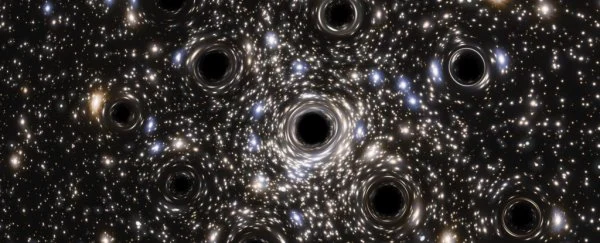
Why wandering black holes leave galactic centers
Galaxies change as they grow and merge with their neighbors. During those encounters, gravitational interactions can shift black holes away from their original central positions. Some then spend billions of years moving through other regions of their host galaxies.
Smaller galaxies offer particularly interesting settings for this process. Their weaker gravitational influence can make it harder for displaced black holes to settle toward the center. Consequently, a black hole’s current address may differ greatly from where its journey began.
Wandering does not always mean escaping
The term “rogue” can suggest an object traveling alone between galaxies. Yet the research also concerns black holes that remain inside their hosts, away from the central region.
That distinction matters. A displaced black hole can help trace a galaxy’s development without leaving it entirely. Its position offers a clue about the processes that rearranged the galaxy over time.
How ASTRID follows black hole journeys
Emma Jane Weller led the study with Priyamvada Natarajan and Colin J. Burke. Their findings appear in The Astrophysical Journal Letters.
The team examined galaxies spanning 10 million to 1 trillion solar masses in stars. They traced their evolution across approximately 12.6 billion years. This range covers stellar mass, rather than the combined mass of stars, gas, and dark matter.
ASTRID models interactions among dark matter, gas, stars, and black holes. Crucially, it allows black holes to move through their surroundings. It does not artificially keep every black hole at a galaxy’s center. news.yale.edu
Giving black holes room to move
Instead, the simulation models gravitational effects that influence their paths and gradual movement toward central regions. This approach lets researchers compare central black holes with wanderers within the same evolving population.
That freedom matters because fixing objects at the center would conceal the very journeys this study seeks to understand.
Reading two histories from wandering black holes
The researchers examined a measure called the black hole occupation fraction. In plain language, this means the proportion of galaxies that contain a black hole.
They also separated central and wandering populations. Among low-mass galaxies, the central occupation fraction declined toward the present, while the wandering fraction increased. The simulated pattern points to mergers redistributing black holes away from galactic centers. arxiv.org
Numbers and locations offer different clues
Counting black holes can help researchers investigate their origins. Mapping their positions adds information about subsequent galaxy assembly.
The distinction prevents an overly simple interpretation. A galaxy without a central black hole does not necessarily lack black holes elsewhere. Searches restricted to its center could therefore overlook part of its history.
This is what the “cosmic archive” comparison means. Black holes do not literally remember events. Instead, their population patterns retain physical clues that researchers can compare with models of cosmic evolution.
Could roaming black holes reveal their first seeds?
The findings connect with a larger question: How did massive black holes begin?
One explanation starts with light seeds, the smaller black holes left behind by early stars. Another proposes heavier starting points, including black holes formed through the direct collapse of pristine gas.
Those different beginnings could leave different populations for astronomers to find today. The simulation suggests that low-mass galaxies can retain information about their initial seeds despite later growth and mergers.
For that reason, wanderers could contribute to the search for evidence about black hole formation. Studying them alongside central objects could help researchers separate early conditions from later galactic changes.
However, the study does not establish that heavy seeds explain all massive black holes. It provides a framework for investigating competing possibilities, rather than a final answer to the seed debate.
Star formation adds another clue
The team also identified a connection with star formation. In the simulation, low-mass galaxies still forming stars preferentially hosted wandering black holes. Galaxies that had stopped forming stars more often contained central ones.
This association adds another factor to examine alongside black hole location. It does not, by itself, prove that moving a black hole causes star formation to continue or stop. arxiv.org
How astronomers could test the predictions
Observations will need to cover more than galactic centers. Yale’s announcement outlines a combination of deep X-ray observations, optical and infrared spectroscopy, and radio measurements. Brief flares associated with stars passing too close to black holes offer another possible route. news.yale.edu
Each approach can reveal different parts of the population. Together, they could help astronomers compare actual galaxies with ASTRID’s predictions and assess how well the proposed historical clues survive.
Comparing the two populations also changes the questions observers ask. Instead of checking only whether a galaxy has a central black hole, they can examine where its black holes reside. That broader view could help link individual galaxies with the population trends in the simulation.
Wandering black holes and the next chapter
Wandering black holes could widen the search for answers about galaxy evolution. Their numbers, locations, and host environments offer complementary clues about processes separated by billions of years.
The next step is to test those relationships through observations. If the predicted patterns hold, astronomers may reconstruct more of a galaxy’s past by studying objects far from its center. These overlooked travelers could help connect the universe’s earliest black hole seeds with the galaxies we see today.
Main sources:
- Yale University: Roaming black holes may tell the hidden history of galaxies, September 23, 2026.
- Research paper: The Black Hole Occupation Fraction as a Fossil Record of Seeding, Dynamics, and Galaxy Assembly, The Astrophysical Journal Letters.
- Research abstract and preprint.
- Space.com: Rogue black holes could wander the cosmos sharing the histories of their home galaxies.