
Little Red Dots may reveal how the Universe built its first massive black holes. A new simulation suggests these compact sources contain rapidly growing black holes surrounded by dense gas. That material could explain both their unusual light and their remarkable growth.
The finding connects two puzzles that James Webb observations have brought into focus. Why do these distant objects look so strange? And how did early black holes become enormous so quickly? Researchers now offer a possible shared explanation, although observations must still test whether it describes the real population.
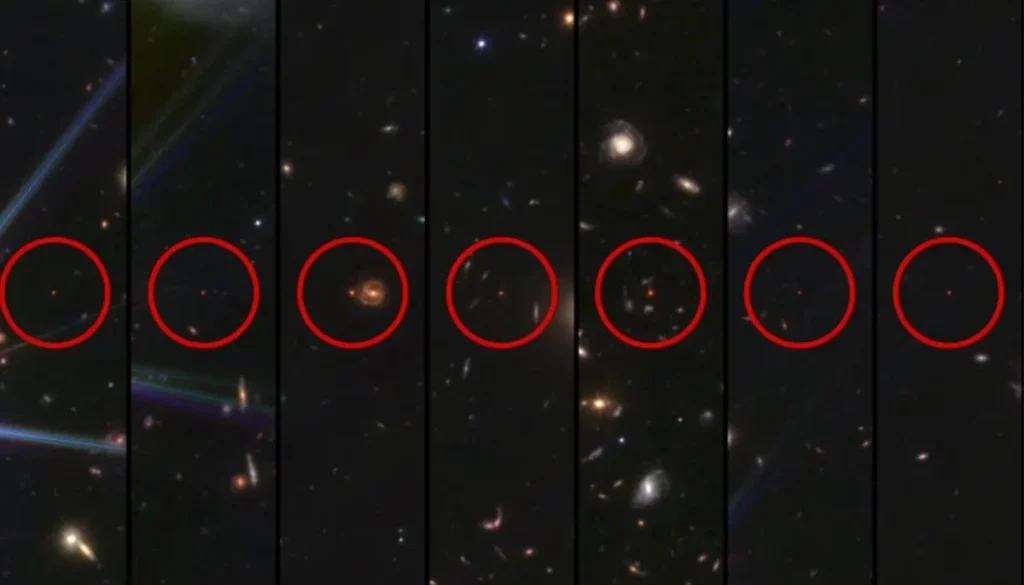
A Simulation Connects Two Cosmic Mysteries
A team led by Sunmyon Chon at the Max Planck Institute for Astrophysics investigated the origins of early massive black holes. Their study appeared in Nature on September 16, 2026.
Using Japan’s ATERUI III supercomputer, the researchers followed gas, gravity, and radiation within an early cosmic environment. They then examined individual clouds and the dense structures around newly formed black holes.
Systems resembling Little Red Dots emerged through those modeled processes. This matters because the calculation links an object’s formation with the light astronomers could observe.
However, a natural outcome within a simulation still depends on its assumptions. The result establishes a plausible physical pathway, rather than confirming every red source has the same identity.
How Black Holes Get a Massive Head Start
Nearby Galaxies Change the Conditions
Intense far-ultraviolet radiation from neighboring galaxies changes how nearby gas behaves. It suppresses molecular cooling, delaying ordinary star formation and allowing a large gas reservoir to accumulate.
Eventually, exceptionally massive stars develop within this environment. The detailed calculations allow multiple objects to form, so the process does not require gas to remain completely unfragmented.
These stars can reach several hundred thousand solar masses before collapsing. Their remnants provide black hole seeds approaching one million solar masses.
Starting Large Makes a Difference
Such a beginning gives these objects a substantial advantage over smaller stellar remnants. They already possess considerable mass before their main feeding episodes begin.
In the same simulation, smaller seeds start at roughly 800 solar masses and grow inefficiently. Their surroundings struggle to retain the gas they need.
The comparison highlights the importance of both starting mass and a sustained fuel supply. It does not exclude every alternative route to massive black holes.
A Gas Cocoon Enables Rapid Growth
When Radiation Cannot Escape Easily
Dense gas gathers around the young black holes, forming thick disks and envelopes. Although this material feeds them, it also prevents radiation from escaping freely.
Normally, radiation from accreting material pushes against incoming gas. This competition underlies the familiar Eddington limit.
Here, some photons travel inward with the gas before they can escape. That trapping allows feeding rates several to a few dozen times the conventional Eddington rate.
The model therefore permits rapid growth without requiring a violation of physical laws.
A Brief Surge, Then Slower Evolution
The most intense feeding lasts less than a million years. Afterward, the available reservoir changes, and the growth rate declines.
By around 650 million years after the Big Bang, the simulated black holes reach approximately 30 million solar masses. Crucially, that final mass reflects their longer evolution, not just the brief initial surge.
The surrounding structure resembles a quasi-star-like system: a black hole embedded within dense, glowing gas. Here, “cocoon” describes the obscuring material without implying a perfectly spherical shape.
Why Little Red Dots Have Unusual Spectra
The proposal must explain more than fast growth. It also needs to account for the light Webb actually detects.
Radiation interacts with the surrounding gas before reaching an observer. This processing helps produce the distinctive spectrum associated with these compact sources.
Hydrogen provides another important clue. Little Red Dots often show broad hydrogen emission features, which researchers use to investigate their hidden central regions.
In this model, scattering by free electrons broadens the hydrogen lines. Consequently, line width does not necessarily measure gas motion alone.
That distinction matters when astronomers interpret black hole properties from spectra. A convincing explanation must reproduce several observed features together.
The simulation offers that connection between the dense feeding environment and observable signatures. Nevertheless, matching selected features does not establish that it explains every object.
What the Simulation Still Cannot Establish
Missing Jets and Winds
The researchers do not include kinetic feedback from black hole jets or winds. These processes could carry material away and reduce the amount available for growth.
For that reason, they treat the calculated growth as an upper limit under the assumption that this feedback is absent.
One Environment Cannot Represent Everything
The calculation follows a selected early region with conditions favorable for massive seed formation. Additional simulations must establish how often comparable environments produce similar outcomes.
Another question concerns the population’s evolution. Explaining a short obscured phase does not automatically explain why these sources become scarce at later cosmic times.
Their abundance, lifetimes, and changing environments must fit together. Those uncertainties leave meaningful work for both observers and theorists.
This also calls for careful wording. Scientists have modeled objects with relevant properties; they have not directly observed the complete formation sequence described here.
What Astronomers Need to Test Next
A useful next step is to repeat the calculations across different starting conditions. Researchers also need to assess how additional feedback changes the results.
Meanwhile, further Webb spectra can test the predicted hydrogen features and surrounding gas conditions. Comparisons across larger samples will help reveal whether one pathway explains many sources.
Little Red Dots May Reveal a Hidden Growth Phase
Little Red Dots may capture massive black holes during a brief period of growth behind dense gas. The proposed pathway combines unusually large seeds, abundant fuel, and trapped radiation.
Together, those ingredients could explain why these sources look unusual and how early black holes gained mass. The next challenge is establishing whether this sequence occurs widely enough to match Webb’s observations. For now, the simulation offers a promising, testable explanation.
Main sources:
- Nature — Overmassive black holes and little red dots naturally form in simulations : https://www.nature.com/articles/s41586-026-10985-8
- National Astronomical Observatory of Japan — Japanese Supercomputer Explains Webb’s Little Red Dots, : https://www.nao.ac.jp/en/news/science/2026/20260917-cfca.html
- Max Planck Institute for Astrophysics — How the Universe’s First Supermassive Black Holes Were Born, : https://www.mpa-garching.mpg.de/1154783/news20260917