
BY:SpaceEyeNews.
Young stars are reshaping NGC 7129, and the James Webb Space Telescope has revealed the activity in remarkable detail. Around 3,300 light-years from Earth, this stellar nursery contains glowing cavities, embedded protostars, and intricate streams of gas.
Webb’s infrared view reaches into dusty regions that conceal much of this activity at visible wavelengths. Yet the most compelling story concerns what those young stars do to their surroundings. As they grow, they move material, reshape clouds, and influence where other stars might emerge.
The result offers a striking view of a stellar birthplace undergoing constant change.
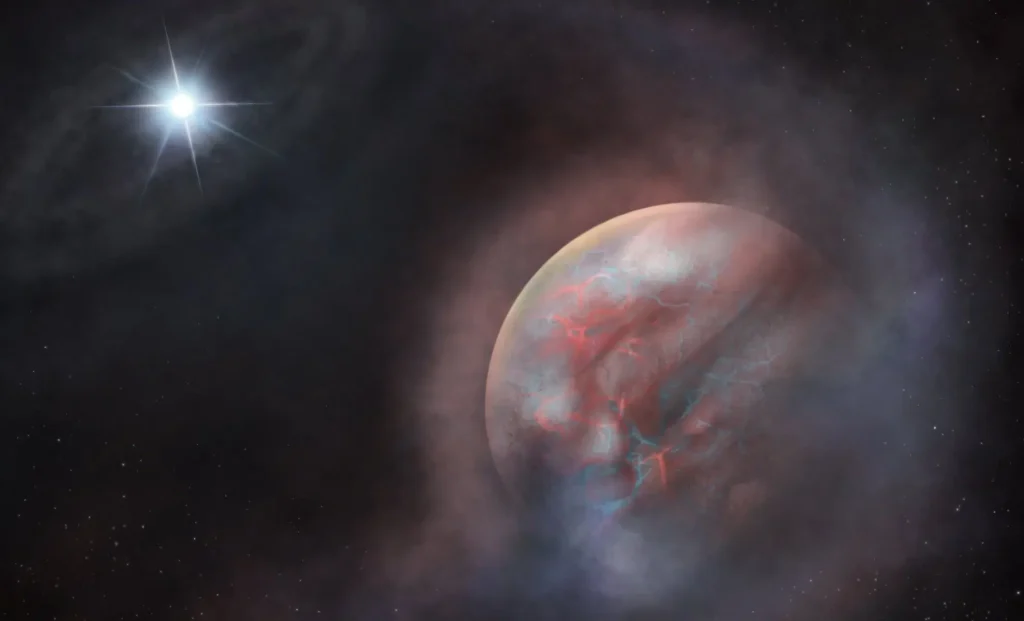
What Webb Reveals Inside NGC 7129
NASA released the new image on October 6, 2026. Webb’s Near-Infrared Camera, or NIRCam, captured a scene containing stars at different stages of development.
A broad golden cavity dominates much of the view. To its right, clumpy red structures conceal younger objects within thicker material. Along the cavity’s upper edge, a sharp ridge marks another transition in the surrounding gas.
These colors represent infrared observations, rather than the scene as human eyes would naturally see it. Gold highlights hot atomic hydrogen. Red represents cooler molecular hydrogen affected by shocks from embedded protostars.
Together, these regions reveal how stellar activity changes the same cloud in different ways. science.nasa.gov
The Young Star Shaping a Vast Cavity
Near the image’s center sits LkHα 234, a luminous young star with roughly five to eight times the Sun’s mass. Its prominent diffraction pattern makes it especially easy to identify. Those spikes come from the telescope’s optics; they are not streams leaving the star.
LkHα 234 has reached the pre-main-sequence stage. It has mostly finished gathering mass, but gravity continues to contract it and raise its internal temperature. Eventually, it will enter the sustained hydrogen-fusion stage familiar from stars like our Sun.
A Hollow Spanning 3.5 Light-Years
The golden cavity beside this star stretches approximately 3.5 light-years across. Outflows from an earlier stage of its development helped carve this space within the molecular cloud.
Both those outflows and the star’s light energize surrounding gas, making it glow. Meanwhile, the movement of material produces different outcomes across the region.
Some gas moves away, reducing the cloud’s available supply. Other material gathers into compressed regions, where conditions may favor additional star formation. Compression creates possibilities, however, rather than guaranteeing that every dense patch will produce a star.
Stellar Winds Sculpt the Cloud’s Edges
Several stars within the cavity also occupy the pre-main-sequence stage. Their stellar winds push into nearby gas, creating smaller cavities and curved structures called bow shocks.
These features show that the central star does not shape the entire scene alone. Multiple stars contribute to the surrounding patterns, each influencing material in its immediate neighborhood.
A Boundary Where Chemistry Changes
The sharp ridge above the golden cavity reveals another form of stellar influence. Light from the central and embedded stars heats the region beside colder, denser molecular gas.
Astronomers call this boundary a photodissociation region. Here, energetic radiation separates hydrogen molecules into individual atoms, changing the cloud’s chemistry.
This boundary helps connect the image’s striking appearance with the physical processes behind it. Over millions of years, radiation and winds gradually erode the cloud. The stars therefore influence how much material remains available for future stellar growth.
Hidden Protostars Reveal an Earlier Chapter
On the right side of NGC 7129, the red structures tell a different story. They contain protostars that occupy an earlier developmental stage than the more mature young stars around the cavity.
These objects continue to gather surrounding material and increase their mass. At the same time, they release outflows that interact with the dense gas around them.
Where these flows encounter surrounding material, shocks heat and disturb the gas. Those interactions contribute to the textured structures and red emission represented in Webb’s image.
Why the Patterns Look Tangled
Several protostars produce outflows within this crowded region. From Earth, some of their structures overlap along the same line of sight.
That overlap makes the scene difficult to interpret at a glance. A seemingly continuous feature may contain contributions from several young objects.
Tracing individual flows can help astronomers investigate how each protostar affects its surroundings. It also helps distinguish local activity from the larger changes occurring throughout the nursery.
Sharper Details and a Shadow in the Dust
Webb builds on earlier infrared observations from NASA’s retired Spitzer Space Telescope. The official comparison shows how Webb resolves finer gas and dust filaments within the same region.
This distinction matters: Spitzer also observed infrared light. Webb’s sharper view adds structural detail to an already familiar stellar nursery.
Another intriguing feature appears near the upper left, within a blue nebula. A protostar there has a surrounding disk that casts a shadow across nearby nebulosity.
NASA compares that feature with the “Bat Shadow” previously observed by Hubble. It provides another example of how young stellar systems shape the light and material around them. science.nasa.gov
What NGC 7129 Reveals About Stellar Feedback
Together, these features illustrate stellar feedback: the ways stars change their environment through radiation, winds, and outflows.
The region allows astronomers to examine several developmental stages within one shared setting. They can study how growing stars affect nearby gas while more mature neighbors reshape larger areas.
A central question remains how these processes influence the cloud’s future. Compression can support further star formation, while dispersal reduces the material available.
A Stellar Birthplace Still Changing
NGC 7129 captures an ongoing relationship between young stars and the cloud that produced them. Cavities, ridges, and overlapping outflows reveal different parts of that relationship.
Webb’s detailed observations give astronomers a clearer view of those connections. As researchers examine the data, this stellar nursery offers a valuable setting for understanding how one generation of stars influences the next.
Main sources:
NASA — NASA’s Webb Captures Commotion From Nebula’s Stellar Jets — Primary source for the verified details and image interpretation.
The Daily Galaxy — Webb Peers Through Cosmic Dust and Exposes a Chaotic Star Factory 3,300 Light-Years Away — Original coverage supplied for this article.