
BY:SpaceEyeNews.
The most distant fast radio burst ever identified has led astronomers to an unexpected home: a tiny galaxy buzzing with star formation. Its radio signal traveled for roughly 11 billion years before reaching Earth. Yet the galaxy behind it may offer an equally important discovery.
Called FRB 20240304B, the signal connects two scientific puzzles. It provides clues about what generates these brief radio flashes. It also helps researchers investigate the thin gas between galaxies. Together, MeerKAT and the James Webb Space Telescope have extended this approach into a much earlier chapter of cosmic history.
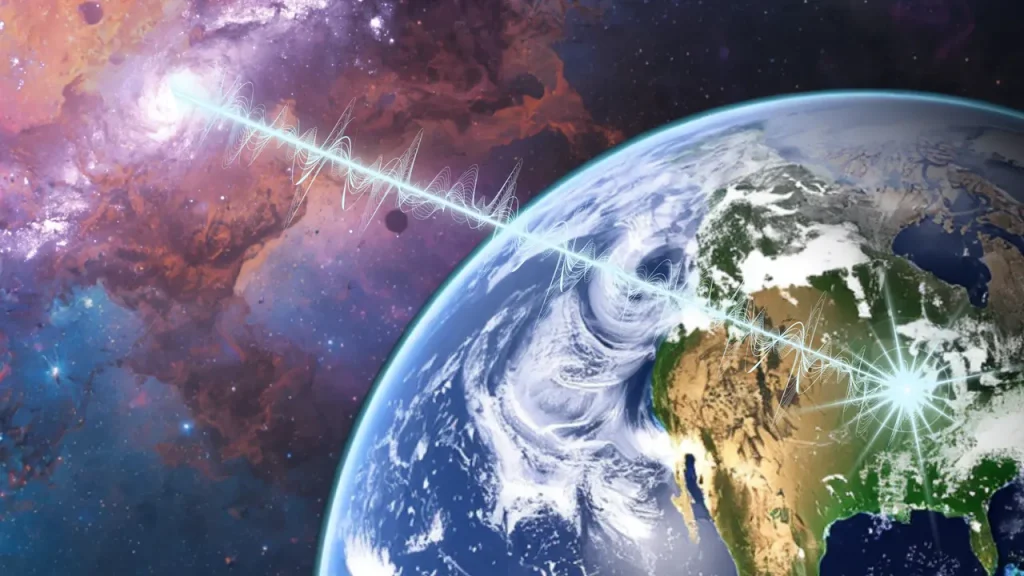
Most Distant Fast Radio Burst: An 11-Billion-Year Journey.
How Astronomers Traced the Most Distant Fast Radio Burst
The MeerTRAP team detected the signal with South Africa’s MeerKAT radio telescope on March 4, 2024. Its designation reflects that detection date. The research reached the journal Science in October 2026.
Radio observations gave astronomers a precise position. However, identifying the galaxy at that location proved difficult. Ground-based observations could not reveal its faint host, so the team turned to Webb.
Webb Found the Galaxy Behind the Signal
Webb’s Near-Infrared Camera, or NIRCam, revealed the host. Its Near-Infrared Spectrograph, NIRSpec, then measured a redshift of 2.148.
That measurement places the event around three billion years after the Big Bang. Astronomers therefore see the galaxy as it appeared long before our solar system existed.
The distinction between the telescopes matters. MeerKAT detected the radio flash. Webb studied the galaxy and established its place in cosmic history. science.nasa.gov
A Record That Needs Careful Wording
This discovery roughly doubles the redshift reach of FRBs with identified hosts. However, that does not mean the signal traveled twice as long as the previous record holder.
Redshift describes how cosmic expansion stretches light during its journey. It does not increase in direct proportion to travel time.
For readers, the clearest description is a signal that traveled for roughly 11 billion years. Calling its host simply “11 billion light-years away” can blur different ways astronomers measure cosmic distances.
The significance remains striking: researchers can now investigate an FRB from an era far earlier than most known examples. arxiv.org
Why This Tiny Galaxy Surprised Scientists
The host’s properties challenged the team’s expectations. Instead of a large stellar population, Webb revealed a dwarf galaxy with vigorous star formation.
NASA describes its stellar mass as approximately 1,000 times lower than the researchers expected. The galaxy also contains relatively few heavy elements. Astronomers use “metal-poor” for this chemical characteristic, including elements beyond hydrogen and helium.
These details matter because a host galaxy provides context for an otherwise fleeting signal. Its stars and chemical composition help researchers evaluate which source populations could exist there.
A Young Stellar Population at Cosmic Noon
The galaxy existed during cosmic noon, when the universe’s overall star formation activity reached its peak.
Its current star formation rate suggests that much of its stellar population could have formed within about 30 million years. That estimate points to rapid growth. It does not establish the precise age of every star.
Such an active environment gives scientists a useful clue: the process behind this FRB may follow star formation relatively quickly. esawebb.org
Does the Discovery Point to a Magnetar?
Magnetars remain leading candidates for producing fast radio bursts. These compact stellar remnants have exceptionally strong magnetic fields.
The key issue here is timing. A massive star can evolve quickly and leave behind a young magnetar. That route allows FRB activity to begin without a prolonged wait.
Other proposed pathways involve neutron-star mergers, which can require much longer delays. The host’s young stellar population makes a lengthy formation route less convincing for this particular event.
Nevertheless, the evidence remains indirect. Researchers have characterized the galaxy, rather than individually identified the object that emitted the signal.
The result supports a magnetar explanation without proving it. Nor does one discovery establish that every FRB shares the same origin. Different host environments may still point toward multiple formation pathways. esawebb.org
What the Radio Signal Reveals Between Galaxies
The burst also carries information about the material along its path. Space between galaxies contains thin, ionized gas that can affect radio signals.
As the pulse crosses this material, lower radio frequencies arrive later than higher frequencies. Measuring that difference lets astronomers estimate the accumulated free electrons along the route.
Combining this information with the host’s distance strengthens its scientific value. Researchers can investigate how ordinary matter spreads through otherwise difficult-to-observe regions.
Reading the Imprint of Intervening Structures
The signal’s path intersects the nearby Virgo Cluster and a more distant foreground galaxy group. Gas associated with these structures contributes to its measured dispersion.
Scientists must account for those contributions when interpreting the signal. They must also consider material within our galaxy and near the source.
This approach probes matter along one direction. It does not provide a complete cosmic map or directly measure dark matter. arxiv.org
What Comes Next for Distant Radio Bursts?
Finding more distant examples would let researchers compare FRB environments across different periods of cosmic history. They could test how frequently these signals accompany young stellar populations.
A larger sample would also improve studies of gas between galaxies. Each additional sightline offers another measurement through the cosmic web.
The discovery demonstrates the value of coordinated observations. Radio telescopes locate fleeting signals, while Webb investigates faint hosts.
Still earlier detections remain a possibility, rather than an accomplished result. This event reaches cosmic noon, not the birth of the universe’s first stars.
A Brief Signal With Lasting Scientific Value
The most distant fast radio burst offers more than a new record. Its small, active host strengthens a possible connection with young magnetars. Meanwhile, its long journey provides information about intervening gas.
The source remains uncertain, but the observations narrow the questions. Future discoveries could show whether this surprising galaxy represents an exception or a broader pattern in the distant universe.
Main sources:
NASA: Webb Measures Distance to Farthest Fast Radio Burst, Suggesting Origin
ESA/Webb: Webb measures distance to farthest fast radio burst, suggesting origin
Research paper: A fast radio burst from the first 3 billion years of the Universe