
BY:SpaceEyeNews.
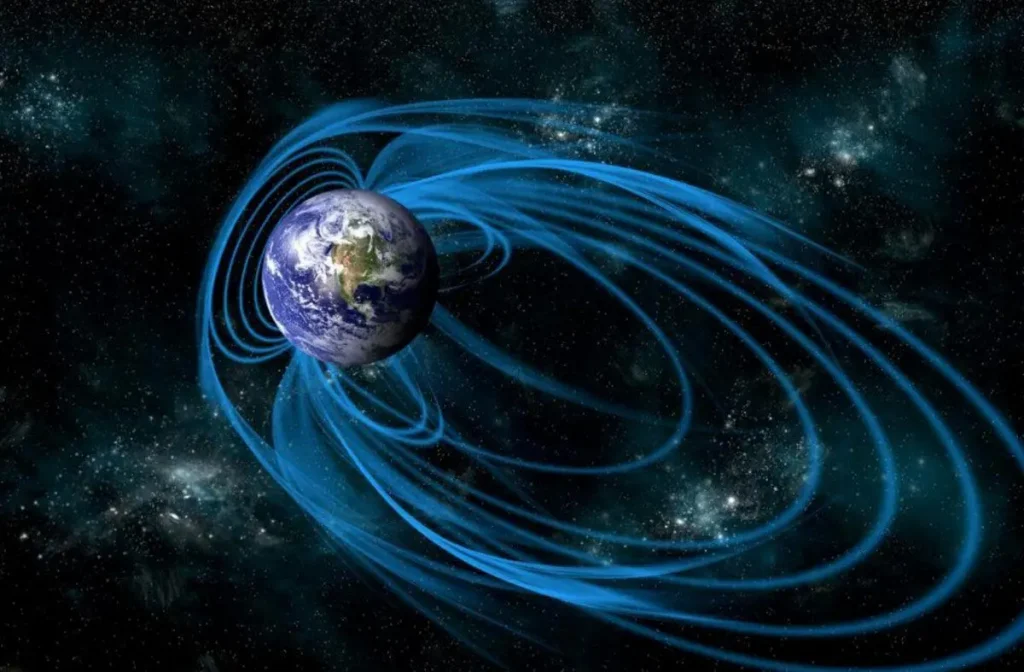
Earth’s magnetic reversal now has an unsettling soundtrack. Scientists have transformed a reconstruction of the Laschamp excursion into creaking, rumbling sounds that follow changes in our planet’s magnetic field. Around 41,000 years ago, that field weakened dramatically and briefly reversed its polarity.
The result offers a striking way to explore an invisible event. However, nobody recorded these sounds in prehistoric times. Researchers created them from scientific data and natural audio recordings, giving listeners a new perspective on Earth’s magnetic history.
How Scientists Made Earth’s Magnetic Reversal Audible
Researchers at the Technical University of Denmark and Germany’s GFZ research centre developed the audiovisual presentation. ESA shared it in October 2024, so the sound project itself is not a new discovery.
The team reconstructed changes in magnetic strength and direction, then translated those variations into an evolving soundscape. Sound artist Klaus Nielsen blended recordings of creaking wood and falling stones into the composition.
This approach, called sonification, represents information through sound. Here, the noises accompany a visualization of shifting magnetic field lines. Their unsettling character comes from the creative treatment of the data, rather than an actual sound emitted by reversing poles. www.gfz.de
Ancient Rocks Supply the Evidence
Volcanic rocks and sediment cores preserve clues about the magnetic field when they formed. Researchers analyze those records to reconstruct past conditions.
ESA’s Swarm satellites, meanwhile, measure the modern field and help scientists understand its behavior. They cannot directly observe an event from 41,000 years ago.
That distinction matters. Geological evidence anchors the ancient reconstruction, while satellite observations improve our understanding of the magnetic system operating today. Together, these approaches connect long histories with detailed modern measurements. www.gfz.de
These reconstructions have limits. Ancient records do not cover every region equally, and their dates carry uncertainties. As a result, models capture broad patterns more reliably than fine detail. The animation offers a scientifically informed reconstruction, rather than a complete record of every magnetic change. blogs.egu.eu
The Laschamp Excursion: A Brief Magnetic Flip
The Laschamp event takes its name from French lava flows that preserved evidence of unusual magnetic directions. Scientists classify it as a geomagnetic excursion because the field eventually returned to its previous polarity.
During the disruption, the familiar arrangement of two dominant magnetic poles became more complicated. The reconstruction even shows intervals with multiple poles. ESA describes a minimum field strength of approximately 5% of today’s value.
Yet that minimum does not describe every stage of the event. Magnetic strength and direction changed throughout the excursion. www.gfz.de
Separating the Different Stages
A 2012 study of Black Sea sediments estimated that reversed magnetic directions persisted for about 440 years. The polarity transitions took approximately 250 years.
These figures refer to different stages within one reconstruction. They do not mean the entire event lasted 250 years, or that minimum strength continued throughout the reversed phase. www.sciencedirect.com
Earth’s magnetic reversal also did not remove all protection. The field weakened rather than vanishing completely, and the atmosphere continued shielding the surface. Describing the event as a total shutdown therefore creates a misleading picture. science.nasa.gov
What the Radiation Evidence Reveals
Researchers have another way to investigate weakened shielding: isotopes created when cosmic rays interact with the atmosphere.
Beryllium-10 provides a valuable record. Scientists examine its traces in ice and marine sediments, then compare them with magnetic reconstructions.
Research presented at the European Geosciences Union General Assembly in 2024 found substantially increased production during the Laschamp excursion. Average beryllium-10 production reached approximately twice the present-day rate.
That result supports increased cosmic-ray access to the atmosphere during a period of weak magnetic shielding. However, it does not establish that people everywhere received twice today’s radiation exposure. www.egu.eu
The distinction separates an atmospheric indicator from conditions at ground level. Local exposure depends on additional factors, including atmospheric protection and the type of radiation involved. The isotope record also cannot, by itself, establish the extent of ozone changes.
Did Magnetic Changes Affect Early Humans?
The possibility of environmental consequences makes the Laschamp event especially intriguing. Some researchers have explored whether altered atmospheric conditions increased ultraviolet exposure and encouraged protective behaviors.
Suggested responses include sheltering in caves, wearing clothing, or applying ochre to skin. However, those connections remain hypotheses.
In a 2025 EGU interview, researchers discussing related simulations emphasized that their study did not establish direct causation between geomagnetic conditions and human evolution. blogs.egu.eu
The same caution applies to suggestions linking the event with Australian megafauna extinctions or increased cave art. Similar timing alone cannot identify a cause.
Magnetic records demonstrate that an extraordinary excursion occurred. Establishing its effects on ecosystems and human behavior requires separate evidence. A compelling soundscape cannot resolve those questions, however dramatic it sounds.
Could Earth’s Magnetic Reversal Happen Again?
Modern observations make that question understandable. In October 2025, ESA reported significant expansion of the South Atlantic Anomaly.
Between 2014 and 2025, this weak-field region grew by an area nearly half the size of continental Europe. Satellites crossing it encounter increased radiation exposure, which can disrupt electronics.
Meanwhile, magnetic north has moved toward Siberia. Swarm observations also show strengthening over Siberia and weakening over Canada, illustrating the field’s uneven evolution. www.esa.int
However, regional weakening does not establish that another reversal is imminent. Scientists cannot turn these observations into a dependable countdown. science.nasa.gov
Monitoring still has immediate value. Satellite operators need information about radiation conditions, while navigation systems depend on updated magnetic models. Studying ancient extremes also helps researchers explore how near-Earth conditions might change under weaker shielding.
Listening to Earth’s Magnetic History
Earth’s magnetic reversal offers more than an eerie listening experience. The reconstruction connects geological evidence with an accessible representation of a remarkable planetary event.
Its strongest message comes from the evidence: magnetic protection can change substantially, and researchers can trace those changes across thousands of years.
Questions about ancient environmental consequences remain open. Continued observations and better reconstructions can sharpen the answers, while the soundscape invites a wider audience to explore the science.
Main sources:
- ESA — Sound of Earth’s magnetic flip 41,000 years ago
- GFZ — Sound of Earth’s magnetic flip 41,000 years ago
- European Geosciences Union — Cosmic rays streamed through Earth’s atmosphere 41,000 years ago
- NASA — Why variations in Earth’s magnetic field aren’t causing today’s climate change
- ESA — Swarm reveals growing weak spot in Earth’s magnetic field
- EGU — Chasing Auroras 41 Millennia Ago
- Original research — Dynamics of the Laschamp geomagnetic excursion from Black Sea sediments