
BY:SpaceEyeNews.
Nearly half a century after launch, Voyager 1 is approaching a distance that light needs an entire day to cross. The Voyager 1 distance milestone will place humanity’s farthest spacecraft approximately 25.9 billion kilometers from Earth. NASA expects it to reach that point on November 18, 2026. For engineers, the number carries a practical meaning: every command will need about 24 hours to arrive. A reply will require another day. This extraordinary separation highlights both Voyager’s endurance and the patience behind its continuing mission.
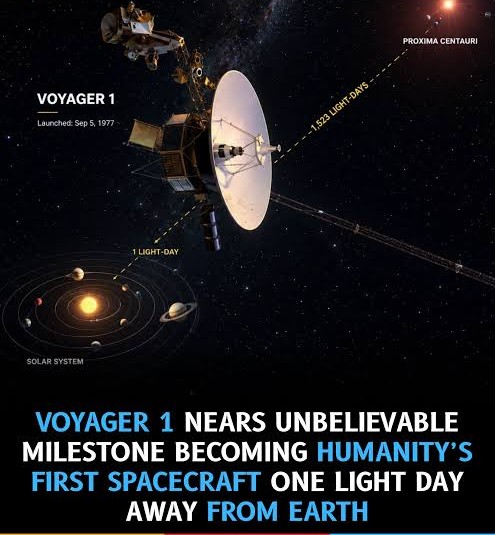
Voyager 1 Distance Milestone: One Light-Day From Earth
NASA places the crossing at approximately 5:16 a.m. Eastern Standard Time on November 18. At that moment, Voyager 1 will sit roughly 16.1 billion miles from Earth.
One light-day measures distance. It describes how far light travels through a vacuum in 24 hours. Radio signals travel at the same speed, making this measurement especially useful for spacecraft communications.
Crucially, NASA’s milestone measures the spacecraft’s separation from Earth, rather than its distance from the Sun. That distinction matters when discussing the timing. science.nasa.gov
A Record Without a New Boundary
Nothing dramatic will happen around Voyager when it reaches this marker. It will continue through the surrounding interstellar environment, following its existing path.
The significance comes from the record itself. No other human-made object has reached this distance from Earth. Almost five decades of travel have brought Voyager to a point that once belonged entirely to scientific imagination.
Why Communicating With Voyager Takes Two Days
Imagine sending a command on Monday and receiving confirmation around Wednesday. Near the milestone, that roughly describes the minimum signal travel time for a command and an immediate reply.
Actual operations can take longer. The spacecraft must execute instructions, and engineers must receive and assess the returning information. The communication delay leaves no room for instant troubleshooting.
Each exchange therefore requires careful planning. Teams must consider what the spacecraft should do before they can observe the outcome from Earth.
Listening for an Extremely Weak Signal
NASA uses its Deep Space Network to communicate with distant missions. Its antenna complexes operate in California, Spain, and Australia.
These widely separated locations help maintain access to spacecraft as Earth rotates. Large antennas and sensitive receiving equipment allow engineers to detect signals that arrive extraordinarily weak. spaceplace.nasa.gov
However, signal strength and travel time create different challenges. Better receivers help NASA hear Voyager. They cannot make its messages arrive faster.
The Voyager 1 distance milestone gives this familiar engineering problem a memorable scale: one day outward, another day back.
Nearly 50 Years Beyond the Original Mission
Voyager 1 launched on September 5, 1977, to investigate the outer planets. Its encounters with Jupiter and Saturn transformed scientists’ understanding of those worlds and their surroundings.
At Jupiter, the mission revealed active volcanism on Io. At Saturn, it examined the planet’s rings and gathered valuable information about Titan. voyager.gsfc.nasa.gov
Those discoveries alone would have secured Voyager’s place in exploration history. Yet the spacecraft continued outward, eventually giving researchers access to an environment beyond the planetary encounters.
From Planetary Explorer to Interstellar Observer
In August 2012, Voyager 1 crossed the heliopause and entered interstellar space. NASA announced that conclusion in 2013 after scientists examined the evidence. www.jpl.nasa.gov
That crossing marked a physical transition beyond the solar wind’s surrounding bubble. The upcoming light-day record marks something different: an unprecedented distance between Earth and a working explorer.
Interstellar Space Does Not Mean Beyond Everything
Voyager’s location can sound contradictory. It travels through interstellar space, yet it has not passed beyond every region associated with our solar system.
The explanation lies in the boundaries involved. The heliopause describes the outer boundary of the heliosphere. Much farther away, the distant Oort Cloud contains icy objects associated with the Sun.
NASA estimates that Voyager 1 needs roughly another 300 years to reach the Oort Cloud’s inner edge. Passing beyond that vast region could take about 30,000 years. science.nasa.gov
These estimates offer a striking perspective on the November record. Even a full light-day barely begins to describe the solar system’s most distant reaches.
A light-day should not be confused with a light-year. Voyager remains far short of the distances that separate the Sun from even nearby stars.
The milestone therefore deserves precise language. Voyager is already an interstellar spacecraft, but November does not mark its departure from the entire solar system.
Keeping Voyager Working as Power Runs Low
Distance is only one challenge facing the mission. Voyager also depends on a shrinking supply of electrical power.
On April 17, 2026, NASA engineers sent commands to shut down its Low-energy Charged Particles experiment. The decision conserved power to help keep the spacecraft operating.
The instrument had worked almost continuously since launch. Its measurements helped researchers investigate charged particles and changing conditions beyond the heliosphere. www.jpl.nasa.gov
Preserving the Mission Means Making Trade-Offs
Turning off an instrument reduces Voyager’s scientific capabilities. However, it also lowers demand on the spacecraft’s limited power supply.
That trade-off makes the approaching record more meaningful. Voyager’s continuing operation reflects repeated engineering decisions, alongside the durability of the spacecraft itself.
Its scientific value comes from taking measurements where researchers have very few direct observations. Voyager 1 and Voyager 2 remain the only spacecraft operating beyond the heliosphere. science.nasa.gov
The mission’s future depends on available power and the condition of aging systems. A distance milestone cannot guarantee how long useful communication will continue.
What the Voyager 1 Distance Milestone Really Means
The Voyager 1 distance milestone turns an enormous number into something people can grasp: a full day for light to travel home.
Reaching that separation requires no new destination or sudden change in speed. It reflects decades of outward travel and sustained engineering effort.
As November approaches, the achievement offers two perspectives at once. Human exploration has reached astonishing distances. Meanwhile, space remains so vast that our farthest spacecraft has spent nearly 50 years covering one light-day.
Every useful signal from Voyager connects those two realities.
Main sources:
- NASA — Voyager 1: What Is a Light-Day
https://science.nasa.gov/mission/voyager/voyager-1/voyager-1-what-is-a-light-day/ - NASA — Where Are Voyager 1 and 2 Now?
https://science.nasa.gov/mission/voyager/where-are-voyager-1-and-voyager-2-now/ - NASA — Voyager Frequently Asked Questions
https://science.nasa.gov/mission/voyager/frequently-asked-questions/ - NASA/JPL — NASA Shuts Off Instrument on Voyager 1 to Keep Spacecraft Operating
https://www.jpl.nasa.gov/news/nasa-shuts-off-instrument-on-voyager-1-to-keep-spacecraft-operating/ - NASA — Deep Space Network
https://www.nasa.gov/communicating-with-missions/dsn/