
BY:SpaceEyeNews.
Compact planet-forming disks are revealing details that astronomers could not previously see. New ALMA observations show rings, gaps, and cavities inside several tiny disks surrounding young stars. These features could help explain how planets grow within relatively small planetary nurseries.
The discovery challenges the impression that smaller disks have simpler interiors. Instead, some structures remained hidden because earlier images lacked sufficient resolution. However, the observations do not confirm Earth-like planets. They reveal environments that could support planet formation, alongside possible clues to developing worlds.
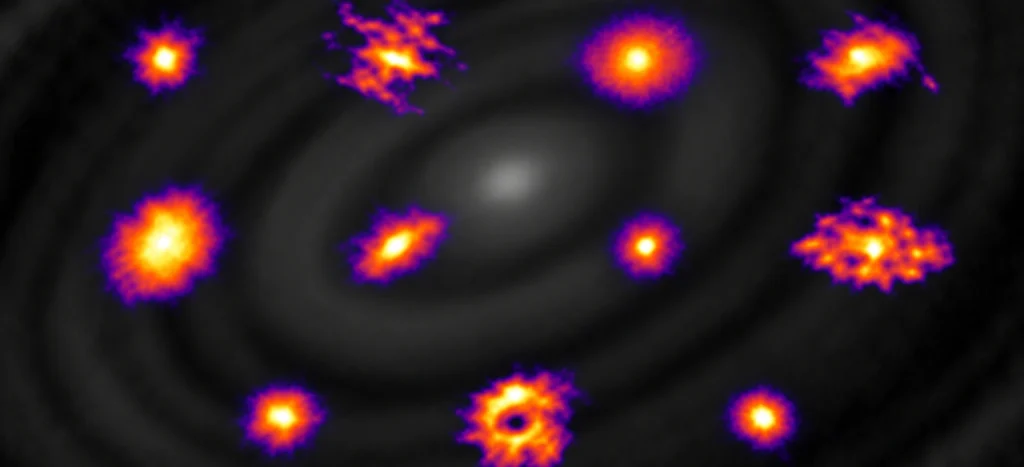
Compact Planet-Forming Disks Reveal Hidden Structures.
ALMA Brings Compact Planet-Forming Disks Into Focus
An international team led by Pietro Curone examined 11 extremely compact disks in the Lupus star-forming region. Curone works with the University of Chile and the Center for Astrophysics and Associated Technologies.
The researchers used ALMA’s most extended antenna configuration to separate closely spaced features. Observations at approximately 0.9 millimeters achieved an angular resolution of roughly 0.02 arcseconds.
That represents ALMA’s highest available angular resolution at this wavelength. The result gave researchers a sharper view of regions previously difficult to distinguish.
Seven Disks Reveal Structures or Promising Hints
Four disks showed clear internal structures within 10 astronomical units of their stars. Another three displayed indications of similar features. One astronomical unit equals the average distance between Earth and the Sun.
That distinction matters: the team did not find equally strong evidence across all seven systems. Nevertheless, the observations demonstrate that apparently smooth disks can conceal intricate details.
The findings also shift attention toward regions closer to young stars. Earlier detailed disk images often emphasized structures farther out. Exploring smaller orbital scales helps researchers connect observations of developing systems with the locations of planets around older stars. That connection remains a research goal, rather than proof that any particular disk will produce a familiar kind of planetary system.
Sz 112 Reveals a Tiny Central Cavity
One system, Sz 112, provides a particularly striking example. Its central cavity extends approximately 1.6 astronomical units from the star. This measurement describes the cavity’s radius, rather than its diameter.
The study identifies Sz 112 as the smallest known transition disk, a category characterized by an inner cavity. That description does not mean it is the smallest disk anywhere in the Universe.
An official comparison places Sz 112 beside HL Tau, a familiar example of a much larger disk. The images highlight how similar-looking structures can occur across very different physical scales.
Why the Image Scale Matters
The comparison includes an enlarged view of Sz 112. Readers should therefore check the scale bars before comparing apparent sizes. The tiny cavity offers a close look at structure on scales comparable to Earth’s orbital distance.
How Compact Planet-Forming Disks Could Preserve Dust
The newly visible structures matter because planet formation requires solid material to remain available long enough to grow. Dust particles do not simply stay in place throughout a disk’s lifetime.
Instead, particles can lose angular momentum and drift toward their star. This movement can remove material before it joins larger bodies.
Pressure concentrations offer a possible solution. They can slow or stop inward drift, allowing solids to accumulate in particular regions.
Rings Can Point to Favorable Conditions
Visible rings and gaps can indicate pressure variations that help retain dust. However, a gap itself is not automatically a dust trap. The relevant process involves how gas pressure influences nearby particles.
Finding such structures in compact planet-forming disks suggests that small systems may also preserve material for planet growth. Their limited size does not necessarily prevent them from hosting these useful conditions.
Could Super-Earths Explain the Gaps?
Developing planets offer one possible explanation for some observed structures. Their gravity could alter surrounding material and create gaps.
The researchers explored that interpretation by estimating the masses needed if a single planet produced each gap. For structures within five astronomical units, the estimates fall within the super-Earth and mini-Neptune range.
These possibilities make the observations especially interesting. They could reveal signs of relatively low-mass planets during formation, in regions that remain difficult to investigate.
Possible Planets, Not Confirmed Discoveries
The interpretation remains conditional. Rings, gaps, and cavities do not constitute direct detections of planets. Other physical processes can also produce disk structures.
Nor does the term super-Earth establish Earth-like surface conditions. The observations do not demonstrate oceans, breathable atmospheres, or habitability.
The strongest conclusion concerns the disks themselves: astronomers can now distinguish structures that earlier observations missed. Determining whether planets created them requires additional evidence.
Faint Outer Rings Reveal More Extensive Disks
The observations also uncovered faint outer rings around Sz 73 and Sz 130. These extend beyond the systems’ bright central disks.
Their presence raises another question about apparent disk size. A concentrated bright region can dominate an image while fainter material remains difficult to detect.
Consequently, some systems classified as compact may contain more extensive material than their brightest regions suggest. This does not erase the distinction between small and large disks. It shows why sensitivity matters alongside resolution.
Together, the inner structures and outer rings reveal two observational challenges. Astronomers must separate closely spaced features while also detecting weak emission farther out.
What Future Observations Need to Establish
Further studies can test how often compact disks contain these features. A larger sample would help researchers assess whether the observed systems represent broader patterns.
Observations at different wavelengths could also clarify the distribution of dust. Measurements that trace gas would add information about the surrounding disk environment.
Most importantly, follow-up work must investigate what produces the structures. Establishing a planetary explanation would strengthen the connection between these young disks and mature planetary systems.
Compact Planet-Forming Disks Offer a Clearer View of Origins
Compact planet-forming disks now look more intricate than earlier images suggested. ALMA has revealed features that could preserve dust and, in some cases, reflect developing planets.
The discovery advances the study of planetary origins without confirming another Earth. Its value lies in opening previously inaccessible regions to closer investigation, helping astronomers explore how small planetary nurseries might develop into diverse systems of worlds.
Main sources:
- ALMA Observatory: ALMA Reveals Hidden Planet-Forming Structures in the Smallest Disks
- University of Chile: Astronomers Reveal Planet-Formation Structures in Tiny Stellar Disks
- Universe Magazine: Building blocks of Earth-like planets discovered in the smallest protoplanetary disks in the Universe.