
BY:SpaceEyeNews.
The JWST mysterious signal has given astronomers a puzzle in one of the sky’s most closely studied regions. Webb detected infrared emission where existing images show no identifiable source. The signal appeared during two observing sessions, 88 days apart, yet its origin remains uncertain.
Researchers found it in the Hubble Ultra Deep Field, a region familiar from decades of observations. Earlier images offer no clear counterpart. That mismatch raises an intriguing question: what produced light that Webb could measure, while leaving no obvious object in those images?
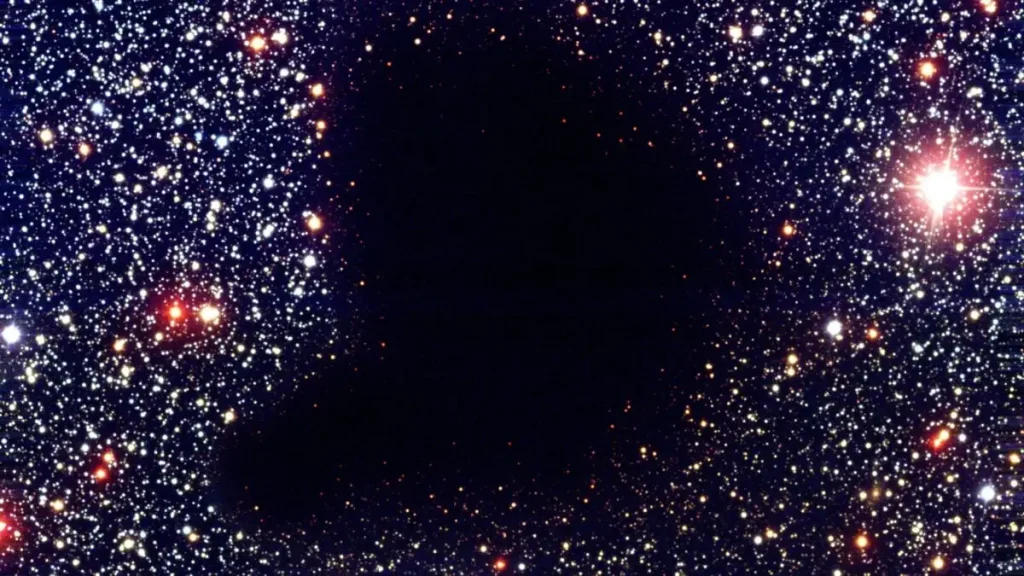
JWST Mysterious Signal — Barnard 68 Illustration.
How Webb Found the Unexpected Source
Mason Huberty of the University of Minnesota and his colleagues approached the field differently. Instead of selecting visible objects for detailed study, they searched for emission that might reveal overlooked sources.
Their method uses Webb’s Near-Infrared Spectrograph, or NIRSpec. The instrument’s tiny shutters control which light enters for analysis. Normally, researchers configure them around selected targets.
For this search, the team opened nearly all the shutters, while closing those covering selected known foreground objects. This reduced interference from sources that could complicate the measurements.
The technique carries the name Multiobject Coronagraphy for Slitless Spectroscopy, shortened to MOCSS. It lets researchers search spectra without first requiring an obvious object in an image.
Six detections matched distant galaxies. Another detection presented a much harder identification problem.
Why the JWST Mysterious Signal Stands Out
A Detection Across Separate Observations
The unusual feature appeared at approximately 1.6 micrometers, within the near-infrared range. Researchers detected it across four combined exposure sets and two observing orientations.
Those observations took place in August and November 2023. Different orientations helped the team check whether the feature came from an instrumental artifact or overlapping light.
Its consistent appearance strengthens the case for a real source. However, two observing sessions do not establish a periodically repeating signal or continuous activity between those dates.
The Earlier Images Showed No Counterpart
The more difficult clue comes from Webb’s earlier JADES imaging, taken in October 2022.
At its measured brightness, the emission should have contributed enough light to appear in those images. Yet researchers found no corresponding source.
Perhaps the source changed between the imaging and spectroscopy. A temporary brightening could help explain the difference, although that possibility creates further questions about what happened.
The Missing Clue Is Its Distance
One emission line leaves astronomers with an identification problem. Different substances emit light at characteristic wavelengths, but cosmic expansion shifts those wavelengths during their journey.
Consequently, the observed infrared feature could represent different emissions originating at different distances. Researchers cannot confidently choose between those possibilities from this line alone.
Additional lines would provide a pattern for comparison. That pattern could establish the source’s redshift and narrow down the physical process behind its emission.
Until then, claims about its precise distance or age would go beyond the evidence. The observations reveal a location on the sky, but its place along that sightline remains uncertain.
Could an Unusual Galaxy Explain the Signal?
An Early Galaxy Faces Difficult Conditions
One possibility places the source in the early Universe. Under this interpretation, Webb detected hydrogen emission that cosmic expansion shifted into infrared wavelengths.
However, neutral hydrogen surrounding early galaxies can strongly absorb this proposed emission. Explaining its arrival would require favorable conditions along its path.
The lack of detectable background light from the source adds another difficulty. Together, these features make the early-galaxy interpretation demanding, rather than impossible.
A Later Galaxy Also Leaves Questions
A galaxy from a later cosmic era offers other possible line identifications. Yet several interpretations predict companion features that researchers did not detect.
The isolated emission also appears unusually strong relative to the missing background light. An extreme stellar population might explain some characteristics, but no galaxy interpretation fits everything comfortably.
Could a Temporary Event or Black Hole Explain It?
A Source That Changed Over Time
A temporary event could explain why the earlier images show no counterpart. The source might simply have been fainter when Webb collected those images.
Researchers considered a particular type of supernova. However, that scenario predicts another emission line absent from the available spectrum. Dust could weaken that companion feature, so the missing line does not settle the question alone.
Another possibility involves a star passing too close to a supermassive black hole. Such an encounter can produce a luminous flare, with strong emission persisting after other light fades.
The available observations cannot establish whether such an event occurred.
Activity Beyond the Visible Source
The study also considers an active galactic nucleus. In another scenario, activity in a neighboring galaxy could illuminate a separate cloud of gas.
That would help explain why the emitting material lacks an obvious source at the same position. Nevertheless, missing companion lines and other constraints still complicate these explanations.
What Could Solve the JWST Mysterious Signal?
Deeper spectroscopy offers a direct route forward. Detecting additional lines could reveal both the source’s distance and the nature of its emission.
The researchers specifically propose observations with NIRSpec’s integral field unit. This would allow them to examine the mysterious location and nearby galaxies together.
New measurements could also test whether its brightness changes over time. Such information would help distinguish persistent emission from a temporary event.
These are proposed investigative steps. The study does not present a completed follow-up that resolves the mystery.
An Unseen Source, an Open Question
The JWST mysterious signal highlights how a different observing strategy can uncover surprises in familiar territory. Astronomers have measurable emission, repeated detections, and several possible explanations. What they lack is enough evidence to identify the source confidently.
For now, “empty space” means no visible counterpart in existing images. The next useful clue may come from finding another line of light.
Main sources:
- Original research — Huberty and colleagues, A Single Line-Emitter Identified in an Unbiased Search with JWST/NIRSpec.
- NASA — Near-Infrared Spectrograph (NIRSpec).
- ScienceAlert — Astronomers Have Detected a Mysterious Signal Coming From Empty Space.