
BY:SpaceEyeNews.
Where does space begin? For a passenger flying 90 kilometres above Earth, the answer depends on which standard you choose. That altitude exceeds the threshold used for American spaceflight recognition. Yet it falls short of the 100-kilometre Kármán line used by the Fédération Aéronautique Internationale, or FAI.
The difference reaches beyond terminology. Commercial operators sell journeys into this region, while governments still lack a universally agreed boundary between airspace and outer space. Scientific evidence helps explain the transition. However, choosing a boundary also means deciding what that line should govern.
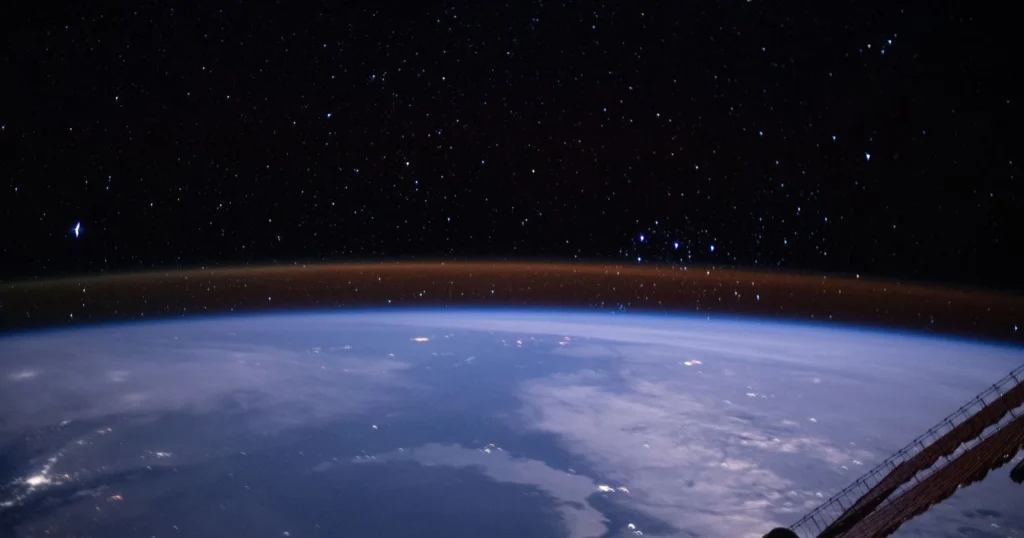
Where Does Space Begin? Earth’s Glowing Horizon.
Where does space begin under existing standards?
The FAI adopted its 100-kilometre boundary in 1960 to distinguish aviation records from astronautics records. That purpose matters. A sporting convention does not automatically establish an international legal border.
Meanwhile, 50 statute miles equals approximately 80.47 kilometres. American astronaut recognition programmes have historically used that lower threshold.
These standards answer particular institutional questions. Neither creates a visible boundary above Earth, nor does either settle every question about spaceflight.
Even Theodore von Kármán discussed a range rather than one exact altitude. FAI technical material places his suggested range at roughly 91–122 kilometres. The familiar 100-kilometre figure sits within it.
Consequently, treating that round number as a precise physical discovery oversimplifies its origins. www-2025.fai.org
Why science produces different answers
The case for an 80-kilometre boundary
Astronomer Jonathan McDowell revisited the issue in a 2018 paper published in Acta Astronautica. He proposed 80 kilometres as a more appropriate boundary.
His approach examined orbital trajectories and atmospheric drag. Essentially, he asked how low orbiting objects could dip before atmospheric resistance overwhelmed their ability to continue around Earth.
This focuses attention on the lowest part of an elliptical orbit. It does not imply that satellites can maintain ordinary, long-lived circular orbits at 80 kilometres.
McDowell’s proposal offers a physical argument for a lower convention. It does not establish that every other definition is scientifically meaningless. arxiv.org
Why another analysis suggests 110 kilometres
Nicolas Bérend’s FAI presentation examines the transition through aerodynamic lift and orbital behaviour. Under its chosen vehicle assumptions, the analysis identifies an altitude near 110 kilometres.
However, changing those assumptions changes the result. Bérend also distinguishes this lift-based approach from McDowell’s drag-based reasoning.
The apparent disagreement therefore reflects different questions. One approach examines orbital survival; another examines the changing conditions for sustained horizontal flight.
Science can identify useful transitions without selecting one compulsory boundary for records, recognition, and international law. www-2025.fai.org
Space tourism puts the gap on display
The contrast became especially visible in July 2021.
Richard Branson joined Virgin Galactic’s Unity 22 flight on July 11. The company reported an altitude of 53.5 miles, approximately 86 kilometres. Nine days later, Jeff Bezos travelled aboard Blue Origin’s New Shepard beyond 100 kilometres.
Branson’s flight exceeded the American recognition threshold but remained below the FAI boundary. Bezos’s flight crossed both. x.com
For customers, that distinction affects what a journey advertised as reaching space actually promises. Clear altitude information helps explain the experience without pretending that every organization applies identical criteria.
Crossing either threshold also differs from entering orbit. Both missions followed suborbital trajectories and returned to Earth.
Astronaut wings and recognition are different
The Federal Aviation Administration ended its Commercial Space Astronaut Wings programme after 2021. It now lists qualifying participants online.
Its recognition threshold remains 50 statute miles for eligible commercial flights. Crucially, the FAA explicitly states that it does not define where space begins. It also no longer designates people as astronauts.
Calling 50 miles America’s definitive legal boundary would therefore misrepresent the agency’s position. www.faa.gov
Where does sovereign airspace end?
The legal question carries broader consequences.
Article 1 of the Chicago Convention recognizes each country’s complete and exclusive sovereignty over the airspace above its territory. The Outer Space Treaty, meanwhile, prohibits national appropriation of outer space.
Neither treaty supplies an agreed altitude separating those domains. www.icao.int
Consider a vehicle passing above another country at 90 kilometres. A universally accepted boundary could help clarify whether it occupies sovereign airspace or outer space.
However, an altitude alone would not answer every legal question about that journey. International law also applies to activities in outer space.
The uncertainty concerns where legal regimes meet, rather than whether rules exist at all. UN discussions continued in 2026, reflecting the difficulty of reaching agreement across different national positions. www.unoosa.org
High-altitude vehicles add practical pressure
Advanced high-speed vehicles further complicate the picture because some trajectories cross the disputed band.
A 2023 Congressional Budget Office analysis modelled a boost-glide vehicle reaching approximately 120 kilometres. It then spent most of its flight at 30–40 kilometres. www.cbo.gov
Those figures illustrate why trajectory matters. Passing through the 80–100-kilometre region does not mean remaining there throughout a flight.
An agreed boundary could clarify some sovereignty questions. Nevertheless, it would not automatically determine whether a particular passage complies with international law.
Why the Kármán line remains at 100 kilometres
The FAI has considered the lower alternative. In 2018, it acknowledged a scientific case for examining an 80-kilometre boundary.
Its 2025 commission minutes nevertheless reaffirmed the decision to retain 100 kilometres. www.fai.org
Changing that records standard would also differ from negotiating a global legal agreement. One institution can revise its criteria without settling the positions of governments worldwide.
Where does space begin? Agreement still matters
“Where does space begin?” remains a practical question with several institutional answers. The atmosphere provides a gradual transition, while organizations need usable thresholds.
For passengers, clear definitions make commercial claims easier to understand. For governments, agreement could clarify the relationship between airspace and outer space.
The challenge extends beyond choosing 80 or 100 kilometres. Countries and institutions must also decide what crossing that boundary means.
Main sources:
- FAI: Technical presentation on the Kármán line
- Jonathan McDowell: The edge of space: Revisiting the Karman Line
- FAA: Human Space Flight
- Virgin Galactic: Unity 22 altitude announcement
- Blue Origin: First human flight announcement
- ICAO: State sovereignty over airspace
- United Nations: Outer Space Treaty
- Congressional Budget Office: 2023 flight analysis
- FAI: 2025 commission meeting minutes