
BY:SpaceEyeNews.
A wandering black hole has revealed itself through the brilliant flare of a star that passed too close. The event, called TDE 2023mfm, occurred roughly 3,500 light-years from its galaxy’s center. That unusual location makes the discovery especially interesting.
Most familiar massive black holes occupy galactic centers. This one appears to sit elsewhere within a galaxy that already hosts a central active black hole. Together, those clues raise a compelling question: did an earlier encounter between galaxies leave a second black hole behind?
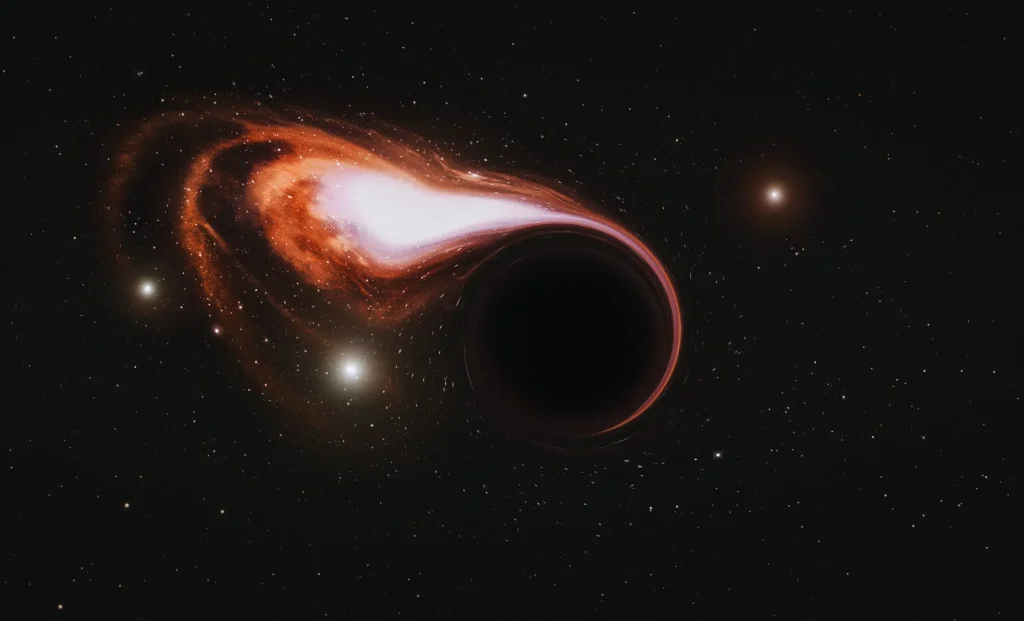
Wandering Black Hole Revealed by a Star’s Final Glow.
How a Wandering Black Hole Became Visible
A passing star supplied the light
Black holes can remain difficult to detect when little material surrounds them. However, a nearby star can change that situation dramatically.
When a star approaches closely enough, differences in gravitational pull across it can overcome its own gravity. Astronomers call the resulting process a tidal disruption event, or TDE. Hot stellar debris then produces radiation that telescopes can observe.
In this case, the star revealed an existing black hole. It did not create the black hole or transform into one.
The Zwicky Transient Facility first detected the event. Researchers then combined observations from several facilities to investigate its brightness, position, and changing emissions.
Several telescopes helped establish the picture
The observing campaign included Hubble, Keck, Lick, Swift, Chandra, XMM-Newton, and the Very Large Array. Each contributed information across different wavelengths.
Optical and ultraviolet measurements helped characterize the flare. Meanwhile, high-resolution imaging established its position away from the galaxy’s nucleus.
This combination matters because a bright flare alone cannot explain the entire system. Researchers also need to determine where it originated and how its emissions developed.
Why the Black Hole’s Location Matters
Measurements placed TDE 2023mfm about 1.08 kiloparsecs from the galactic nucleus. That corresponds to approximately 3,500 light-years.
Importantly, this figure describes the projected separation across our view of the galaxy. It does not represent the galaxy’s distance from Earth. The actual three-dimensional separation could be larger.
Radio observations also distinguished emission near the disruption site from emission at the galaxy’s center. That supports the presence of two separate active locations.
Calling the object “wandering” describes its position outside the nucleus. It does not mean astronomers have directly measured it speeding across the galaxy.
A Massive Object With a Familiar Flare
Millions of solar masses
The research estimates a black hole mass on the order of millions of Suns. Different methods produce estimates spanning roughly one million to ten million solar masses.
These values describe mass, rather than physical diameter. They also carry uncertainty, so no single exact figure captures every estimate.
Although its location stands out, the flare shares several features with other optically detected tidal disruption events.
Hot debris and a fading glow
The optical emission rose to maximum brightness over approximately a month. It then faded during the following months.
For more than a month after its peak, the emission remained near 20,000 Kelvin. A broad hydrogen emission feature provided another clue about the event’s nature.
Together, the temperature, changing brightness, and spectrum supported the tidal disruption interpretation. The unusual setting therefore accompanied a recognizable type of stellar event.
Could a Smaller Galaxy Explain This Wandering Black Hole?
One possibility involves a past merger with a smaller galaxy.
As galaxies merge, the smaller system can lose many of its outer stars. Its dense central region may survive longer, potentially retaining its original black hole.
Researchers found evidence consistent with a compact stellar population at the flare’s location. Its estimated stellar mass ranges from ten million to one hundred million Suns.
That concentration could represent a dwarf galaxy or the remaining core of a stripped galaxy. Either interpretation could help explain why a massive black hole occupies this position.
However, the evidence does not establish a complete history. The host shows no obvious signs of a recent major merger. A smaller encounter remains possible, and the proposed stellar structure needs further investigation.
Why Did the Radio Signal Appear So Late?
An unusually long wait
The event’s radio behavior adds another puzzle. Early monitoring found no radio emission associated with the flare.
A faint signal became detectable around 991 days after the event, roughly 2.7 years later. Its subsequent evolution appeared slow.
This timing contrasts with the earlier optical display. It suggests that the conditions producing detectable radio waves developed differently from those responsible for the initial flare.
Several explanations remain possible
Material flowing outward could eventually encounter surrounding gas and generate radio emission. Alternatively, a delayed outflow could account for the late signal.
The researchers favor a delayed outflow, but additional observations must test that interpretation. The detection date alone cannot establish precisely when the underlying activity began.
Meanwhile, observations did not detect X-rays from the disruption site. A faint X-ray source near the nucleus more likely belonged to the central active black hole.
What Astronomers Could Learn Next
Continued radio monitoring could reveal how the outflow evolves and interacts with its surroundings. Deeper imaging may also clarify the stellar population near the flare.
Those measurements could help distinguish a surviving smaller galaxy from a stripped remnant. They may also strengthen or weaken particular explanations for the black hole’s origin.
For now, this wandering black hole demonstrates how a passing star can expose an otherwise hidden massive object. Its location offers a valuable clue to galactic history, while its delayed radio signal leaves an intriguing question open.
Main sources:
- Sfaradi et al., An Off-Nuclear Tidal Disruption Event Discovered At Late Times: The Case Of TDE 2023mfm: https://arxiv.org/abs/2609.35998
- Li et al., VLA Observations Confirm AT 2023mfm as an Off-nuclear Tidal Disruption Event: https://arxiv.org/abs/2606.06595
- Daily Galaxy, original coverage: https://dailygalaxy.com/2026/10/dying-star-revealed-a-massive-black-hole/