
BY:SpaceEyeNews.
Milky Way habitability may depend on something easy to overlook: time without major cosmic disruption. A new study suggests our galaxy offers a favorable balance between planetary ingredients and relatively quiet surroundings.
Researchers examined simulated galaxies to explore where potentially habitable worlds could enjoy lasting stability. Their findings place the present-day Milky Way among galaxies that efficiently provide such opportunities.
That makes our cosmic address encouraging. However, the study does not establish that life exists elsewhere. It examines the conditions that could give life a chance.
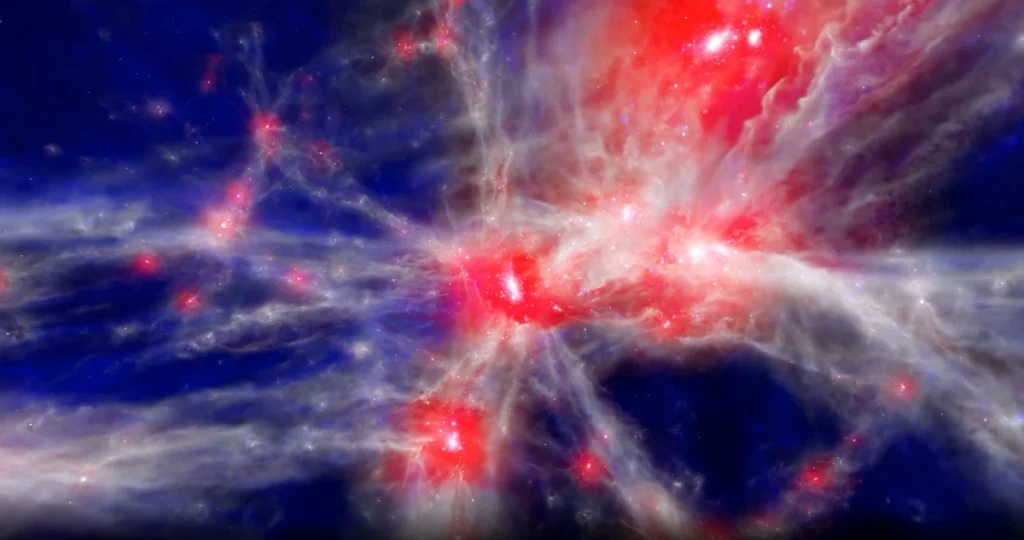
Galaxy Evolution in the EAGLE Simulation.
How Scientists Studied Milky Way Habitability
Luke Barnes and colleagues used the EAGLE simulations to investigate habitability across evolving galaxies. Their study appears in Monthly Notices of the Royal Astronomical Society.
EAGLE follows the development of cosmic structures through gravity, gas physics, star formation, and black hole activity. It provides a framework for comparing galactic environments across cosmic history.
The researchers then applied a habitability model to those simulated environments. They considered stars, the distribution of heavier elements, potential planet formation, and several sources of disruption.
This approach connects two questions that astronomers often examine separately. Where can suitable planets form? And how long might favorable conditions last?
Why Habitable Time Matters
The team assessed the time potentially habitable planets could provide relative to the amount of ordinary matter or stellar material.
This measure goes beyond counting promising worlds. A galaxy might create many planets while exposing them to frequent environmental disturbances.
Another environment could offer longer periods of stability. Those extended windows may matter for biological development, although the model cannot determine whether life actually begins.
Which Cosmic Conditions Did the Model Consider?
The researchers included five potentially serious influences on habitability. These were core-collapse supernovae, Type Ia supernovae, gamma-ray bursts, close stellar encounters, and quasars.
Their effects differ, so the model considers more than a single measure of galactic activity.
Radiation and Stellar Activity
Both categories of supernova can expose nearby environments to radiation. Gamma-ray bursts represent another source of intense radiation, with consequences that depend on proximity and exposure.
Meanwhile, quasars mark highly active galactic centers. Matter gathering around a supermassive black hole can produce powerful emissions.
The relevant issue is that activity and its effects on surrounding environments. A black hole’s presence alone does not make an entire galaxy unsuitable for life.
Crowded Stellar Neighborhoods
Close encounters between stars introduce a different concern. Gravitational interactions can alter planetary orbits and disturb otherwise stable systems.
Consequently, local crowding matters alongside radiation. A planet’s wider neighborhood can influence its prospects even when its own star appears suitable.
These processes help explain why the researchers examined both galaxy properties and distance from galactic centers.
Why Our Galaxy Offers a Favorable Balance
The study’s central finding is reassuring: the present-day Milky Way is typical of galaxies that efficiently provide habitable time.
Its modeled combination of planetary opportunities and comparatively low cosmic hazards makes it a favorable environment.
The authors’ accompanying explanation highlights our neighborhood’s balance. Earlier stellar generations supplied heavier elements, while the Sun occupies a region away from the crowded galactic center.
Those elements provide materials for rocky planets and complex chemistry. However, their availability tells only part of the story.
A promising environment also needs enough stability to preserve its opportunities. The study therefore connects chemical enrichment with the changing activity of galaxies.
A Galaxy’s History Matters
The researchers found less favorable conditions in early, newly formed galaxies and systems with high star formation rates.
Such environments can contain more activity associated with short-lived massive stars. Their histories therefore influence the conditions surrounding potential planetary systems.
Still, galaxy size alone cannot settle the question. Chemical composition, local density, activity, and position within a galaxy all deserve attention.
The result does not crown the Milky Way as uniquely suitable. Instead, it places our home within a broader population of favorable galaxies.
What This Means for the Search for Life
Milky Way habitability offers a wider perspective on the search for living worlds. A suitable orbit around a star provides only part of the context.
The surrounding galaxy also has a history. Its changing chemistry and activity can shape the opportunities available to planetary systems.
One implication is that future habitability research could benefit from combining planetary characteristics with environmental history. That could improve comparisons between promising regions.
However, the simulations do not identify inhabited planets or provide a ready-made list of observational targets.
Their contribution is broader: they help researchers investigate how the universe distributes opportunities for life across space and time.
For readers, the distinction matters. The number of planets and the duration of favorable conditions describe different aspects of cosmic habitability.
Comparing galaxies this way also helps separate abundant planetary ingredients from enduring environmental stability. Both contribute to the study’s picture of a potentially welcoming universe.
What the Simulations Cannot Establish
Every habitability model depends on assumptions. Here, uncertainties include planet formation and the consequences of different cosmic events.
Galaxy-scale simulations also cannot describe every planet’s atmosphere, oceans, geology, or biological possibilities.
A relatively quiet neighborhood does not guarantee a suitable surface environment. Likewise, suitable chemistry does not establish that organisms will emerge.
The findings therefore describe modeled opportunities, rather than measured frequencies of extraterrestrial life.
Even the phrase “best places for life” needs context. The research supports favorable conditions in galaxies like ours, rather than a definitive ranking of every cosmic address.
Milky Way Habitability Gives Us a Bigger Picture
Our galaxy’s appeal extends beyond the existence of rocky planets. Its chemical history and relatively calm present may help provide lasting opportunities.
The study gives scientists a framework for examining those opportunities across galactic evolution.
For Earth, that offers a compelling perspective on our surroundings. Life’s story unfolds on a planet, but the wider cosmic neighborhood helps shape the time and conditions available.
Main sources:
- Western Sydney University: Official study record
- Monthly Notices of the Royal Astronomical Society: Research paper
- arXiv: Authors’ research preprint
- SciTechDaily: Original article
You Might Also Like:
Milky Way gamma-ray glow: A Dark Matter Clue
Ancient Milky Way Merger Revealed by Hubble
Milky Way Outer Disk Ripples Reveal a Wavy Galaxy