
BY:SpaceEyeNews.
NASA galaxy images reveal a universe far more active than its beautiful portraits suggest. Across 16 views, glowing gas rises beyond galactic disks, black hole jets reshape surrounding material, and dusty regions nurture new stars.
Together, these portraits explore a question that connects every galaxy: what controls its growth? The answer involves more than the number of stars it contains. Gas supply, energy flows, and interactions with neighboring systems all influence its future.
NASA released the original Chandra gallery on August 25, 2026. Its scientific value extends well beyond the images’ striking appearance.
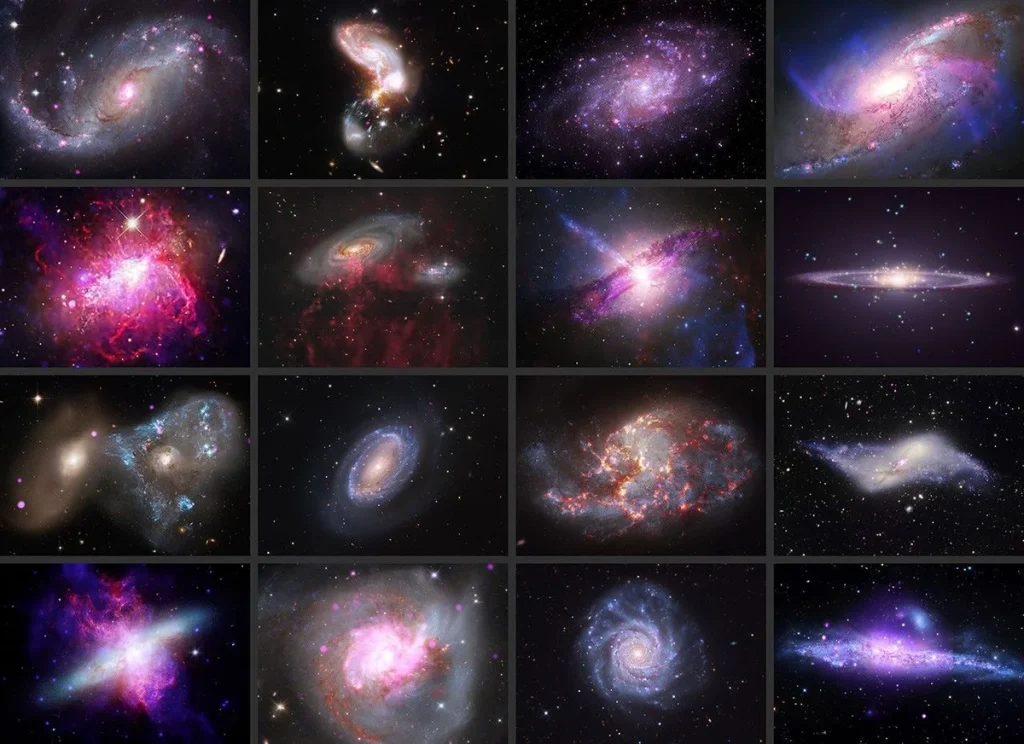
How NASA Galaxy Images Reveal Hidden Activity
Each portrait combines Chandra X-ray observations with measurements from other observatories. Different images feature different telescope combinations, including Hubble, James Webb, and several additional instruments.
Chandra traces extremely hot gas and energetic sources. Optical observations reveal stellar structures, while infrared measurements highlight dust and regions that visible light struggles to show.
These layers connect a galaxy’s familiar outline with activity that otherwise remains difficult to recognize. They help astronomers compare where stars form, where hot gas gathers, and where energy changes surrounding conditions.
The collection presents new composite views of known galaxies. Chandra gathered its contributing observations across decades, so these portraits do not represent one simultaneous observing session. science.nasa.gov
M82: When Star Formation Changes a Galaxy’s Future
The Cigar Galaxy, also known as M82, offers one of the collection’s clearest examples of galactic change. An earlier gravitational encounter helped stimulate its intense star formation.
Now, winds and the final stages of massive stars help drive hot material away from its disk. X-ray observations trace gas at millions of degrees, extending thousands of light-years into surrounding space.
A Changing Gas Supply
This outward flow matters because galaxies need gas to produce new stars. Moving material away from active regions can influence how much fuel remains available.
M82 therefore shows how star formation can change the conditions for later generations of stars. Its bright stellar activity helps reshape its own environment.
Nearby in the gallery, NGC 4631, the Whale Galaxy, provides another revealing side view. Its extended hot halo helps astronomers examine material above and below a galactic disk.
Black Hole Jets Reshape Their Surroundings
Centaurus A draws attention with a prominent dust lane and an energetic jet. The jet carries particles tens of thousands of light-years from the galaxy’s central region.
Such activity originates around a feeding supermassive black hole. Material outside the black hole can enter powerful outflows, transferring energy into the surrounding environment.
The resulting structures show why a galaxy’s central activity matters far beyond its core. Astronomers can follow its influence across enormous distances.
Messier 106’s Unusual Arms
Messier 106 adds another striking example. Its central jets interact with surrounding gas, creating hot structures that resemble additional spiral arms.
These unusual arms differ from the familiar star-rich arms of an ordinary spiral galaxy. Their appearance reflects heated gas and the energy supplied by central activity.
Together, Centaurus A and Messier 106 demonstrate how black holes help shape their host galaxies. Their influence depends on the surrounding material and the way energy reaches it.
Galactic Encounters Open New Chapters of Star Formation
Gravitational encounters can reorganize a galaxy’s gas and change where stars develop. Arp 143 provides a vivid example, with an expanding disturbance associated with an earlier encounter.
As gas compresses, conditions can favor new stellar nurseries. The resulting patterns preserve clues about the interaction that helped create them.
Rather than showing a fixed structure, this system captures one stage in a much longer transformation.
Looking Through the Dust
Elsewhere, II Zw 096 contains merging galaxies with intense star formation behind thick dust. Optical views reveal only part of this activity.
Infrared observations help astronomers examine regions that dust obscures at visible wavelengths. X-rays add information about hot gas and energetic sources within the system.
Comparing these observations connects the galaxies’ changing shapes with their internal activity. Such systems also provide useful examples for investigating processes that were common earlier in cosmic history.
Messier 90 Is Losing Its Star-Making Fuel
A galaxy’s environment can also reduce the material available for future stars. Messier 90 illustrates this process as it moves through the Virgo Cluster.
The galaxy encounters hot gas between the cluster’s members. This interaction strips away some of its own gas, changing the reservoir that supports star formation.
Unlike M82’s internally driven outflow, this process depends strongly on the surrounding cluster environment. Both examples highlight the importance of tracking where gas goes.
Messier 90 does not need to lose every trace of star formation for this change to matter. A shrinking fuel supply can gradually alter its development.
What These Galaxies Reveal About the Milky Way
These distant systems offer useful comparisons for understanding our own galaxy. Astronomers study their gas flows, stellar populations, and central activity to investigate how galaxies evolve.
The gallery also provides examples of possible outcomes from future galactic encounters. However, it cannot predict the Milky Way’s exact path.
A future merger with Andromeda remains uncertain. NASA’s coverage of a 2025 study described approximately equal chances of a collision or no collision within ten billion years.
That estimate depends on measured motions, masses, and gravitational influences from neighboring galaxies. It should not become a fixed countdown. science.nasa.gov
NASA Galaxy Images Connect Beauty With Discovery
The strongest message from these NASA galaxy images concerns change. Gas moves, stars develop, and central black holes influence their surroundings.
Combining telescopes helps astronomers connect those processes instead of viewing each in isolation. Across all 16 portraits, the gallery offers a richer picture of galactic evolution—and fresh perspectives on the galaxy we call home.
Main sources:
- NASA: Galactic Gems Glisten in New Gallery From NASA’s Chandra
- NASA: Full Galaxy Gallery
- Chandra X-ray Observatory: Galaxy Gallery and Image Details
- NASA: Hubble Casts Doubt on Certainty of Galactic Collision
You Might Also Like:
Cloud-9 dark galaxy: New Evidence of Missing Stars
IC 1101 galaxy: A Giant Still Growing
Hidden Galaxy in Webb Data Reveals a Measurement Trap