
BY:SpaceEyeNews.
Britain wants to capture dead satellites with robotic claws, then send them into lower orbits for disposal. The UK space debris removal mission aims to tackle two abandoned spacecraft using a single cleanup vehicle. However, its significance extends beyond those first targets.
ClearSpace must demonstrate that a spacecraft can approach an unresponsive satellite, secure it, and manage its removal safely. Success could help turn orbital cleanup into a repeatable service. For now, the project remains in development, with demanding engineering work ahead before its planned 2029 launch.
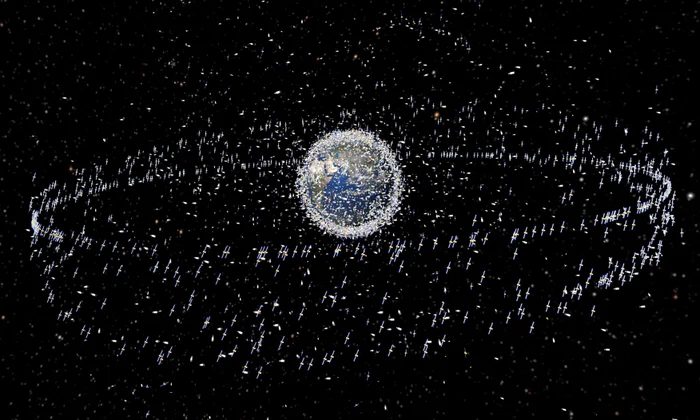
An ESA visualization shows how abandoned satellites and other debris crowd Earth’s orbit, increasing the danger of collisions. ((European Space Agency (ESA))
What the UK Space Debris Removal Mission Will Do
The UK Space Agency has selected ClearSpace to design, develop, and deliver the UK Active Debris Removal mission, or UK ADR. ClearSpace describes the agreement as a £61 million contract. That is approximately the $81 million figure in the original news report.
Its initial assignment involves two defunct UK-registered satellites in low Earth orbit. The government plans a 2029 launch from SaxaVord Spaceport in Scotland’s Shetland Islands. It wants both satellites removed by 2032.
These dates remain targets. ClearSpace says operations depend on final mission and launch scheduling. Neither announcement reviewed identifies the two satellites, so their names and individual characteristics should not be assumed.
The immediate priority is building and testing the spacecraft that will carry out these operations.
How Robotic Claws Will Capture Dead Satellites
The gripping arms provide the most striking image, but precise navigation makes capture possible. A successful approach requires much more than bringing two spacecraft close together.
Matching the Target’s Movement
First, the cleanup vehicle must approach its target and match its orbital motion. ClearSpace plans to demonstrate autonomous guidance, navigation, and control during these operations.
Although satellites travel around Earth at tremendous speeds, capture does not happen at that full relative velocity. The approaching spacecraft must reduce the difference between its movement and the target’s movement.
That distinction matters. This operation resembles carefully coordinated formation flying more than catching an object racing past.
Taking Hold Without a Docking Port
An abandoned satellite cannot necessarily communicate, adjust its orientation, or help guide an approaching vehicle. Some targets may also tumble.
Furthermore, these satellites were not designed for servicing. Engineers cannot assume they have convenient docking interfaces or predictable capture points.
The robotic system must therefore secure an unprepared object while maintaining control. After contact, the vehicle must manage the combined spacecraft safely before changing orbit.
That transition from approach to stable capture will be a central test of the mission’s technology.
What Happens After the Capture?
Once the spacecraft secures a target, it will move that satellite into a lower orbit. The announced concept then involves releasing it, allowing atmospheric drag to bring it toward reentry.
This approach aims to preserve the cleanup vehicle for another assignment. It differs from a disposal operation that sends both spacecraft into the atmosphere together.
However, lowering an orbit does not necessarily produce immediate reentry. The timing depends on the resulting orbit, atmospheric conditions, and the satellite’s physical characteristics.
The public announcements do not provide a detailed disposal trajectory or reentry safety assessment for either target. Therefore, readers should not assume complete destruction of every component or a particular reentry location.
Why Removing Two Satellites Matters
Two removals will not solve the wider debris problem. Nevertheless, the mission could demonstrate a practical way to reduce future debris generation.
Large abandoned objects can produce many fragments if they collide or break apart. Removing them before that happens addresses a potential source of additional debris.
ESA’s 2026 Space Environment Report identifies active removal as necessary to counter long-term growth driven by collisions. This process can become self-reinforcing as fragments contribute to further collisions, often discussed as Kessler syndrome.
The mission’s value therefore extends beyond counting two objects removed. It could establish techniques for addressing larger targets that smaller fragments make increasingly difficult to reach safely.
Can One Cleanup Spacecraft Work Again?
The government describes a refuellable spacecraft designed with future operations in mind. That ambition could make the project particularly useful.
A vehicle that completes several assignments could spread development and launch costs across more removals. However, that remains a potential economic advantage, rather than a demonstrated saving.
Refuelling capability also does not guarantee unlimited service. Continued operations would depend on spacecraft condition, available fuel, suitable targets, and access to refuelling services.
For UK ADR, the first meaningful demonstration will be completing one disposal and continuing to the second target. Longer service would build on that foundation.
What Engineers Still Need to Prove
Several questions will determine whether the proposed system becomes an operational capability.
Can it approach an unprepared satellite reliably? Will its capture mechanism establish a secure grip? Can the vehicle maintain control after contact and complete the disposal sequence?
Testing must also establish how the spacecraft responds when conditions differ from expectations. An uncertain target motion or unexpected contact could complicate operations.
ClearSpace says its next steps include designing, building, and testing the spacecraft. The announcements establish the programme’s direction, but they do not demonstrate completed orbital capture.
Keeping that distinction clear helps readers understand both the opportunity and the remaining uncertainty.
A Foundation for Future Space Services
Successful UK space debris removal could support a broader market for services in orbit. Related navigation and robotic capabilities may contribute to inspection, servicing, and future satellite life extension.
However, those applications would require their own engineering and commercial development. UK ADR is also separate from ESA’s ClearSpace-1 mission.
Ultimately, the strongest measure of success will be safe, repeatable operations. Removing two satellites would provide valuable experience, while showing what still needs improvement before orbital cleanup becomes routine.
Main sources:
UK government — Mission announcement, funding, launch plans, and removal objectives:
https://www.gov.uk/government/news/world-first-mission-puts-uk-expertise-to-work-to-help-clean-up-space
ClearSpace — Contract announcement and planned technical capabilities:
https://clearspace.today/news/clearspace-prime-uk-active-debris-removal-contract
European Space Agency — Space Environment Report 2026:
https://www.esa.int/Space_Safety/Space_Debris/ESA_Space_Environment_Report_2026
European Space Agency — Active debris removal:
https://www.esa.int/Space_Safety/Space_Debris/Active_debris_removal
You Might Also Like:
Starlink Satellite Anomaly Debris Raises New Concerns in Orbit.
Ancient Supernova Debris Found in Antarctic Ice Reveals Earth’s Cosmic Journey
Shenzhou-20 Emergency Rescue: How China Saved Its Tiangong Crew After a Space Debris Scare-Video