
BY:SpaceEyeNews.
2024 XA1 completed one rotation every 1.63 seconds before entering Earth’s atmosphere over eastern Siberia. That measurement makes it the fastest-rotating near-Earth asteroid currently known, according to new research from a Chinese-led international team.
The discovery reveals more than an unusual record. Scientists extracted the asteroid’s changing brightness from trails across telescope images. Those variations helped them investigate its rotation and physical structure.
Published in The Astronomical Journal, the findings revisit observations from December 2024. They show how brief telescope exposures can preserve detailed information about a rapidly moving object.
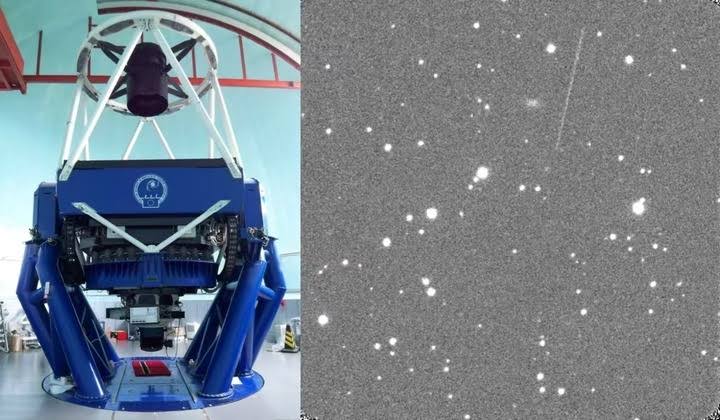
2.4-meter Lijiang Telescope Photo: Courtesty of Zhang Xiliang
2024 XA1: A Brief Window Before Atmospheric Entry
The Catalina Sky Survey team discovered the asteroid using the Bok telescope at Kitt Peak, Arizona. Approximately ten hours later, it entered the atmosphere above Russia’s Sakha Republic.
The event occurred on December 3, 2024, UTC. In Beijing, the date had already advanced to December 4. Both dates therefore describe the same encounter.
ESA’s account shows how follow-up observations quickly improved the trajectory forecast. Initial measurements suggested only a small probability of atmospheric entry. Additional observations then allowed monitoring systems to confirm the approaching event.
Catching the Final Hour
At China’s Lijiang observatory, researchers used a 2.4-meter telescope to observe the asteroid shortly before its arrival.
The Chinese Academy of Sciences recorded the observing interval as approximately 15:10–15:30 UTC. Atmospheric entry followed at around 16:15 UTC.
Other observatories also collected images. Together, these observations supported an international effort to track a small object during a rapidly closing window.
The rotation study later examined information within the telescope images. Researchers did not announce the 1.63-second result during that final hour.
How a Bright Trail Revealed the Spin
A fast-moving asteroid can cross many image pixels during one exposure. Instead of appearing as a single point, it leaves a trail.
For this investigation, that trail provided a useful record. Different positions along it corresponded to different moments during the exposure.
One published image captured 2024 XA1 with a 20-second exposure. Its brightness varied along the resulting streak, preserving clues to its rotation.
Reading Changes Along the Streak
The researchers reconstructed a light curve, which tracks brightness over time. Their analysis combined measurements from three images.
An irregular rotating object can present different apparent areas toward an observer. Consequently, its reflected sunlight can brighten and fade as it turns.
However, researchers must distinguish those variations from observational effects. The published trail analysis notes small deviations associated with atmospheric turbulence. Extracting a reliable signal therefore requires more than simply measuring alternating bright and faint patches.
The final fitted light curve brought the observations together. It allowed the team to examine a repeating pattern across separate exposures.
Why 0.81 Seconds Does Not Mean One Rotation
The strongest repeating brightness signal occurred approximately every 0.81 seconds. Yet the researchers adopted a double-peaked rotation period of approximately 1.63 seconds.
That distinction matters because an irregular asteroid can show two brightness peaks during one complete turn. A repeating brightness feature therefore need not represent a full rotation.
The result comes from interpreting the light curve, rather than watching a resolved surface feature move around the asteroid.
What Makes the Rotation Record Remarkable?
The reported period improves on the previous 2.58-second record associated with near-Earth asteroid 2024 BX1.
Expressed another way, the new measurement corresponds to roughly 37 rotations per minute. It represents a rotation rate about 58 percent higher than the earlier record.
These figures describe spin around the asteroid’s own axis. They do not describe its travel speed through space.
The qualification “currently known” also matters. Scientists can compare only objects with measured rotation periods. The discovery establishes an observational record, not a physical limit for every asteroid.
What 2024 XA1 Reveals About Its Structure
The extreme spin provides evidence about how the asteroid held itself together.
Its weak gravity could not maintain a loose collection of material under the inferred rotational conditions. Instead, the researchers conclude that material strength maintained its integrity.
This supports a compact, strength-dominated object rather than a rubble pile held together mainly by gravity.
However, that conclusion does not provide a detailed interior map. It cannot establish the absence of cracks or identify an exact mineral composition.
Why Size Estimates Differ
The observatory announcement gives an estimated equivalent diameter of approximately 55 centimeters. That calculation assumes properties typical of an S-type asteroid.
An earlier observational study estimated approximately 76–82 centimeters using a reflectivity of 0.15. ESA’s event summary describes an object roughly one meter across.
These figures should not become interchangeable measurements of a precisely known diameter. Brightness-based size calculations depend on assumptions about how efficiently the surface reflects sunlight.
For a given brightness, a more reflective object can be smaller. A darker surface requires a larger object to return comparable light.
What This Means for Short-Warning Observations
The practical advance concerns physical characterization: learning what an observed asteroid is like during a limited observing opportunity.
Detection, trajectory prediction, and physical characterization answer different questions. Finding an object establishes its presence. Tracking its positions helps calculate where it will travel. Measuring its changing brightness adds information about its rotation.
This study strengthens that third step. It demonstrates how researchers can recover useful physical clues from images of a fast-moving target.
Nevertheless, the findings do not demonstrate longer warning times. They also do not establish a fully automated system that immediately delivers every physical property.
Future observations can test how widely the technique applies. Image quality, brightness, viewing geometry, and available observing time will influence the information researchers can extract.
The opportunity lies in making better use of the light telescopes already collect.
2024 XA1: A Small Object With Lasting Scientific Value
2024 XA1 left observers little time, but its images preserved an unusually detailed rotational signature. The resulting study links a record spin to evidence about structural strength.
Its broader value lies in the method. A streak across a telescope image can contain a sequence of measurements, rather than a single brightness estimate.
As researchers examine more brief encounters, such techniques could deepen their understanding of small asteroids. This case shows how careful analysis can extend the scientific value of observations long after an object leaves view.
Main sources:
- Yunnan Observatories, Chinese Academy of Sciences — Research announcement: https://ynao.cas.cn/xwzx/kyjz/202610/t20261019_8293744.html
- The Astronomical Journal — “Photometric Study of the Fastest-rotating Near-Earth Asteroid 2024 XA1”: https://doi.org/10.3847/1538-3881/aeaa5d
- European Space Agency — 2024 XA1 event summary: https://neo.ssa.esa.int/past-impactors/2024xa1
- Earlier observational study — Size estimates and observing results: https://doi.org/10.3724/j.issn.2096-9287.2026.20250055
- Global Times — https://www.globaltimes.cn/page/202610/1373070.shtml
You Might Also Like:
Deimos asteroid impact may explain its smooth surface
Two Asteroid Encounters Reveal a New Deep-Space Race
Tianwen-2 Asteroid Mission Reaches Earth’s Quasi-Moon-Video