
BY:SpaceEyeNews.
The Sun’s magnetic field has gained a new dimension in observations of its outer atmosphere. Researchers have reconstructed its strength and three-dimensional direction using data from telescopes already in service. Their approach extracts information from coronal light and waves that earlier analysis methods could not fully recover.
The advance offers a clearer view of the magnetic structures behind solar activity. It also opens a path toward better models of solar eruptions. However, the technique remains an early research capability. Scientists still need to validate and refine it before routine use.
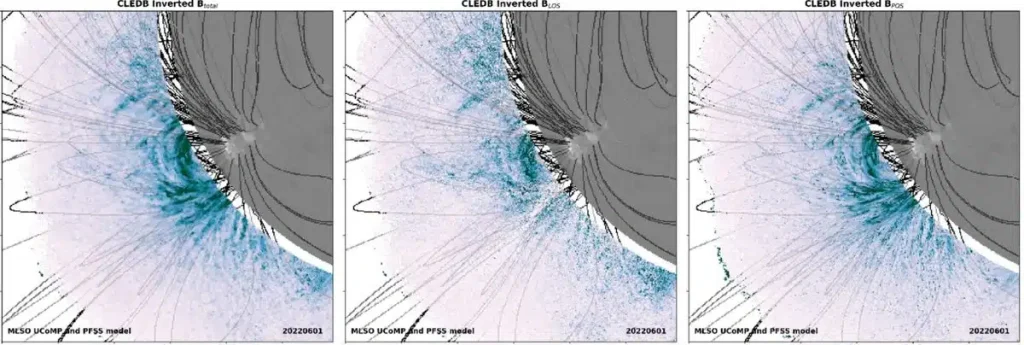
A 3D reconstruction of the solar corona’s magnetic field on June 1, 2022. Credit: NSF/NSO/AURA.
What the Sun’s Magnetic Field Maps Reveal
Earlier research produced broad, two-dimensional maps of coronal magnetism. Those measurements captured valuable information across the plane of the sky. Yet they did not provide the full directional picture.
The new method estimates all three components of the magnetic field. Crucially, it recovers information about the component pointing toward or away from the observer. That adds a missing perspective to the structures scientists can study above the solar surface.
The distinction matters when interpreting the images. These maps show estimated magnetic strength and direction across observable coronal regions. They do not provide a complete scan of the Sun’s interior or its entire surrounding atmosphere.
Researchers describe the achievement as a transition from a theoretical method to a demonstrated observational capability. Its value lies in extracting more information from actual measurements, while retaining the need for careful interpretation.
The advance also builds on earlier progress. Two-dimensional mapping already gave researchers meaningful measurements, while theoretical studies established the basis for the new technique. Describing the work as decades of failure would overlook those contributions. The latest study connects those developments and applies them to real solar data. That makes the achievement a practical extension of existing research, with new information that scientists can now explore.
How Light and Waves Reveal Solar Magnetism
The team used a mathematical approach called IQUD inversion. In practical terms, an inversion works backward from measured signals to estimate the physical conditions that produced them.
Here, the relevant signals come from light and waves traveling through the corona. Each supplies clues about the magnetic environment. Combining those clues allows researchers to estimate properties that either diagnostic alone cannot fully establish.
Combining Two Sets of Clues
Polarized light carries information about magnetic orientation. Meanwhile, waves moving through coronal plasma offer another way to investigate magnetic strength. The method brings these complementary measurements into a single reconstruction.
That combination helps overcome a difficult observational gap. Researchers recovered substantial magnetic structure along the observer’s line of sight. They achieved this without the polarization measurement normally used to constrain that component.
This does not make the reconstruction assumption-free. Instead, it gives scientists a different route to estimating the field from available evidence. The result depends on both suitable observations and the analysis used to interpret them.
Existing Telescope Data Put the Method to the Test
The observations came from the Mauna Loa Solar Observatory in Hawaii. The team examined data from the Coronal Multi-channel Polarimeter, known as CoMP, and its upgraded successor, UCoMP.
CoMP supplied observations from October 14, 2016. UCoMP provided a second dataset from June 1, 2022. Applying the method to these measurements moved the work beyond theoretical and statistical tests.
Researchers from NSF NCAR, the National Solar Observatory, and Southwest Research Institute collaborated on the study. The Astrophysical Journal Letters published their findings. Both NCAR and the National Solar Observatory announced the results on October 28, 2026.
The observation dates also highlight an appealing aspect of the work. Older measurements can support new discoveries when analysis improves. Scientists did not need a newly built telescope to demonstrate this particular capability.
Why Better Magnetic Maps Matter for Solar Forecasts
The Sun’s magnetic field helps shape the activity that produces space weather. A clearer understanding of its coronal structure could therefore improve how researchers model solar eruptions.
Many existing approaches use surface measurements to estimate how magnetic fields extend into the atmosphere. Coronal observations provide additional evidence against which scientists can test those calculations.
Giving Solar Models a Stronger Test
The immediate benefit is a better foundation for evaluating models. Researchers can compare their expectations with magnetic estimates drawn from observations higher above the surface. Differences could help identify where their descriptions need refinement.
Over time, that process could support better forecasts. Space weather can affect satellites, radio communications, navigation systems, and electrical infrastructure. Understanding its solar origins remains an important part of improving preparedness.
Nevertheless, this study does not establish a new warning time or a measured increase in forecast accuracy. It demonstrates a way to obtain useful magnetic information. Turning that capability into reliable predictions requires further work.
That distinction keeps the significance clear. Better measurements can strengthen forecasting research without immediately becoming a forecasting service.
What Still Needs Testing—and Where COSMO Fits
The first reconstructions have limitations. Researchers need further development and validation before they can treat the method as a routine capability. Successful results from the selected observations provide a starting point for that process.
The team has made its analysis software and datasets openly available. Other scientists can therefore test the approach, investigate its performance, and suggest improvements. Wider scrutiny will help establish how reliably it works across suitable observations.
Revisiting the Archive
CoMP and UCoMP observations are publicly available. In principle, researchers could apply IQUD inversion to other days with suitable measurements. That creates an opportunity to revisit existing records rather than waiting exclusively for future observations.
However, availability alone does not guarantee a useful reconstruction. The observations must contain the information the method requires. Researchers will need to assess that suitability when selecting additional datasets.
A Possible Role for COSMO
The planned COSMO coronagraph network offers a potential future home for these products. Researchers hope the technique could eventually produce standard magnetic maps within that network.
For now, the method has not entered routine observatory processing as an operational data product. Its future role will depend on continued testing, refinement, and integration. The promise lies in making these measurements more broadly useful and repeatable.
A Clearer View of the Sun’s Magnetic Field
The Sun’s magnetic field now offers researchers more information through observations they already possess. Combining light and wave measurements has opened a new route to reconstructing coronal magnetism in three dimensions.
The next challenge is turning that demonstration into a dependable research tool. With further validation, these maps could strengthen solar models and eventually contribute to better space-weather forecasts.
Main sources:
NSF NCAR — “Coronal magnetic fields in 3D,” October 28, 2026.
https://news.ucar.edu/133098/coronal-magnetic-fields-3d
National Solar Observatory — “Scientists Find a New Way to Map the Sun’s Hidden Magnetic Field,” October 28, 2026.
https://nso.edu/blog/new-way-to-map-suns-hidden-magnetic-field/
You Might Also Like:
Sun’s Influence on Earth’s Climate: New Galactic Clues
Hidden Magnetic Waves Inside the Sun Reveal Its Deep Interior
Parker Solar Probe helicity barrier: the key to the Sun’s million-degree corona-Video