
BY:SpaceEyeNews.
On October 20, 2026, NASA picked up the Voyager 1 signal again. Engineers had yet to send a single command to troubleshoot the loss of contact. Two days earlier, a scheduled listening session had turned up nothing. A second attempt had produced the same result. When contact resumed, the team found that Voyager had switched to backup thrusters. That discovery gave engineers a place to start looking. It also left them with a puzzle. What happened aboard the spacecraft between the last ordinary contact and the moment Earth could hear it again?
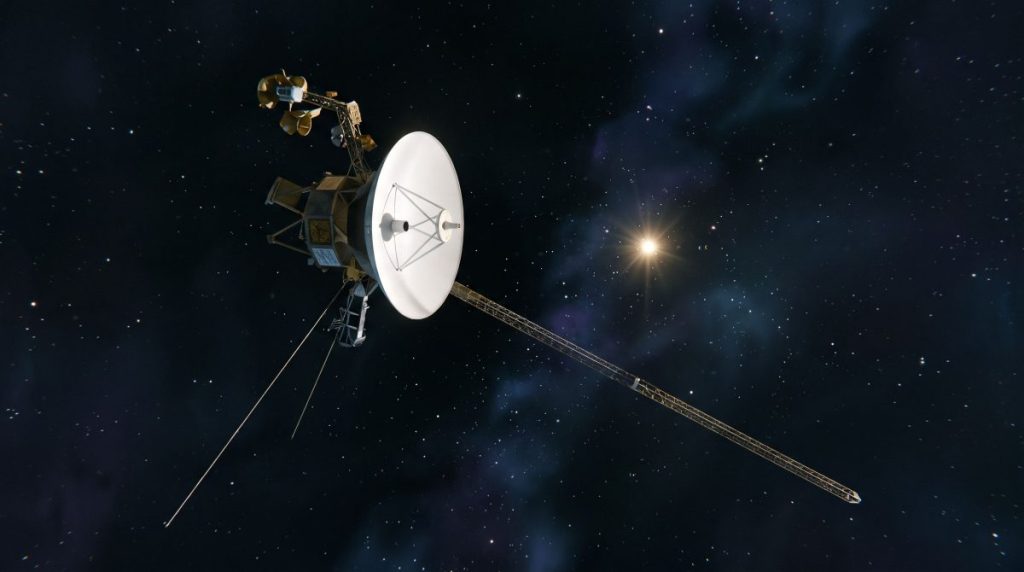
Two chances to hear the Voyager 1 signal
On October 18, NASA’s Deep Space Network listened for Voyager 1 during a scheduled pass. Its antennas could detect no radio signal from the probe. The next opportunity came about 24 hours later, on October 19. Again, the network heard nothing. Another day passed before the signal reappeared. In its October 29 mission update, NASA said the team had kept in touch with Voyager 1 since that third pass.
Those listening times tell us something important about the two days of silence. NASA knows when its antennas listened and what they heard on each occasion. Two missed appointments, however, leave gaps in the record. They cannot tell engineers precisely when the signal disappeared or what the transmitter did between passes. During each pass, controllers could judge whether they had a usable link. Once the link returned, they could finally examine what had changed aboard the spacecraft.
The first clue came from the thrusters
Voyager uses small thrusters to control which way it faces. Even in interstellar space, the spacecraft must keep its main antenna pointed toward Earth. That gives engineers good reason to examine a change in the thrusters whenever the radio link behaves unexpectedly. After contact resumed, they established that one group had gone offline. A backup group had taken over.
Voyager’s computers know how to make that switch. If they detect a problem with the active thrusters, onboard instructions allow them to select the backups. The spacecraft can then pause routine work and settle into a stable configuration. Engineers call this response fault protection. It gives the team on Earth time to investigate while Voyager takes immediate action on its own.
What the thruster switch leaves open
Finding the backups active answers a specific question about the hardware. It still leaves engineers to determine what prompted the handover. Did a change in pointing put Earth briefly outside the antenna’s narrow radio beam? NASA’s October update left that question open. Mission manager Kareem Badaruddin said his team had never seen Voyager behave quite this way. For engineers who know how the safeguard should operate, the puzzle lies in reconstructing this particular sequence.
Why engineers switched three devices at once
In July, engineers carried out a power-saving procedure on Voyager 2. About six weeks later, in early September, they performed the same maneuver on Voyager 1. The team nicknamed it the “Big Bang.” It involved turning off three devices together and switching to alternatives that draw less electricity.
Both Voyagers lose about four watts of available electrical power each year as their plutonium power sources age. Their generators turn heat from radioactive decay into electricity. Each year, the same hardware has a little less electricity to share among the radio, instruments and other systems. Turning off equipment saves electricity, but it also removes a source of heat. A device that serves one purpose on the wiring diagram can serve another simply by warming the hardware around it. Engineers therefore had to consider where heat would go after each change. Switching all three devices together kept heat where the spacecraft needed it while bringing overall demand down.
What a few watts buy in interstellar space
In April, the team had already turned off Voyager 1’s experiment for detecting low-energy charged particles. The detector had run almost continuously since launch in 1977. Beyond the heliosphere, it recorded passing pressure fronts and changes in the density of charged particles. Those observations helped scientists map variations in the material between stars along Voyager’s path.
Years earlier, scientists and engineers had agreed on the order in which they would retire instruments as the power supply declined. The particle experiment came next on that list. Its counterpart on Voyager 2 had already gone quiet in March 2025. Without September’s power savings, another science instrument might have faced shutdown as early as summer 2027. The swap gives researchers more time with instruments that can still sample conditions beyond the Sun’s protective bubble. NASA described the September operation and the October silence separately. Its investigation has yet to establish a connection between them.
A Wednesday command, a Friday reply
On November 18, NASA expects Voyager 1 to reach a point about 25.9 billion kilometers from Earth. It will become the first human-made object one light-day away. Send a command on a Wednesday morning at that distance, and it reaches Voyager on Thursday morning. Even if the spacecraft answers immediately, the earliest its reply can reach Earth is Friday morning.
For the operations team, that example describes the wait for just one answer. Suppose engineers ask which set of thrusters Voyager is using. If the answer raises a second question, a follow-up command starts another round trip. By October, the travel time for radio signals already approached a full day each way. Engineers had to weigh what they could learn from the next contact against what they could ask Voyager to do.
The November milestone brings no sudden change aboard the spacecraft. Voyager 1 crossed into interstellar space in 2012. It will encounter no new boundary when the radio travel time reaches exactly 24 hours. The date marks a change people on Earth can appreciate with an ordinary calendar. A question and its answer now occupy parts of three days.
What the returning Voyager 1 signal made possible
For the people listening on October 20, hearing the Voyager 1 signal settled the most immediate question. Earth could hear the spacecraft again. Contact also gave engineers access to a clue they could never have obtained from two silent listening sessions alone. They now know the backup thrusters took over. The cause of the silence remains under investigation. Meanwhile, each successful contact offers something beyond news of the spacecraft itself. It allows measurements from instruments that engineers have kept warm and working to make their way home from interstellar space.
Main sources
NASA Science, October 29 mission update on the signal loss and power-saving operation
https://science.nasa.gov/blogs/voyager/2026/10/29/nasas-voyager-1-conserves-power-resolves-brief-communications-pause/
NASA Jet Propulsion Laboratory, April 17 update on the particle instrument shutdown
https://www.jpl.nasa.gov/news/nasa-shuts-off-instrument-on-voyager-1-to-keep-spacecraft-operating/
NASA Science, Voyager mission status and the one-light-day milestone
https://science.nasa.gov/mission/voyager/where-are-voyager-1-and-voyager-2-now/
NASA Science, Voyager instruments and antenna pointing
https://science.nasa.gov/mission/voyager/instruments/
Universe Space Tech, original coverage by Ivan Hrinko
https://universemagazine.com/en/voyager-1-behaved-strangely-during-its-last-communication-with-earth/
You Might Also Like:
Two-Day Link Micro Wormhole: Voyager 1’s Delay Explained-Video
Voyager 1 Power Shutdown: NASA Turns Off Instrument to Extend Mission
Voyager 1 Distance Milestone: One Light-Day From Earth