
BY:SpaceEyeNews.
Cosmic reionization may have started with starlight escaping galaxies while their most massive stars were still alive. Hubble found a clue in six compact galaxies. The ones with the fastest galactic winds let the smallest share of ionizing light escape. That finding poses a puzzle for astronomers. Many models give those winds a central role in clearing paths for starlight. Yet by the time strong winds appeared in these galaxies, the best opportunity for light to get out seemed to have passed.
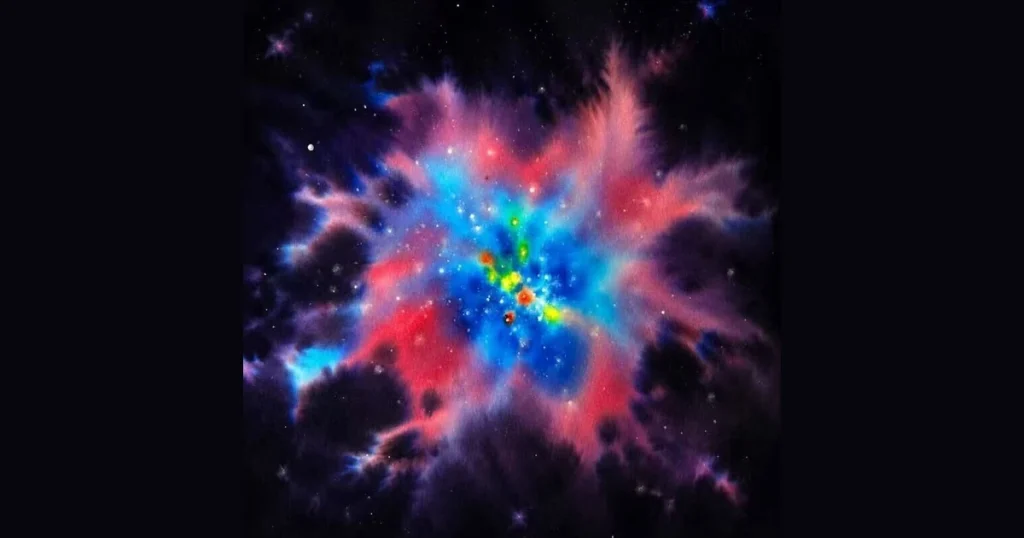
Cosmic Reionization and the Light of the First Stars.
Why timing matters for cosmic reionization
During the universe’s first billion years, light from early galaxies helped strip electrons from hydrogen atoms across intergalactic space. A star could contribute to that change only if its light made it beyond its home galaxy. Even a brilliant cluster of young stars could have little effect on distant gas if nearby hydrogen absorbed most of its radiation.
Many simulations describe a sequence that makes intuitive sense. A galaxy forms a generation of massive stars. A few million years later, the first supernovae drive gas outward, opening routes for ultraviolet light. But massive stars have short lives. A path that opens while a cluster still shines at full strength can carry far more light than one that opens later.
To see why, take two clusters that each release half their ionizing light for one million years. One does so near the peak of its ultraviolet output. The other does so after its most luminous stars have faded. Both reach the same escape fraction, but the first sends many more photons into intergalactic space.
Why Hubble looked closer to home
Looking straight at the first galaxies poses a problem. Hydrogen along the way absorbs the particular wavelengths astronomers need to measure. A telescope can pick up other light from a distant galaxy and reveal its stars. The missing ultraviolet light, however, leaves astronomers with little direct evidence of how much originally escaped.
Cody Carr and his colleagues chose six galaxies about 3.5 billion light-years away. Each packs a burst of star formation into a region generally less than 6,500 light-years across. These galaxies can form roughly ten Suns’ worth of stars in a year. Their compact size and intense activity resemble conditions astronomers expect in some early galaxies. Their distance also gives Hubble access to radiation that intervening hydrogen would absorb over a much longer journey.
Hydrogen leaves a record of its motion
The team used Hubble to separate each galaxy’s ultraviolet light into a spectrum. Neutral hydrogen absorbs light at specific wavelengths, leaving dips in that spectrum. Moving gas shifts the positions of those dips. Their widths also reveal the range of speeds within the gas. Earlier studies often relied on signatures from heavier elements to trace winds. Hydrogen gave this team a direct look at the material standing in the photons’ way.
For each galaxy, the researchers compared the wind measurement with its escape fraction. That number describes the share of a galaxy’s ionizing light that reaches the space beyond it. The strongest ultraviolet leakers lacked fast galactic winds. At the other end of the sample, galaxies with the fastest winds allowed the least light through.
How young stars could open an early window
Long before a massive star becomes a supernova, it changes the gas around it. Its ultraviolet radiation can ionize nearby hydrogen. The star also sheds material in a fast stellar wind. Across a young cluster, these processes could leave routes with relatively little neutral hydrogen. Photons traveling along those routes would stand a better chance of reaching intergalactic space.
A stellar wind starts at an individual star. The galactic winds Hubble traced involve gas moving across a much larger region. That difference helps explain how local winds could aid escape even in a galaxy that lacks a fast, large-scale outflow. It also sets a limit on what the observations reveal. Hubble measured escaping radiation and gas motion. The proposed routes through the gas come from the researchers’ interpretation of those measurements.
How supernova-driven winds can keep light inside
Gas can travel outward and still stand between a star and the edge of its galaxy. Consider a cluster with gaps in the gas surrounding it. Light escapes through those gaps. If a newly launched wind sweeps neutral material across them, fewer photons make it through. The gas has moved farther from the stars, yet it now covers more of their sky.
The researchers suggest that something similar happens as supernova-driven winds gather material and gain speed. More neutral hydrogen along a photon’s path means a greater chance that an atom will absorb it. This explanation fits the fastest winds in the sample. It also gives astronomers a reason to consider how much gas a wind carries and how widely it spreads. Wind speed alone cannot tell them whether a galaxy offers starlight a clear route out.
What six galaxies can tell us about the first billion years
The team compared separate galaxies at different stages of recent star formation. The researchers estimated the ages of the stars that contribute most of the light in each galaxy. That age refers to the recent burst. A galaxy can contain much older stars even when a handful of young clusters dominate its ultraviolet spectrum. Each spectrum captures a moment in one galaxy’s history. Together, the observations suggest an order of events, but they leave open how long the early escape window lasts. They also leave room for older winds to affect their surroundings differently as a burst of star formation fades.
For researchers modeling cosmic reionization, the result offers a specific test. A simulation can follow the radiation leaving a compact galaxy as its massive stars age. Does escape peak while the youngest stars dominate the light, or only after a fast galactic wind develops? Comparing that prediction with Hubble’s measurements could show where models need a closer treatment of radiation and stellar winds.
How common was the early escape window?
The team is seeking more Hubble observing time to learn whether the pattern holds across a larger sample. Finding the same sequence in more galaxies would strengthen the case for an early escape window. Finding exceptions could be just as revealing, especially if they show which gas conditions keep a route open longer. The question for cosmic reionization is how often the first galaxies let light out during those few million years when their brightest stars had the most light to give.
Main sources:
- Nature Astronomy — Lyman continuum escape during the onset of galactic winds in compact starbursts
- Johns Hopkins University — Hubble observations reveal supernovae may not have ushered in the reionization of the early universe
- University of Minnesota — Galactic Winds May Prevent Light from Reionizing the Universe
- Live Science — Interview with lead author Cody Carr and details of the six galaxies
You Might Also Like:
Hubble Detects Impossible Galaxy That Changed the Early Universe
Early Universe Dust Mystery Solved by James Webb Telescope
Dark Galaxy Candidate: A Lonely Cloud With No Visible Stars