
BY:SpaceEyeNews.
Dwarf galaxies’ missing oxygen presents a striking puzzle: where did most of the material their stars produced go? A study of 37 nearby galaxies found that they retain just 11% of their expected oxygen, on average. The rest lies outside the measured inventory of their stars, gas, and dust.
That shortfall offers a revealing test of how galaxies evolve. Stellar activity appears to remove oxygen more efficiently than current simulations predict. However, scientists still need to establish how much remains nearby and how much travels farther into space.
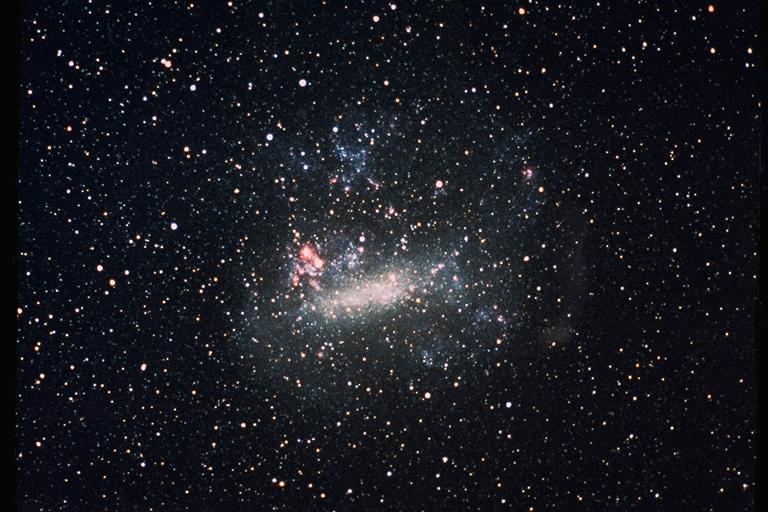
Dwarf galaxy-wikipedia.
Measuring Dwarf Galaxies’ Missing Oxygen
The Galaxies Losing Oxygen via Winds project, or GLOW, compares chemical production with the material galaxies retain. Its findings appeared in The Astrophysical Journal, with NASA highlighting the results on November 2, 2026.
Across the sample, oxygen retention ranged from 4% to 25%. Even the galaxies at the upper end held only a quarter of their estimated production. The average retention of approximately 11% implies a deficit of roughly 89%. www.rutgers.edu
Those percentages describe this particular sample. They do not establish one retention rate for every dwarf galaxy across the universe.
Crucially, the calculation compares present inventories with estimates covering a galaxy’s history. Astronomers did not watch nearly nine tenths of its oxygen suddenly disappear. Instead, they reconstructed how much should exist and measured how much remains inside.
This distinction gives the result its meaning. The deficit records the cumulative outcome of chemical production, gas movement, and any subsequent recycling.
Most of the oxygen that remains occupies interstellar gas, rather than stars or dust. That distribution makes gas measurements particularly important. Counting only the oxygen inside stars would miss the dominant internal reservoir and produce an incomplete comparison.
How Hubble Reconstructed the Galaxies’ Past
Hubble supplied a crucial part of that reconstruction. Its archival optical images let researchers distinguish individual stars within the nearby systems. From these stellar populations, the team reconstructed star formation histories and examined their compositions.
Those histories underpin estimates of how much oxygen the stars produced over time. Researchers then compared those estimates with the oxygen inventory in stars, interstellar gas, and dust.
Supporting observations came from Spitzer, the Very Large Array, and the Australian Telescope Compact Array. Together, the datasets helped build a broader picture than optical images alone could provide.
The sample’s proximity therefore matters. For most known dwarf galaxies, distance prevents Hubble from separating individual stars this way. GLOW focuses on systems where researchers can connect a detailed stellar history with the chemical material present now. attheu.utah.edu
The galaxies span stellar masses of roughly three million to three billion times the Sun’s mass. These figures describe their stars, rather than their total mass including dark matter. The range targets systems where stellar activity should strongly influence chemical retention. arxiv.org
Galactic Winds Carry Oxygen Outward
The leading explanation involves energy from massive stars and supernova activity. These processes drive galactic winds that transport enriched gas away from the regions where stars formed.
In this picture, stars both manufacture oxygen and help move it beyond their host galaxies. The new result strengthens the evidence that this outward transport has major consequences for small systems.
Nevertheless, the basic idea of galactic winds is not new. The important finding concerns their apparent effectiveness. These galaxies contain substantially less oxygen than current simulations predict they should retain. science.nasa.gov
The inventory constrains the accumulated outcome of those processes. It does not provide a complete record of each outflow, its speed, or its eventual destination.
That leaves an important distinction between evidence for oxygen loss and a detailed explanation of its journey. Researchers can identify the shortfall without yet tracing every stage of the material’s movement.
Where Does the Missing Oxygen Go?
Nearby Halos or Intergalactic Space
Some oxygen may occupy diffuse gas halos around the galaxies, beyond their main stellar regions. Astronomers call this surrounding reservoir the circumgalactic medium.
Other material may travel beyond those surroundings and enter intergalactic space. The challenge involves determining how much oxygen follows each route.
NASA’s account explicitly leaves that balance unresolved. Earlier measurements have detected oxygen around dwarf galaxies, but they do not settle where most of the missing inventory resides. science.nasa.gov
Therefore, describing all the absent oxygen as permanently lost would overstate the evidence. Material outside a galaxy’s main body does not necessarily lie beyond any possibility of return.
A Galaxy’s Neighbors May Matter
The GLOW analysis also points to an environmental connection. Galaxies in denser surroundings, or near massive neighbors, show a wider spread toward higher oxygen retention.
That pattern suggests surroundings can influence the chemical inventory alongside internal stellar activity. Possible explanations include recycling expelled gas or acquiring material that neighboring systems have already enriched. arxiv.org
However, the correlation does not identify one mechanism operating everywhere. It provides a reason to investigate how galaxies exchange material with their surroundings.
Consequently, two galaxies with similar stellar masses need not keep identical shares of their oxygen. Their locations add another variable for researchers to test.
Why Galaxy Models Face a New Test
The oxygen deficit gives simulations a demanding observational benchmark. Models must account for how much material stars produce, how much leaves, and how much returns.
Matching the oxygen remaining inside a galaxy requires getting that overall balance right. A simulation that retains too much oxygen may misrepresent one or more parts of this cycle.
This does not mean the study overturns our understanding of the universe. It highlights a specific mismatch in descriptions of chemical retention and gas transport within small galaxies.
Oxygen offers a practical way to examine that mismatch. Scientists understand its stellar production reasonably well, and observations can identify its characteristic signals.
Following this element also helps researchers investigate the wider distribution of stellar material. A galaxy’s chemical history extends into its surroundings, making those external reservoirs essential to the full picture.
Following Dwarf Galaxies’ Missing Oxygen
Dwarf galaxies’ missing oxygen leaves researchers with a clearer inventory problem and an unfinished search. The next steps include investigating fainter systems and examining massive stars within nearby GLOW targets.
Planned work includes Roman searches for faint galaxies, followed by deeper Hubble and Webb observations to explore their stellar histories. attheu.utah.edu
The central question now reaches beyond the galaxies themselves. Locating the oxygen will help establish how much material returns, how much remains nearby, and how much enriches intergalactic space. Each outcome tells a different part of the same evolutionary story.
Main Sources:
NASA: NASA’s Hubble Uncovers Case of Missing Oxygen in Nearby Dwarf Galaxies
Rutgers University: Stars Make Oxygen for Small Galaxies. They Lose Most of It.
University of Utah: NASA’s Hubble uncovers case of missing oxygen in nearby dwarf galaxies
Research paper: GLOW II: A Census of Oxygen in Low-Mass Galaxies
You Might Also Like:
Planetary-Mass Brown Dwarf Shows Signs of a World-Building Disk
Red Dwarf Stars Consume Earth-Like Planets, Astronomers Find New Evidence
HIP 61637 b Brown Dwarf Challenges Formation Models