
BY:SpaceEyeNews.
olar wind turbulence contains a hidden magnetic pattern that changes with scale and distance from the Sun. Researchers analyzing NASA’s Parker Solar Probe measurements found opposite rotational preferences within apparently chaotic magnetic fluctuations. Near a crucial transition, larger disturbances favor one direction, while smaller disturbances favor the other. The pattern also shifts toward larger scales farther from the Sun. Together, these findings give scientists a sharper test of how magnetic structures evolve. They could eventually strengthen the physical foundations of space weather models, although practical forecasting improvements remain a future goal.
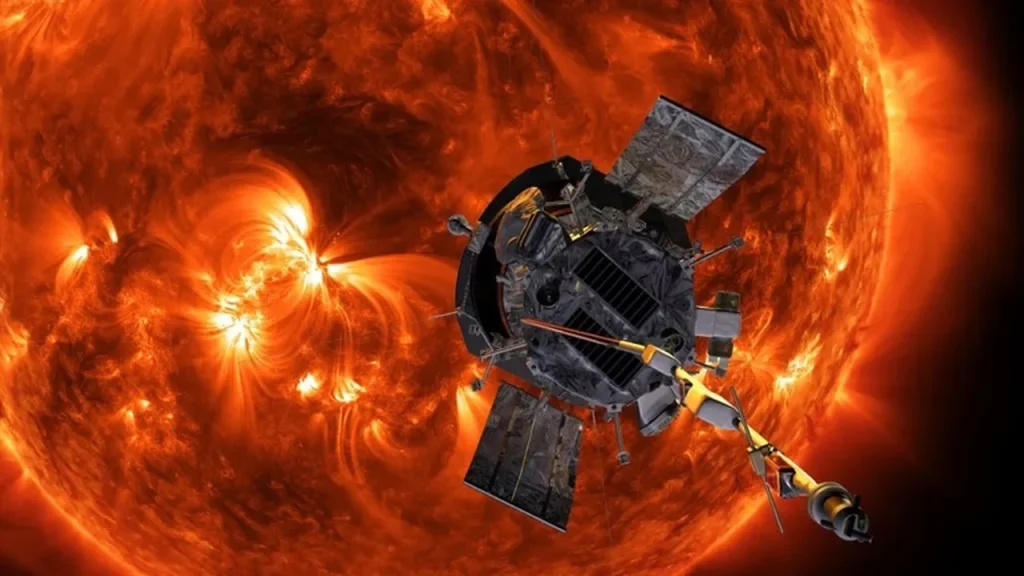
Artist’s illustration of NASA’s Parker Solar Probe near the Sun, studying solar wind turbulence–Credit: NASA/Johns Hopkins APL/Steve Gribben.
A Magnetic Pattern Hidden in Solar Wind Turbulence
The discovery centers on magnetic handedness: the preferred direction in which a fluctuating magnetic field rotates. Researchers found a paired signature with opposite handedness across neighboring parts of the fluctuation spectrum.
That spectrum separates variations by frequency, allowing scientists to examine patterns that a single magnetic reading cannot reveal. Instead of treating the measurements as one irregular signal, the analysis distinguishes behavior across different scales.
An international team used Parker’s magnetic field and particle measurements to investigate this structure. The study appears in The Astrophysical Journal Letters under the title “Nonlocal Evolution of Magnetic Helicity across the Magnetohydrodynamic–Kinetic Interface.”
Magnetic helicity describes aspects of a magnetic field’s twisting and linkage. Here, its spectral signature gives researchers a way to identify organization within turbulent fluctuations.
The important result is a consistent statistical preference. Individual fluctuations can still vary considerably. Their combined behavior nevertheless reveals a structure that randomness alone would obscure.
This distinction makes the finding more interesting: disorder and organization coexist within the same flowing plasma.
Where the Magnetic Rotation Changes Direction
Viewed radially away from the Sun, larger-scale fluctuations preferentially rotate counterclockwise. At smaller scales, the preference switches clockwise. The University of Tokyo’s announcement describes this reversal near the boundary between fluid-like and particle-like dynamics.
A Boundary Between Two Physical Regimes
Above this boundary, collective plasma motion provides a useful description. Below it, individual particle motions become increasingly important. The transition therefore connects two ways of describing the same material.
Locating the reversal there gives researchers a specific region to investigate. A successful explanation must connect the opposite magnetic signatures across that boundary.
Readers should also distinguish scale from distance. Scale describes the size of a disturbance within the plasma. Distance describes its location relative to the Sun. The study compares both, revealing a relationship between them.
The viewing direction matters, too. Clockwise and counterclockwise describe rotation from a particular perspective, so removing that perspective would make the explanation incomplete.
Nor does this observation mean the Sun’s entire magnetic field suddenly reversed. Researchers examined the preferred rotation of turbulent fluctuations across scales. The discovery concerns the internal organization of those fluctuations, with a clear distinction between local variations and the Sun’s global magnetic cycle.
The Magnetic Pattern Grows Farther From the Sun
The reversal provides only part of the story. Farther from the Sun, the paired signature becomes more pronounced and shifts toward lower frequencies. The university announcements connect this shift with longer wavelengths and larger spatial structures.
Why the Outward Evolution Matters
The research summary describes measurements spanning approximately 0.1–0.8 astronomical units. That range lets scientists compare the signature across different distances within the inner heliosphere.
Crucially, its evolution departs from simple local particle-scale relationships, including the decrease in ion cyclotron frequency with distance. That frequency describes how ions circle around a magnetic field.
This mismatch makes the observation a useful test for theory. An explanation must account for how the pattern changes across the sampled region, beyond matching conditions at one location.
Osaka University emphasizes the growth of magnetic structures at the boundary between microscopic and collective behavior. The result points toward a richer connection between these regimes. It gives theorists a concrete pattern to reproduce, while leaving room to investigate the processes responsible.
What Solar Wind Turbulence Means for Space Weather
Turbulence helps shape the environment through which solar disturbances travel. Understanding its evolution therefore matters when researchers model conditions between the Sun and Earth.
TU Braunschweig’s announcement highlights the relevance to shock waves and magnetic clouds associated with solar eruptions. These disturbances interact with a turbulent background during their journey through interplanetary space.
Better physical descriptions could help models represent that journey more accurately. However, the new study does not demonstrate a validated improvement in storm forecasts.
A Foundation for Better Models
The practical connection involves several steps. Researchers must explain the observed pattern, test their explanation, and determine how it affects larger-scale predictions.
Only then can forecasters evaluate whether incorporating those processes improves useful outcomes, such as timing or intensity estimates. A discovery can matter for prediction before it becomes an operational forecasting tool.
For now, the strongest claim concerns the underlying physics. Parker’s measurements reveal behavior that models of solar wind turbulence need to address. Any eventual forecasting benefit will require further evidence.
What Parker’s Measurements Leave Unanswered
The observations establish a pattern and describe its evolution. They also raise a demanding question: which processes produce opposite handedness and shift the structure toward larger scales?
The Next Test for Turbulence Theory
Future comparisons between observations and simulations could examine whether proposed mechanisms reproduce both features together. Matching the rotation reversal alone would leave the outward evolution unexplained.
Additional measurements could also test how consistently the signature appears under different solar wind conditions. These are logical research directions, rather than completed results from this study.
The wider significance reaches beyond one spacecraft or one region. Researchers study turbulent plasmas throughout astrophysics, including Earth’s magnetic environment and disks surrounding astronomical objects.
Still, applying this particular finding elsewhere requires care. Different environments have different conditions, and a shared physical ingredient does not guarantee identical behavior.
Parker provides a valuable observational reference: a measurable relationship between scale, magnetic handedness, and distance. That relationship gives future explanations something precise to match.
Hidden Order Changes the Questions
Solar wind turbulence now presents scientists with a clearer puzzle. Opposite rotational preferences appear near a key physical boundary, while their signature evolves farther from the Sun. Explaining both features will test how well existing models connect collective motion with particle behavior.
The discovery’s immediate value lies in that challenge. It turns an apparently irregular magnetic signal into a recognizable pattern that researchers can compare with theory. Space weather applications may follow as understanding improves. For now, Parker Solar Probe has supplied a detailed clue to how magnetic organization develops within the Sun’s constantly changing outflow.
Main Sources:
University of Tokyo — Official announcement:
Structure in the unstructured: new phenomenon discovered in the solar wind
Osaka University — Official research announcement, October 13, 2026:
Magnetic structure growth at the boundary between microscopic and macroscopic scales
TU Braunschweig — Official announcement:
New phenomenon discovered in the solar wind
The Astrophysical Journal Letters — Research paper:
Nonlocal Evolution of Magnetic Helicity across the Magnetohydrodynamic–Kinetic Interface
Imperial College London — Publication record and research abstract:
Research summary and publication details
You Might Also Like:
Parker Solar Probe helicity barrier: the key to the Sun’s million-degree corona-Video
Parker Solar Probe Particle Accelerator Reveals a Hidden Power Source Near the Sun
Parker Solar Probe helicity barrier: the key to the Sun’s million-degree corona-Video