
BY:SpaceEyeNews.
Artemis II atmospheric disturbances have brought an unexpected consequence of lunar exploration into focus. Beyond carrying astronauts toward the Moon, the mission reportedly changed electron concentrations across a vast stretch of the upper atmosphere. Those changes raise questions about navigation accuracy beneath the spacecraft’s path.
However, dramatic descriptions of atmospheric “holes” need context. They describe temporary electron depletion, not missing air or permanent openings. More importantly, detecting these changes does not establish that cars, drones, or everyday GPS devices malfunctioned. The real story concerns what researchers observed, how propulsion produced those effects, and what remains uncertain.
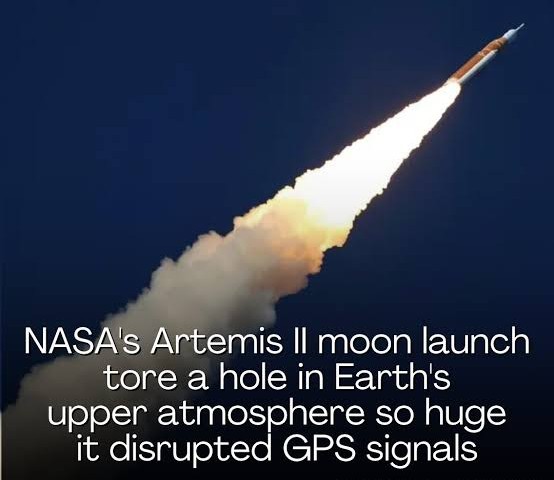
Artemis II atmospheric disturbances extended beyond liftoff
NASA confirms that Artemis II launched from Kennedy Space Center on April 1, 2026, at 6:35 p.m. EDT. The crew began a journey around the Moon, while engineers checked Orion’s systems during its initial Earth orbits.
The atmospheric investigation extends beyond that opening ascent. Coverage of the preliminary research describes disturbances associated with launch and later propulsion maneuvers. This matters because different engines operated at different points along the mission’s route.
Two distinct propulsion systems
NASA’s flight updates identify the interim cryogenic propulsion stage as the vehicle responsible for the early apogee-raise burn. Its RL10 engine increased the highest point of Orion’s orbit.
The Moon-bound maneuver came later. On April 2, Orion’s own main engine began its translunar injection burn at 7:49 p.m. EDT. That firing lasted five minutes and 50 seconds.
Consequently, describing these events simply as two upper-stage burns shortly after launch confuses the mission sequence. Accurate timing helps connect atmospheric observations with the correct propulsion event. It also prevents a spacecraft maneuver from becoming part of an oversimplified launch narrative.
Why engine burns deserve closer attention
A rocket’s liftoff power does not explain every atmospheric effect. The altitude, location, and surrounding conditions of an engine firing also influence what happens next.
Rocket exhaust introduces gases into an environment containing charged particles. Chemical reactions can encourage ions and electrons to recombine, reducing the number of free electrons locally. Separately, launch-generated waves can disturb electron concentrations across the upper atmosphere.
These processes can overlap, but they describe different aspects of the disturbance. A broad wave pattern does not automatically represent an equally broad region of electron depletion.
A known effect with new questions
NASA-hosted research documents ionospheric depletion from earlier Space Shuttle engine firings. Therefore, spacecraft exhaust changing the ionosphere is an established phenomenon, rather than an entirely new discovery.
The interest surrounding Artemis II concerns the reported scale and repeated effects during one mission. The New York Post describes disturbances extending roughly 5,000 kilometers across North America. That figure should describe the reported geographical extent, rather than the diameter of a clearly defined opening.
Understanding the pattern requires more than comparing rocket sizes. Researchers must connect each observation with the engine activity and atmospheric conditions present at that moment.
What the GPS measurements actually show
Ground receiver networks offer scientists a way to track changing electron content along satellite signal paths. Those observations help reveal structures that would otherwise remain difficult to monitor across large areas.
For this investigation, researchers examined satellite-navigation observations to reconstruct atmospheric changes. The method turns navigation signals into scientific measurements of the environment through which they travel.
Yet those measurements answer a different question from whether a navigation device reported an incorrect position. Establishing that practical effect requires additional analysis of receiver performance and positioning calculations.
Atmospheric evidence versus navigation errors
NOAA explains that total electron content influences radio-signal propagation. Changes along a signal’s path can introduce navigation errors when receivers cannot adequately account for them.
Nevertheless, there is no single positioning error that applies to every receiver beneath a disturbance. Signal frequency, satellite geometry, receiver design, and correction methods all affect the result.
This distinction matters when interpreting claims about errors of several meters. A possible error magnitude does not demonstrate that all nearby users experienced it.
The strongest assessment would compare measured positions with known locations throughout the event. It would also identify affected receivers, geographical coverage, and recovery times. Until then, atmospheric observations establish a reason to investigate navigation impacts, rather than a complete account of those impacts.
Navigation risks and the evidence gaps
Precision navigation makes temporary positioning changes relevant beyond ordinary map directions. Drones, surveying equipment, and automated machinery can depend on accurate location data for specific tasks.
The original coverage also raises concerns about autonomous vehicles. However, a hypothetical positioning error does not establish that a vehicle changed lanes or caused an accident.
The New York Post documents no collision or drone incident linked to Artemis II. Readers should therefore understand these examples as potential consequences, not observed outcomes of the mission.
Corrections influence the outcome
NOAA notes that dual-frequency receivers can use two signals to compensate for ionospheric effects. This capability can substantially improve positioning performance.
However, severe disturbances can still interfere with signal tracking. The relevant question is how particular systems performed under the conditions associated with this mission.
General examples from solar storms cannot supply that answer. Those events have different drivers and may produce different patterns and durations. Applying their error estimates directly to Artemis II would overstate what the available evidence establishes.
What future Moon missions could learn
Future investigations could combine engine-firing records, atmospheric measurements, and receiver performance data. Together, these records would help separate detectable atmospheric changes from operationally significant navigation problems.
Several questions deserve attention. How long did each disturbance persist? Which receivers experienced measurable errors? Did correction services compensate successfully? How strongly did local atmospheric conditions influence the outcome?
Repeated observations could also show whether similar maneuvers produce comparable effects. That evidence would support more useful forecasting than assumptions based only on rocket power.
Potential applications include better monitoring and more informed mission planning. These remain research opportunities, rather than confirmed operational changes prompted by Artemis II.
Artemis II atmospheric disturbances: The next question
Artemis II atmospheric disturbances connect lunar exploration with technologies operating far below the spacecraft. The reported electron changes deserve careful study, especially where precision navigation matters.
However, the evidence does not justify treating atmospheric depletion as a permanent opening or a confirmed GPS emergency. NASA establishes the mission sequence, while NOAA explains the navigation mechanisms. Further analysis must establish the actual positioning consequences. That distinction preserves the discovery’s significance without turning an unresolved risk into a documented failure.
Main sources:
New York Post — Original coverage supplied for this article: https://nypost.com/2026/11/05/science/artemis-ii-mission-tore-gps-disrupting-holes-in-atmosphere/
NASA — Apogee-raise burn completion: https://www.nasa.gov/blogs/missions/2026/04/01/artemis-ii-flight-update-apogee-raise-burn-complete-crew-looks-ahead-to-proximity-operations/
NASA — Orion completes translunar injection: https://www.nasa.gov/blogs/missions/2026/04/02/artemis-ii-flight-day-2-orion-completes-tli-burn-crew-begins-journey-to-the-moon/
NASA Technical Reports Server — Spacelab-2 plasma depletion experiments: https://ntrs.nasa.gov/citations/19880033435
NOAA — Space Weather and GPS Systems: https://www.swpc.noaa.gov/impacts/space-weather-and-gps-systems
NOAA — Total Electron Content: https://www.swpc.noaa.gov/phenomena/total-electron-content
You Might Also Like:
Orion Helium Leak Artemis II: No Threat to Reentry but NASA Faces Redesign Challenge
SpaceX 2026 Starship milestones: Moon landing tests, Mars window, and the scale-up behind it-Video
SpaceX Starship Flight 10: Historic Success Boosts NASA & Mars Plans-Video