
BY:SpaceEyeNews.
The JWST Dragon galaxy discovery has expanded a remarkable stellar catalog to 104 unique magnified events. These temporary signals offer a closer look at luminous stars whose light traveled for roughly 6.5 billion years. Their locations also raise an intriguing question about dark matter.
Researchers compared observations from 2022 through 2024 to identify changes across the galaxy’s stretched image, known as the Dragon arc. The resulting sample more than doubles the previous tally of 44 detections. Crucially, it allows astronomers to investigate patterns that smaller samples could barely reveal.
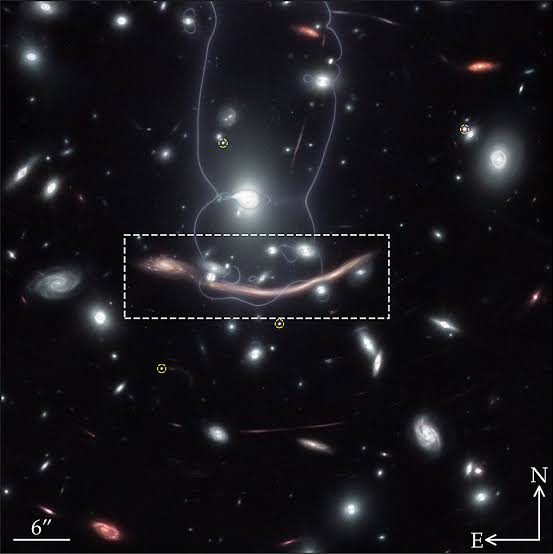
JWST Dragon Galaxy Discovery Expands the Sample
From isolated detections to meaningful statistics
The Dragon lies behind Abell 370, a massive galaxy cluster that magnifies its light. Stars within the foreground cluster add smaller lensing effects, temporarily boosting individual background stars into view.
Earlier work identified 44 detections using observations from two epochs. Official University of Arizona coverage highlighted that achievement in January 2025. The expanded study appeared online in Astronomy & Astrophysics on September 30, 2026.
The new total represents 104 unique candidate events, rather than a confirmed census of 104 distinct stars. Researchers grouped repeated detections across observations and filters to reduce duplication.
That distinction matters because a brightening event does not automatically identify a separate stellar source. Nevertheless, the larger catalog provides a stronger foundation for studying the Dragon’s brightest stellar population.
Instead of relying on a few exceptional objects, astronomers can now examine how events vary across the arc. The comparison matters as much as the total. Event positions and colors address different questions, linking the stars themselves to the foreground structures that make them visible across such an enormous distance.
How JWST Revealed the Stellar Signals
Comparing the same galaxy over time
Finding these events required more than spotting bright points. Researchers compared images from different dates and searched for changes against the galaxy’s background light.
Small differences between observations can create misleading residual features when astronomers subtract one image from another. The team therefore corrected image differences and accounted for changes in how the telescope recorded point sources.
They also excluded bright contaminants and the galaxy’s central region from the search. A separate image of the same background galaxy helped characterize ordinary fluctuations away from the strongest magnification.
Why the stars appear to flicker
These events do not require stellar explosions. Instead, a star’s apparent brightness can change as it moves relative to the foreground lensing pattern.
Near particularly strong magnification regions, small shifts can produce dramatic changes in the light reaching Earth. A previously undetectable star may become visible before fading again.
Comparing multiple observations helps researchers distinguish these temporary signals from persistent features. It also reduces the risk of counting the same event several times.
Blue and Red Supergiants Tell Different Stories
The detected sources favor exceptionally luminous stars, including supergiants. Their colors provide clues about the stellar population behind the flashes.
Blue supergiants are hotter, while red supergiants have cooler surfaces. Together, they offer information about stellar evolution and the galaxy’s continuing production of massive stars.
The team’s color analysis suggested roughly equal contributions from blue and red supergiants. That balance fits a relatively evolved system that still forms stars.
However, the result does not mean half of every star in the Dragon is blue and half is red. JWST detects a highly selected sample whose visibility depends on brightness, magnification, wavelength, and observational timing.
Nor does the ratio provide a precise age for the entire galaxy. Dust can alter observed colors, while incomplete measurements limit classifications for individual events.
The useful finding is that both stellar groups contribute to the signals. Their combined presence gives astronomers a richer picture than either population alone could provide.
The Dark Matter Clue Needs Careful Testing
An uneven pattern near the critical curve
The most intriguing interpretation concerns where the events appear. Researchers compared their distribution on opposite sides of the predicted critical curve.
This curve marks a region of especially strong magnification in the observed image. Farther from it, the event counts appeared similar on both sides. Closer to it, the distribution became uneven.
One side showed a decline that the other did not share. Such an asymmetry could carry information about the matter shaping the foreground cluster’s gravitational field.
Why fuzzy dark matter remains a possibility
Fuzzy dark matter proposes extremely light particles with wave-like behavior on astronomical scales. Their effects on the lensing landscape could help produce an uneven event distribution.
The observed pattern therefore offers a possible avenue for testing that idea. It does not establish that fuzzy dark matter exists.
A major uncertainty concerns the critical curve itself. Different lens models can place this boundary in different locations. An incorrect position could change which events fall on either side and create an apparent asymmetry.
The researchers explicitly acknowledge this alternative. More reliable lens reconstructions must come before strong conclusions about dark matter’s nature.
For now, the stellar catalog provides evidence to investigate, rather than a settled answer.
What Future Dragon Arc Observations Could Resolve
More frequent observations would help astronomers follow individual events through their changing brightness. Better timing could clarify their duration and reveal whether some signals recur.
Additional measurements across several wavelengths could also improve stellar classifications. Those observations would help separate temperature differences from the effects of dust.
Meanwhile, event locations offer another benefit. They can help trace the regions where magnification becomes strongest, providing information that improves gravitational lens models.
That creates a productive connection between observation and interpretation. Better maps help researchers understand the events, while larger event samples help refine the maps.
Applying the same approach to other strongly lensed galaxies would provide an essential comparison. A pattern that persists across independently modeled systems would deserve closer attention than one found in a single arc.
Future work must also account for observational selection. Missing faint events or sampling different regions unevenly could affect the patterns astronomers measure.
A Larger Stellar Sample, a Sharper Scientific Question
The JWST Dragon galaxy discovery marks a shift toward studying distant stellar events as a population. Its 104 candidates offer new opportunities to examine luminous stars and improve models of the intervening cluster.
The dark matter interpretation remains tentative, but that uncertainty does not diminish the observational achievement. Researchers now have more signals to compare and more specific questions to test.
With frequent monitoring and better lens maps, the Dragon arc could become an increasingly useful probe of distant stars and foreground matter. Its flickering points of light have opened a clearer path for investigation.
Main sources:
Astronomy & Astrophysics — Original study, published September 30, 2026:
https://doi.org/10.1051/0004-6361/202660640
University of Arizona News — Official coverage of the earlier 44 detections:
https://news.arizona.edu/news/beyond-dragon-arc-treasure-trove-unseen-stars
Phys.org — Coverage of the expanded 104-event catalog:
https://phys.org/news/2026-11-jwst-tracks-magnified-stellar-events.html
You Might Also Like:
JWST Discovers a Milky Way Twin That Shouldn’t Exist!
ALMA Dragon Egg Reveals Clues to Massive Star Birth
Extraterrestrial Life 2075: When Will We Finally Know?