
BY:SpaceEyeNews.
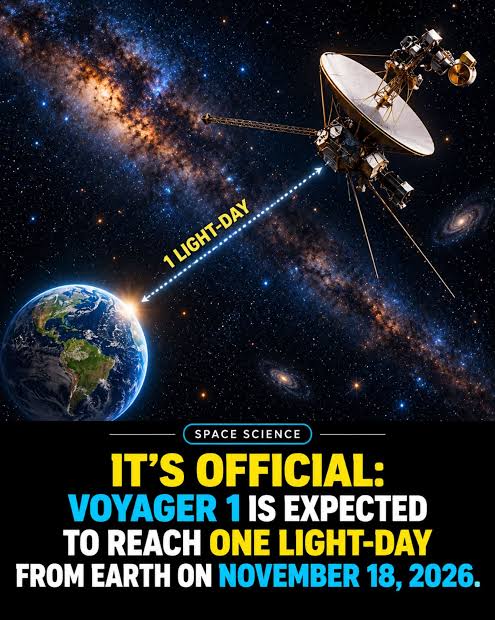
The next Voyager 1 milestone brings humanity’s most distant spacecraft to an extraordinary separation from Earth. On November 18, 2026, the probe will reach one light-day away, approximately 25.9 billion kilometers. NASA has confirmed the approaching date, nearly five decades after its 1977 launch.
Yet the distance tells only part of the story. Engineers must keep aging equipment warm, manage declining electricity, and preserve the instruments that still examine interstellar space. Their recent work has extended scientific operations. As Voyager approaches this symbolic marker, the bigger question concerns how much more it can reveal before its final transmission.
What the Voyager 1 Milestone Means
NASA places the crossing at approximately 5:16 a.m. EST on November 18. At that separation, radio signals need about 24 hours to travel between Earth and Voyager. A command followed by an immediate reply therefore requires roughly two days.
This figure describes the spacecraft’s distance from Earth. It does not measure every kilometer along its curved journey through space.
For mission controllers, the delay makes careful preparation essential. They cannot watch a problem unfold and respond immediately. Information arriving today describes the spacecraft’s condition about a day earlier.
However, the crossing itself brings no sudden change aboard Voyager. It marks no new physical boundary. The achievement gives an accessible measure of how far this working spacecraft has traveled.
A Distance Record With Practical Consequences
The communication delay grows gradually, so November 18 will not suddenly transform mission operations. Instead, the date captures a challenge that engineers already face.
Every instruction must account for the long wait before confirmation. Troubleshooting can involve several exchanges, adding days before controllers understand whether an adjustment worked. Processing commands and scheduling ground antennas can add further waiting. The two-day figure represents signal travel alone, rather than a guaranteed turnaround for every operation.
Declining Power Forces Difficult Choices
Voyager’s radioisotope generators convert heat from decaying plutonium into electricity. Their available electrical output falls by roughly four watts each year. That small annual decline becomes consequential when little spare capacity remains.
The spacecraft needs electricity for communications, computers, scientific instruments, and temperature control. Reducing one demand can help another system survive. However, switching off equipment can also remove heat that nearby components need.
A routine roll maneuver on February 27, 2026, exposed that narrow margin. Voyager experienced an unexpected power drop. Engineers wanted to avoid another decline triggering automatic protective shutdowns.
Consequently, NASA sent commands on April 17 to switch off the Low-energy Charged Particles experiment. The decision preserved power for essential operations and the remaining science instruments.
Two Instruments Continue the Mission
Voyager 1 now retains two operating science instruments. One measures magnetic fields; the other detects plasma waves.
Losing an instrument reduces the range of observations available to scientists. Nevertheless, keeping the remaining pair operating preserves access to conditions that researchers cannot sample directly from Earth.
NASA’s “Big Bang” Extends Voyager’s Science
In early September, engineers completed a coordinated equipment change nicknamed the “Big Bang.” They switched off three devices and substituted three alternatives that consumed less power.
The team had already completed a similar operation on Voyager 2. For Voyager 1, the change balanced electricity savings against the need to maintain suitable temperatures.
Timing mattered because the devices affected heat distribution. Coordinating the switches allowed engineers to reduce consumption while keeping the spacecraft warm enough to function.
NASA said another instrument shutdown could otherwise have arrived as early as summer 2027. The successful change therefore gives the remaining instruments additional operating time.
This was a reconfiguration of equipment already aboard the spacecraft. No new hardware arrived, and the generators gained no fresh energy supply.
That distinction explains both the achievement and its limit. Engineers can stretch the available electricity by changing how Voyager uses it. They cannot eliminate the continuing decline in power production.
Why Interstellar Measurements Still Matter
Voyager 1 crossed the heliopause in August 2012. Since then, it has explored beyond the region dominated by the Sun’s outward-flowing solar wind.
Its remaining instruments provide complementary views of that environment. Magnetic-field measurements trace local field strength and direction. Plasma-wave observations help scientists investigate the ionized gas surrounding the spacecraft.
Together, these measurements contribute to understanding how the solar neighborhood changes beyond the heliosphere. Continuing observations also help researchers compare conditions across different locations and times.
Direct Observations From a Distant Region
The Voyagers occupy a rare scientific position. Both spacecraft can examine interstellar conditions where they actually encounter them.
That access gives even a reduced instrument suite considerable value. Remote observations and computer models offer broader perspectives, while spacecraft measurements provide local evidence for comparison.
However, each instrument shutdown leaves gaps. Preserving two functioning sensors does not replace every capability Voyager once carried. It allows a narrower scientific investigation to continue.
How Long Can Voyager Keep Calling Home?
There is no confirmed date for Voyager 1’s final transmission. Power availability matters, but aging equipment and unexpected faults also influence its remaining lifetime.
Furthermore, the end of science operations and the end of communications need not happen together. A spacecraft could stop collecting scientific measurements yet still return engineering information about its condition.
NASA’s older mission FAQ discusses possible communications through approximately 2036, depending on available transmitter power. That conditional estimate should not become a fixed shutdown deadline.
Recent engineering successes reinforce the uncertainty. Careful adjustments can extend operations, but they cannot guarantee another decade of contact.
The Journey Continues After the Signal Ends
Silence will not stop Voyager’s outward travel. Its motion does not depend on continuously running an engine.
Farther ahead lies the Oort Cloud, the distant population of icy bodies surrounding the planetary system. NASA estimates roughly three centuries for Voyager 1 to reach its inner edge.
That timescale places the current achievement in perspective. Interstellar space begins beyond the heliosphere, while the solar system’s distant gravitationally associated objects extend much farther.
A Voyager 1 Milestone With More to Discover
The Voyager 1 milestone celebrates an extraordinary distance and the sustained work that keeps exploration possible. A spacecraft launched in 1977 still offers measurements from an environment far beyond direct human reach.
Its future depends on practical decisions about watts, warmth, and aging components. Each successful adjustment can preserve another opportunity to observe unfamiliar conditions.
November 18 provides a memorable marker. The lasting scientific value will come from the data Voyager continues to send afterward. Every additional observation extends a record that future missions will build upon.
Main Sources:
NASA — Voyager 1 one-light-day announcement, November 10, 2026:
https://www.nasa.gov/news-release/nasa-invites-media-public-to-join-voyager-1-one-light-day-activities/
NASA — What Is a Light-Day:
https://science.nasa.gov/mission/voyager/voyager-1/voyager-1-what-is-a-light-day/
NASA — Voyager 1 Conserves Power, October 29, 2026:
https://science.nasa.gov/blogs/voyager/2026/10/29/nasas-voyager-1-conserves-power-resolves-brief-communications-pause/
NASA — Instrument Shutdown, April 17, 2026:
https://science.nasa.gov/blogs/voyager/2026/04/17/nasa-shuts-off-instrument-on-voyager-1-to-keep-spacecraft-operating/
NASA — Voyager Science:
https://science.nasa.gov/mission/voyager/science/
NASA — Frequently Asked Questions (historical estimates):
https://science.nasa.gov/mission/voyager/frequently-asked-questions/
You Might Also Like:
Voyager 1 signal returns after 48 hours. Why did it fade?
Voyager 1 Power Shutdown: NASA Turns Off Instrument to Extend Mission
Voyager 1 solar system edge: What It Found Beyond the Heliopause-Video