
BY:SpaceEyeNews.
Starship’s first catch brought SpaceX’s spacecraft back from orbit and into its launch tower’s mechanical arms on November 14, 2026. Emerging through clouds above Starbase, Texas, the vehicle completed a return that SpaceX had never achieved before.
The breakthrough moved Starship closer to a fully reusable launch system. One big test now comes into focus: flying recovered hardware again reliably and efficiently. That test begins with engineers examining the spacecraft and determining what another flight would require.
For satellite operators and future lunar missions, that distinction matters. A successful catch demonstrates recovery. Affordable reuse depends on what happens between this landing and the next launch.
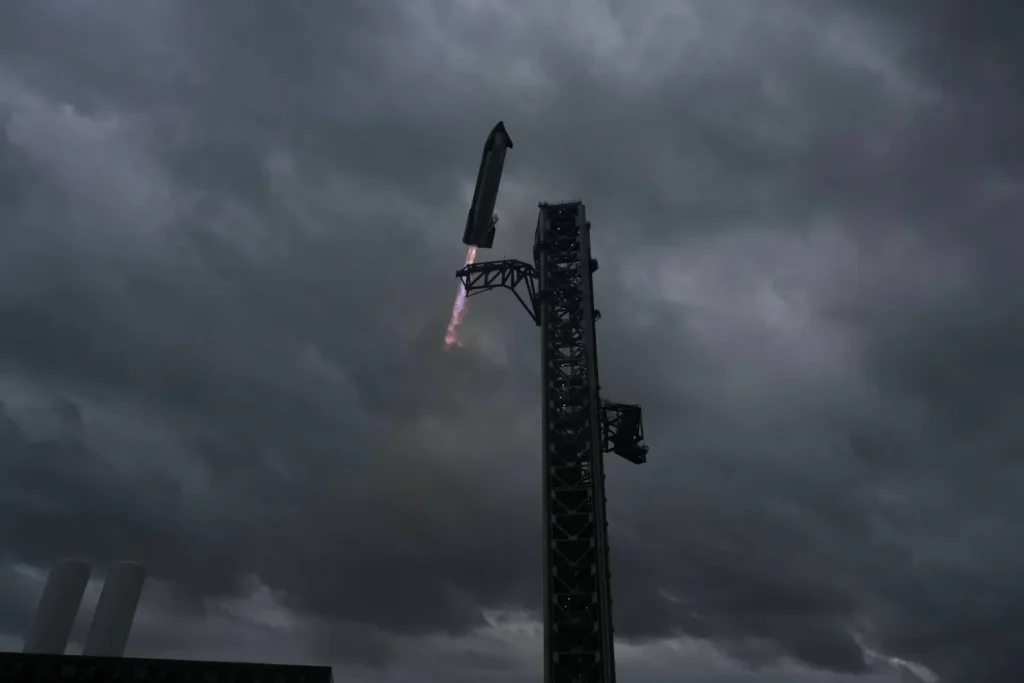
SpaceX’s mega rocket Starship successfully returns to be captured at its launch pad after a test flight from Starbase, Texas, Saturday, Nov. 14, 2026. (AP Photo/Eric Gay)
What Starship’s first catch actually achieved
Flight 15 launched on November 13 and returned the following day. During roughly 22 hours in space, Starship completed 14 Earth orbits and deployed 26 Starlink satellites.
Those details give the recovery practical significance. The spacecraft delivered a payload before returning to its launch site. SpaceX therefore combined useful orbital work with a successful tower catch.
Earlier catches involved Super Heavy, the rocket’s lower stage. This time, the tower received the upper stage after its journey around Earth.
A precise place in spaceflight history
Calling this the first reusable spacecraft would overlook decades of earlier achievements. NASA’s Space Shuttle orbiters flew repeatedly, establishing spacecraft reuse long before Starship.
The distinction here is the recovery method and vehicle involved. SpaceX caught an orbital Starship with launch tower arms for the first time.
That achievement supports the company’s wider ambition to recover both stages. Still, this mission did not complete that entire process.
Why this orbital recovery marks a breakthrough
The final approach drew attention, but the catch depended on much more than the tower. Starship first had to complete its atmospheric return and reach the recovery area under control.
Returning from orbit places demanding conditions on a spacecraft. Its protective surfaces, steering systems, structures, and propulsion must function throughout the descent.
SpaceX’s successful recovery brings those requirements together in one flight. It also gives engineers access to hardware that experienced the complete mission.
Inspection begins the test of reuse
Physical inspection can answer questions that flight footage cannot. Engineers can examine heat protection, check components, and compare their condition with recorded flight data.
A spacecraft can survive a demanding return while still needing substantial work afterward. Consequently, a successful landing does not establish a short turnaround.
The condition of this vehicle will help SpaceX judge its next steps.
The booster setback behind the milestone
SpaceX originally planned to catch both Starship and Super Heavy during Flight 15. Its official mission preview described that objective as a potential first full recovery of an orbital launch system.
However, Super Heavy did not complete its planned return. AP reported that the booster aborted its approach and broke apart over the Gulf of Mexico.
Initial explanations described problems during its return sequence. Engineers still needed to investigate the cause, so early accounts should not replace final findings.
This outcome limits what the mission demonstrated. Starship completed its recovery, while the booster remained an unresolved part of the flight.
For full reuse, both stages must return consistently. A dependable spacecraft catch cannot compensate for repeatedly losing the hardware that launches it.
The big test after Starship’s first catch: flying again
The next decisive demonstration is another useful flight with recovered hardware. Achieving that repeatedly could spread manufacturing costs across multiple missions. That is where the promise of the catch meets the practical demands of running a launch service.
Yet the financial benefit depends on the work required between flights. Inspections, replacement parts, staff time, and launch preparation all affect operating costs.
A recovered spacecraft that needs extensive refurbishment offers a different business proposition from one that returns quickly to service.
Maintenance, turnaround, and reliability
First comes maintenance. The amount of repair will help determine whether recovery produces meaningful savings.
Second comes turnaround time. Faster preparation could allow each vehicle to complete more missions, provided demand and launch infrastructure support that pace.
Third comes reliability. Customers need confidence that payload delivery and recovery can succeed repeatedly.
Together, these measures define the big test ahead. A successful reflight would provide an important starting point, while repeated missions would establish a stronger record. One catch cannot establish future ticket prices or demonstrate hourly operations.
SpaceX must also make the ground process repeatable. Tower availability, inspections, and launch scheduling can influence how efficiently recovered vehicles return to flight.
Payload delivery remains central to that assessment. A higher flight rate has value only when vehicles perform useful missions reliably. Recovery must support that service without creating an excessive maintenance burden.
Announcements about inspection findings or a scheduled reflight would offer more concrete evidence than distant launch targets alone.
The practical question is therefore clear: how much effort separates a successful recovery from another useful mission?
Why repeat flights matter for Artemis
NASA’s lunar ambitions give Starship’s development significance beyond satellite launches. The agency has selected a Starship variant to transport astronauts between lunar orbit and the Moon’s surface.
Reliable launch operations could support the wider infrastructure behind those missions. In particular, SpaceX’s architecture depends on delivering propellant to orbit through additional flights.
Efficient reuse could make those supporting launches easier to sustain. Nevertheless, an Earth return demonstration does not establish lunar landing readiness.
Orbital refueling remains a separate task
SpaceX has already demonstrated propellant transfer between tanks inside one Starship. NASA documented that experiment during Flight 3 in March 2024.
That achievement differs from transferring propellant between separate spacecraft. Moving fuel within one vehicle does not complete the broader refueling operation required by the lunar architecture.
The catch therefore advances one part of a larger development effort. It does not resolve every challenge involving propellant management, mission coordination, or lunar operations.
Starship’s first catch puts the next flight in focus
Starship’s first catch gives SpaceX a recovered orbital spacecraft and a clearer path toward testing reuse. The achievement deserves attention because it turns a planned recovery method into demonstrated flight performance.
Now the evidence must extend beyond a single mission. Inspection results, refurbishment requirements, and another flight of recovered hardware will show what the catch makes possible.
Successful recovery of both stages would strengthen that case further. Until then, the milestone marks substantial progress rather than a finished transportation system.
SpaceX has brought Starship home. The big test ahead is making that recovered hardware useful again, then repeating the process reliably and efficiently.
Main sources:
SpaceX — Flight 15 mission overview:
https://www.spacex.com/launches/starship-flight-15
Reuters — Starship returns to its Texas launch tower:
https://www.reuters.com/business/aerospace-defense/spacexs-starship-aces-first-return-texas-2026-11-14/
Associated Press — Starship’s first orbital tower catch:
https://apnews.com/article/df394c1b5a0f85e11194f9ff7db9ee6b
NASA — Starship Flight 3 and propellant transfer:
https://www.nasa.gov/directorates/esdmd/artemis-campaign-development-division/human-landing-system-program/nasa-artemis-mission-progresses-with-spacex-starship-test-flight/
NASA — Space Shuttle program:
https://www.nasa.gov/space-shuttle/
Original coverage — Asharq Al Awsat:
https://english.aawsat.com/varieties/5341318-spacex-pulls-first-ever-spaceship-catch
You Might Also Like:
Starship Flight 15: Booster Lost, Historic Catch Ahead
SpaceX 2026 Starship milestones: Moon landing tests, Mars window, and the scale-up behind it-Video
SpaceX Starship Flight 10: Historic Success Boosts NASA & Mars Plans-Video